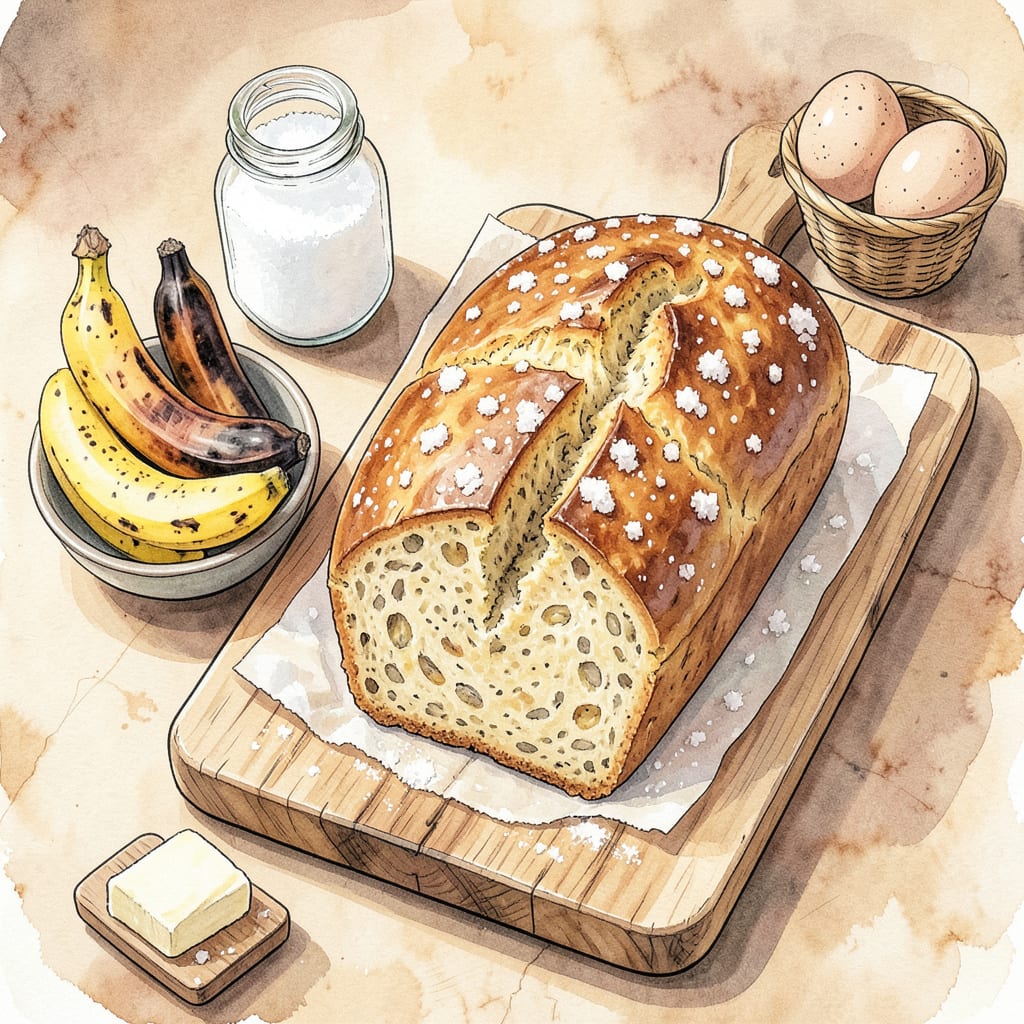
This Filipino-style banana bread delivers the ultra-moist texture that makes every slice irresistible. Developed through years of perfecting the balance between ripe bananas and just the right amount of fat, this recipe transforms simple ingredients into a tender, flavorful loaf that stays soft for days.
The secret lies in using overripe saban bananas—the variety commonly found in Philippine markets—for their intense sweetness and natural moisture. Combined with a precise ratio of wet and dry ingredients, this method ensures a dense yet tender crumb without any dryness. Whether enjoyed plain or with optional Pinoy twists like ube swirls or cheese topping, this banana bread brings authentic Filipino bakery quality to your kitchen.
Ingredients for Banana Bread Recipe Panlasang Pinoy
Overripe saban bananas and pantry staples create this ultra-moist Filipino-style loaf with authentic bakery quality and tender crumb.
| Ingredient | Amount | Notes |
|---|---|---|
| Overripe saban bananas 🍌 | 6 whole | Black-spotted, very soft |
| All-purpose flour 🌾 | 2 cups | Sifted for lighter texture |
| Granulated white sugar 🍚 | 1 cup | Fine grain preferred |
| Unsalted butter 🧈 | ½ cup | Melted and cooled |
| Large eggs 🥚 | 2 whole | Room temperature |
| Baking soda 🧂 | 1 tsp | Fresh for proper rise |
| Baking powder 🧂 | ½ tsp | Aluminum-free preferred |
| Ground cinnamon 🌿 | 1 tsp | Ceylon for milder flavor |
| Vanilla extract 💧 | 1 tsp | Pure extract recommended |
| Salt 🧂 | ½ tsp | Fine sea salt preferred |
| Vegetable oil 🫒 | 2 tbsp | For greasing pan |
| Eden cheese 🧀 | ½ cup | Shredded, optional topping |
| Ube halaya 🍠 | ¼ cup | Optional swirl ingredient |
[recipe_ingredient_scaler]
The **saban bananas** are non-negotiable for authentic Filipino flavor and moisture. Optimal ripeness is indicated by black-spotted peels and soft flesh—**Filipino markets** or well-stocked Asian grocers typically carry them. For the flour, **King Arthur All-Purpose** provides consistent results, though local brands like **Pioneer** work equally well. Butter quality impacts flavor significantly; **Anchor unsalted** is preferred in professional Filipino bakeries for its rich, clean taste. The baking powder and soda must be **fresh** (test by dropping in hot water—immediate bubbles confirm potency).
Substitutions require careful balance to maintain moisture. **Ripe lakatan bananas** can replace saban in equal quantity, though they yield slightly less sweetness. For dairy-free versions, **coconut oil** replaces butter at a 1:1 ratio, while **flax eggs** (1 tbsp ground flax + 3 tbsp water per egg) work for binding. The Eden cheese topping—traditionally **quick-melt processed cheese**—can be substituted with **sharp cheddar** for more pronounced flavor. Ube halaya swirls may use **store-bought jam** (like **Good Shepherd**) at reduced sugar content to avoid over-sweetening.
Completed loaves maintain peak moisture for **3 days** at room temperature when wrapped in parchment, then foil. Refrigeration extends shelf life to **1 week**, though texture firms slightly. For longer storage, slice and freeze in airtight containers for up to **3 months**—thaw at room temperature. The optional cheese topping is best added fresh; if pre-applying, reheat slices at **300°F for 5 minutes** to restore melt. Ube swirled versions may develop a purple tint over time but remain safe to consume.
Why You’ll Love This Recipe
- This loaf works double duty: toasted with butter for rushed school mornings or wrapped in wax paper for my husband’s baon. I’ve brought it to potlucks, and it disappears faster than the lechon—maybe because it’s one of those rare baked goods that tastes even better the next day.
- No Mixer Needed: I just use a fork for the wet ingredients and a whisk for the dry—honestly, the overripe saban bananas mash so easily that even my 8-year-old can handle this part without making a mess. The butter melts right into the warm banana mixture, so no waiting for anything to soften.
- That Caramelized Crust: Here’s what sold me—the granulated sugar creates this thin, crackly top layer while the inside stays ridiculously moist from the saban bananas. It’s not cloyingly sweet either; the natural tang of the bananas balances it out, so you’ll catch yourself sneaking “just one more slice” at midnight.
- Breakfast or Merienda: This loaf works double duty: toasted with butter for rushed school mornings or wrapped in wax paper for my husband’s baon. I’ve brought it to potlucks, and it disappears faster than the lechon—maybe because it’s one of those rare baked goods that tastes even better the next day.
Step-by-Step Instructions for Filipino-Style Banana Bread
This method ensures an exceptionally moist loaf with authentic Filipino flavors and perfect texture.
Step 1: Prepare the Banana Base
Begin by mashing the 6 whole overripe saban bananas in a large mixing bowl until completely smooth. The bananas should be black-spotted and very soft for maximum sweetness and moisture. I use a potato masher for this step, but a fork works equally well if you prefer more texture.
Add the 1 cup granulated white sugar and 0.5 cup unsalted butter (melted and cooled) to the mashed bananas. Whisk vigorously for 2-3 minutes until the mixture becomes pale and slightly thickened. This emulsification process creates the foundation for your bread’s moist crumb.
Step 2: Incorporate Dry and Wet Ingredients
In a separate bowl, sift together the 2 cups all-purpose flour, 1 tsp baking soda, 0.5 tsp baking powder, 1 tsp ground cinnamon, and 0.5 tsp salt. The sifting step is crucial for preventing dense pockets in your finished loaf.
Create a well in the center of your dry ingredients and add the banana mixture. Make another well in the banana mixture and pour in the 2 whole large eggs and 1 tsp vanilla extract. Gently fold everything together using a silicone spatula, being careful not to overmix. The batter should be thick but pourable, with no visible flour streaks.
Step 3: Prepare Pan and Add Optional Elements
Preheat your oven to 350°F and thoroughly grease a 9×5-inch loaf pan with the 2 tbsp vegetable oil. For extra insurance against sticking, line the bottom with parchment paper, leaving an overhang on the sides for easy removal.
Pour half of the batter into the prepared pan. If using the optional 0.25 cup ube halaya, drop spoonfuls over the batter and gently swirl with a butter knife. Add the remaining batter and smooth the top. For the cheese topping, sprinkle the 0.5 cup Eden cheese evenly over the surface.
Step 4: Bake to Perfect Doneness
Bake for 50-60 minutes, or until a wooden skewer inserted in the center comes out clean. The top should be deep golden brown and the edges should pull away slightly from the pan. If the top begins to brown too quickly, tent loosely with aluminum foil after 30 minutes of baking.
Check for doneness by pressing gently on the center – it should spring back immediately. The internal temperature should register 205-210°F on an instant-read thermometer. This higher temperature ensures the bread is fully cooked while maintaining moisture.
Step 5: Cool and Serve
Allow the bread to cool in the pan for 15 minutes, then use the parchment overhang to lift it onto a wire rack. Cool completely for at least 1 hour before slicing. This resting period lets the crumb set properly and prevents gumminess.
For best texture, wrap the cooled loaf in plastic wrap and let it rest at room temperature for 4 hours before serving. This waiting period allows the flavors to meld and the moisture to distribute evenly throughout the loaf. The bread will keep at room temperature for 3 days or can be refrigerated for up to 1 week.
Troubleshooting This Recipe
Dense or Gummy Center
If your banana bread has a dense, gummy center, it’s likely underbaked. The 205-210°F internal temperature is crucial – don’t rely solely on the toothpick test. I’ve found that saban bananas release more moisture than regular varieties, so extend baking by 5-10 minutes if needed. Tent with foil if the top browns too quickly while the center catches up. 🌡️
Another common cause is overmixing the batter. When combining wet and dry ingredients, use a silicone spatula and fold just until no flour streaks remain – about 15-20 strokes. The gluten develops quickly in Filipino-style recipes due to the high moisture content from the bananas.
Dry or Crumbly Texture
Dryness usually means your bananas weren’t ripe enough or you used too much flour. For authentic moisture, use saban bananas with completely black peels – they should feel almost liquid when mashed. If you must use less ripe bananas, add 2 tbsp Greek yogurt to compensate for lost moisture.
Measure your flour correctly by spooning it into the measuring cup and leveling with a knife – never scoop directly from the bag. Filipino bakeries often use 10-15% less flour than American recipes for that signature tender crumb. I weigh mine at 240g for 2 cups to be precise.
Sunken or Flat Top
A sunken center typically indicates the leavening agents expired or the oven temperature was too low. Test your baking soda and powder by dropping a pinch in hot water – it should bubble vigorously. For consistent rise, preheat your oven for 20 minutes before baking and use an oven thermometer to verify 350°F.
Opening the oven door during the first 30 minutes can also cause collapsing. If you added ube swirls, ensure they’re at room temperature before incorporating – cold ube halaya can create dense pockets that weigh down the batter. I learned this the hard way at my first baking competition!
Overly Browned Crust
Filipino-style banana bread tends to brown quickly due to the sugar content from ripe bananas. If your crust darkens before the center cooks through, tent the pan with foil after 25 minutes. For even browning, position your oven rack in the middle position and rotate the pan halfway through baking.
The optional Eden cheese topping can accelerate browning. If using cheese, add it only during the last 10 minutes of baking. For extra protection, brush the top with a thin layer of melted butter after 20 minutes – this creates a barrier that prevents excessive browning while adding flavor. 🧀
Uneven Baking
If one side of your loaf bakes faster, your oven likely has hot spots. Always preheat for 20 minutes and use a baking stone or steel on the lower rack to distribute heat evenly. For perfect results, rotate your pan 180 degrees halfway through the baking time – I set a timer for 25 minutes as my reminder.
Uneven mixing can also cause pockets of dense batter. After folding in the dry ingredients, give the bowl a quarter turn and fold 3 more times to catch any hidden flour. The batter should look uniformly thick with visible banana specks throughout – this visual cue tells you it’s properly mixed.
Cheese Not Melting Properly
For that perfect cheese pull on your Eden cheese topping, shred it fresh rather than using pre-shredded cheese which contains anti-caking agents. Sprinkle the cheese during the last 8-10 minutes of baking when the bread is fully set but still hot enough to melt the cheese completely.
If your cheese forms a skin instead of melting smoothly, your oven might be running too hot. Try reducing the temperature to 325°F when adding the cheese. For extra gooeyness, mix the shredded cheese with 1 tsp cornstarch before sprinkling – this prevents clumping and creates that stretchy texture we all love. 💛
Nutrition Facts

Trained in classic French technique but raised on slow-cooked ribs and spicy rubs, she blends culinary skill with smoke and soul.
- Recipe for Curried Lamb Chops: Spice-Rubbed and Pan-Seared to Succulence - October 3, 2026
- Recipe for Boneless Leg of Lamb Roast in the Oven: Herb-Crusted and Rosy Pink Inside - October 3, 2026
- Meat Loaf Recipe With Beef And Pork: Homestyle Blend With Rich Gravy - October 3, 2026