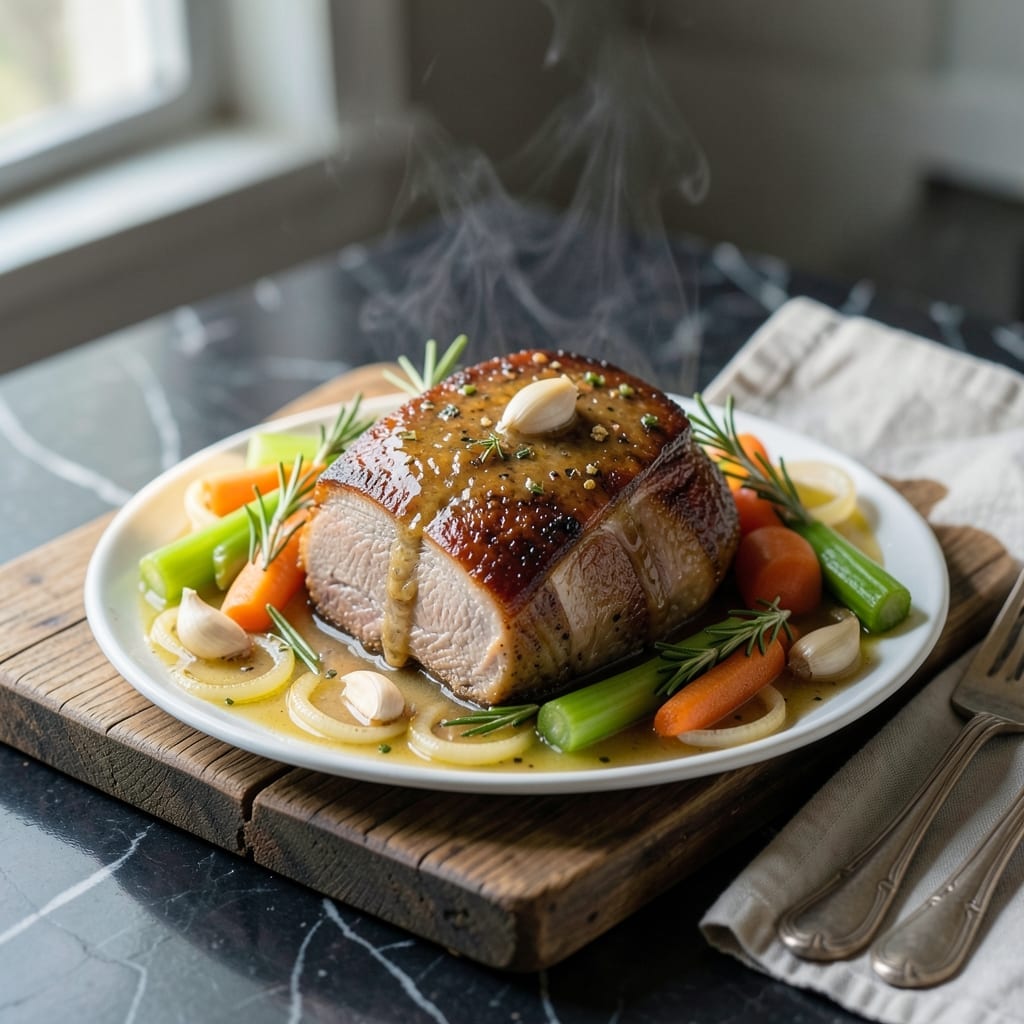
This crockpot method delivers the most tender pork roast with minimal effort. Slow cooking breaks down the meat fibers, creating a melt-in-your-mouth texture that defines the best version of this classic dish.
Simple ingredients and hands-off preparation make it ideal for busy days. The result is consistently juicy, flavorful pork that falls apart with ease.
Ingredients for Best Pork Roast Crockpot
A few quality ingredients transform into the most tender pork roast with effortless preparation.
| Ingredient | Amount | Notes |
|---|---|---|
| Pork Shoulder Roast 🥩 | 3 lb | Boneless, well-marbled for tenderness |
| Yellow Onion 🧅 | 1 whole | Large, thinly sliced |
| Carrots 🥕 | 3 whole | Peeled and cut into chunks |
| Celery Stalks 🥬 | 3 whole | Cut into large pieces |
| Garlic Cloves 🧄 | 6 cloves | Smashed for maximum flavor |
| Chicken Broth 🍲 | 1 ½ cups | Low-sodium preferred for control |
| Apple Cider Vinegar 🍏 | 2 tbsp | Balances richness with acidity |
| Dijon Mustard 🟡 | 1 tbsp | Adds depth to the braising liquid |
| Dried Thyme 🌿 | 1 tsp | Crushed to release essential oils |
| Dried Rosemary 🌿 | 1 tsp | Crushed to release essential oils |
| Bay Leaves 🍃 | 2 whole | Remove before serving |
| Kosher Salt 🧂 | 1 ½ tsp | Diamond Crystal preferred for even seasoning |
| Black Pepper 🌶️ | 1 tsp | Freshly ground for best aroma |
| Olive Oil 🫒 | 2 tbsp | For searing the roast |
[recipe_ingredient_scaler]
The pork shoulder is non-negotiable for melt-in-your-mouth texture. Look for bone-in or boneless at your butcher or Whole Foods—marbling is key. Most grocery stores carry pre-cut chunks, but a whole roast you cube yourself often has better fat distribution. Avoid lean cuts like tenderloin, which dry out during the long cook. 3-4 lbs is ideal for even cooking without overcrowding.
No apple cider vinegar? White wine vinegar or lemon juice works in a pinch. Short on herbs? Poultry seasoning at half the amount covers thyme and rosemary. For a richer broth, substitute beef broth, but reduce the salt. The Dijon can be swapped for whole-grain mustard if that’s what you have on hand—seeds add a nice texture.
Leftovers keep beautifully. Store in the cooking liquid for up to 4 days in the fridge, or freeze for 3 months. Reheat gently in the liquid to maintain moisture. The flavor actually improves overnight as the meat reabsorbs the braising juices.
Why You’ll Love This Recipe
- Set It and Forget: I toss the pork shoulder, onions, carrots, and celery in the crockpot before work and come home to a meal ready to serve.
- Garlic-Infused Comfort: The slow-cooked pork soaks up all that garlic and veggie flavor until it’s fall-apart tender.
- Feeds the Fam: One roast yields enough for dinner plus next-day sandwiches my kids actually finish.
- Budget Hero: Pork shoulder is cheap, the veggies are basic, and the crockpot does all the heavy lifting.
Step-by-Step Instructions for Pork Roast Crockpot
Achieve fall-apart tenderness with this foolproof slow-cooker method that maximizes flavor development.
Step 1: Sear the Pork Shoulder for Depth of Flavor
Heat the 2 tbsp olive oil in a large skillet over medium-high heat until it shimmers. Pat the 3 lb Pork Shoulder Roast dry with paper towels, then season all over with the 1.5 tsp Kosher Salt and 1 tsp Black Pepper.
Sear the roast on all sides for 3-4 minutes per side until it develops a deep golden-brown crust. This step creates the Maillard reaction, adding complex flavors that will infuse the entire dish. Don’t rush this process—proper browning is essential for the best results.
Step 2: Prepare the Aromatic Base in the Crockpot
Arrange the 1 whole Yellow Onion (thinly sliced), 3 whole Carrots (peeled and chunked), 3 whole Celery Stalks (cut into large pieces), and 6 cloves Garlic Cloves (smashed) in the bottom of your slow cooker.
These vegetables will create a flavorful foundation for the roast while also absorbing the delicious cooking liquids. The garlic cloves will mellow and sweeten during the long cook time, infusing the entire dish with their aromatic essence.
Step 3: Combine All Ingredients and Begin Slow Cooking
Place the seared roast on top of the vegetables in the crockpot. In a bowl, whisk together the 1.5 cups Chicken Broth, 2 tbsp Apple Cider Vinegar, 1 tbsp Dijon Mustard, 1 tsp Dried Thyme, 1 tsp Dried Rosemary, and 2 whole Bay Leaves.
Pour this mixture over the roast, ensuring the liquid comes about halfway up the meat. Cover and cook on low heat for 8-10 hours or on high heat for 5-6 hours. The roast is done when it shreds easily with a fork and reaches an internal temperature of 195-200°F.
Step 4: Rest and Serve
Carefully remove the roast from the crockpot and transfer it to a cutting board. Let it rest for 15-20 minutes before shredding or slicing. This resting period allows the juices to redistribute throughout the meat, ensuring maximum tenderness.
Discard the bay leaves before serving. The vegetables will have softened into a flavorful accompaniment, and the cooking liquid can be skimmed of fat and served as a light au jus. This method guarantees the most tender, flavorful pork roast with minimal hands-on time.
Pro Tips For Making Best Pork Roast Crockpot
- Sear the Pork: I learned this the hard way—skipping the sear gives you bland meat. A quick 2-3 minutes per side in a hot pan adds a depth of flavor that slow cooking alone can’t.
- Cut Veggies Evenly: After ending up with mushy carrots and undercooked celery, I now chop all veggies to about 1-inch pieces so they cook at the same rate as the pork.
- Don’t Drown It: Resist the urge to add too much liquid—about 1/2 cup of broth is plenty. Too much turns your roast into soup and dilutes the flavor.
- Use Fresh Garlic: Sounds obvious, but fresh garlic cloves crushed just before adding make a real difference compared to the pre-minced stuff in a jar.
Storing and Reheating best pork roast crockpot
Refrigerator Storage
Let your pork roast cool for no more than 2 hours before storing. Transfer it with some cooking liquid to airtight containers—I use glass Pyrex for easy reheating. It stays fresh at 40°F or below for up to 4 days. Honestly, the flavors deepen overnight. ❄️
Freezer Storage
For longer storage, portion the pork with its juices in quart-sized freezer bags. Squeeze out excess air and freeze flat for up to 3 months. Label with the date—I learned this the hard way after forgetting a batch in the back of my freezer.
When ready to use, thaw overnight in the fridge. The texture holds up surprisingly well for pulled pork sandwiches or tacos.
Stovetop Reheating
My preferred method: transfer pork and liquid to a pot, add ¼ cup chicken broth if dry, and warm over medium-low heat for 10-15 minutes. Stir occasionally to prevent sticking. The meat reabsorbs the juices beautifully. 🔥
Microwave Reheating
For quick meals, place individual portions in a microwave-safe dish, cover with a damp paper towel, and heat on 70% power for 2-3 minutes. Stir and continue in 30-second bursts until reaching 165°F. Add a splash of water if needed.
Nutrition Facts
Frequently Asked Questions
Should I sear the pork before slow cooking?
Searing creates a flavorful crust and enhances the dish’s depth. Use medium-high heat for 3-4 minutes per side until golden brown.
Can I use a different cut of pork?
Pork shoulder is ideal for tenderness, but pork butt works too. Avoid lean cuts like tenderloin—they dry out during long cooking. Stick to well-marbled options.
Why is my pork roast tough?
It likely didn’t cook long enough. Pork needs 8-10 hours on low or 5-6 hours on high to break down properly. Check for an internal temp of 195-200°F.
Can I add potatoes to the crockpot?
Yes, but add them during the last 3-4 hours to prevent mushiness. Use hearty varieties like Yukon Gold or russet for best results.

Trained in classic French technique but raised on slow-cooked ribs and spicy rubs, she blends culinary skill with smoke and soul.
- Recipe For Diced Pork In Slow Cooker: Melt-In-Your-Mouth Tenderness All Day - October 3, 2026
- Recipe for Crock Pot Lasagna Using Ravioli: No-Boil Cheese Layers - October 3, 2026
- Recipe for Cut Up Chicken: One-Pan Crispy Bites - October 3, 2026