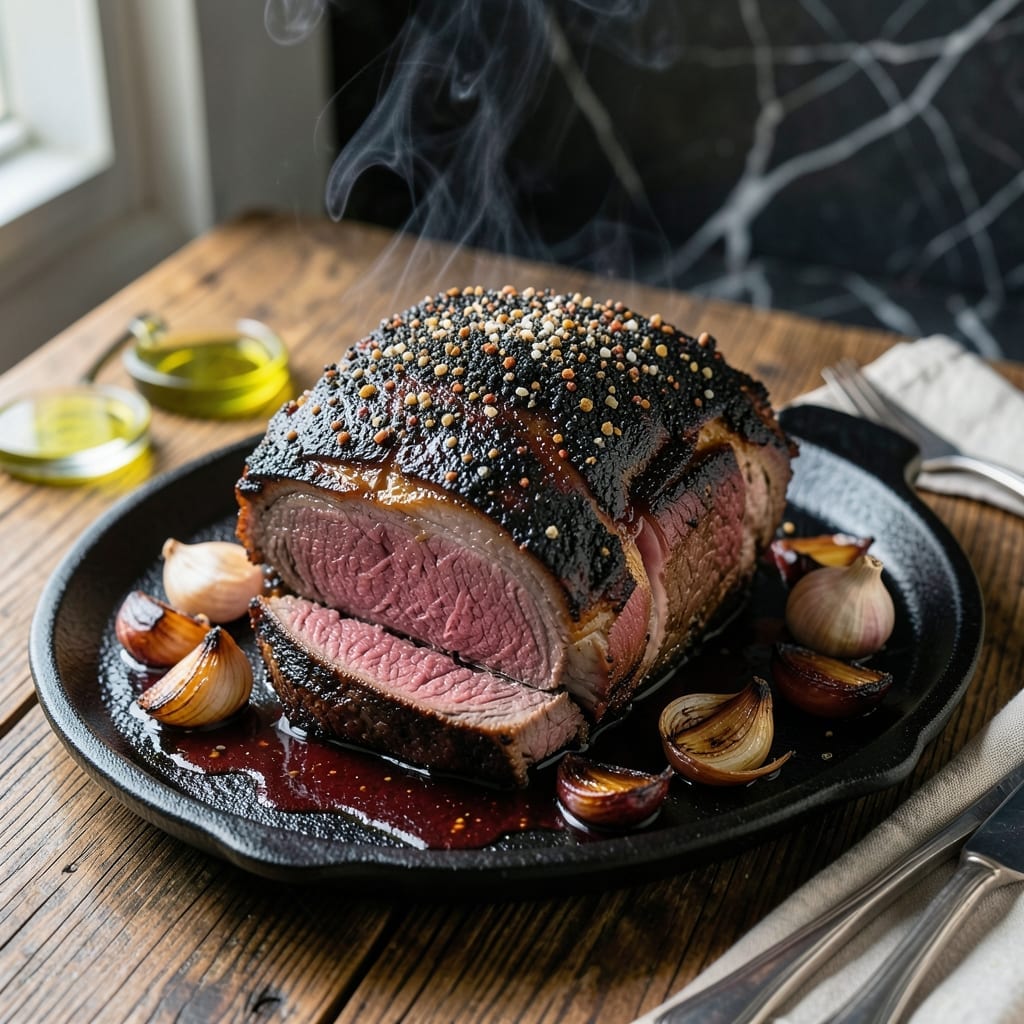
Achieving tender brisket requires patience and precision, a lesson I learned early in my pitmaster days. This method delivers smoky depth with slices that fall apart at the touch of a fork.
Low and slow is the only way to transform tough cuts into melt-in-your-mouth perfection. The technique ensures every bite carries the rich, complex flavors that define great brisket.
Ingredients for Gordon Ramsay Brisket
Pantry staples meet quality beef for that signature smoky, fall-apart texture.
| Ingredient | Amount | Notes |
|---|---|---|
| Beef Brisket 🥩 | 4 lb | Whole packer cut, fat cap intact |
| Kosher Salt 🧂 | ¼ cup | Diamond Crystal preferred for texture |
| Coarse Black Pepper 🌶️ | ¼ cup | Freshly ground for maximum flavor |
| Garlic Powder 🧄 | 2 tbsp | Not garlic salt substitution |
| Onion Powder 🧅 | 2 tbsp | Fine grind for even distribution |
| Smoked Paprika 🌶️ | 2 tbsp | Spanish variety for authentic smoke |
| Brown Sugar 🍚 | ½ cup | Light or dark, packed firmly |
| Apple Cider Vinegar 🍏 | ½ cup | Balances richness in rub |
| Olive Oil 🫒 | ¼ cup | For binding dry rub to meat |
| Hickory Wood Chunks 🪵 | 4 pieces | For smoking, soaked 1 hour |
| Beef Broth 🥣 | 2 cups | Low-sodium preferred for control |
| Unsalted Butter 🧈 | ½ cup | For basting during cooking |
| Fresh Rosemary 🌿 | 4 sprigs | Stems removed, chopped fine |
| Yellow Mustard 🟡 | ¼ cup | Binder for dry rub adhesion |
[recipe_ingredient_scaler]
The brisket itself is non-negotiable—whole packer cut with fat cap intact from a reputable butcher like Snake River Farms. Look for good marbling and a flexible cut; it should bend slightly when fresh. I always order mine from Crowd Cow (the Wagyu brisket is next-level). For the wood, hickory gives that classic smoke profile, but post oak works too if that’s what you’ve got.
Swapping the packer cut? Flat cut works in a pinch but lacks the fat content for true low-and-slow perfection. No smoked paprika? Regular paprika plus 1 tsp liquid smoke gets you 80% there. Brown sugar can be coconut sugar at 1:1 ratio. The apple cider vinegar is key for tang—don’t skip it, but white vinegar works if that’s all you’ve got.
The dry rub keeps in an airtight container for 6 months. Brisket itself? Smoke it fresh—don’t try to prep the meat the night before. Leftovers (if any) freeze beautifully for 3 months. Reheat gently in the juices to maintain that tender texture.
Why You’ll Love This Recipe
- Set It and Forget: I rub the brisket with salt, pepper, and those powders, then let the oven do the work—no babysitting required.
- Smoky Depth: The garlic and onion powders build a crust so flavorful, I swear I can taste the restaurant-quality in every bite.
- Feeds the Crew: This one brisket stretches across tacos, sandwiches, and pasta for days—my family’s new favorite leftovers.
- Budget Hero: A cheap cut transforms into something extraordinary with just pantry staples. Honestly, it feels like stealing.
Step-by-Step Instructions for Smoked Beef Brisket
This method delivers that perfect balance of smoky depth and fall-apart tenderness every time.
Step 1: Prepare and Season the Brisket
Pat the 4 lb Beef Brisket completely dry with paper towels. I can’t stress this enough—moisture is the enemy of good bark formation. Trim the fat cap to about ¼ inch thickness, leaving enough to protect the meat during the long cook.
In a bowl, combine the 0.25 cup Kosher Salt, 0.25 cup Coarse Black Pepper, 2 tbsp Garlic Powder, 2 tbsp Onion Powder, 2 tbsp Smoked Paprika, and 0.5 cup Brown Sugar. Stir in the 0.25 cup Olive Oil and 0.25 cup Yellow Mustard to create a thick paste.
Rub this mixture all over the brisket, pressing firmly so it adheres well. The mustard helps the rub stick and adds a subtle tang that balances the richness. Let it sit at room temperature for 1 hour to allow the flavors to penetrate.
Step 2: Set Up the Smoker for Low and Slow Cooking
Soak the 4 pieces Hickory Wood Chunks in water for 1 hour before starting. Preheat your smoker to 225°F using the soaked hickory. I prefer hickory for its strong, bacon-like smoke that pairs perfectly with beef.
Place the brisket fat-side up on the smoker grates. The fat cap will render down during cooking, basting the meat in its own juices. Add a water pan to the smoker to maintain humidity—this prevents the brisket from drying out during the long cook.
Step 3: Smoke and Baste for Maximum Flavor
Smoke the brisket undisturbed for 4-5 hours until it develops a dark mahogany bark. Resist the urge to open the smoker—every time you do, you lose heat and smoke, adding 10-15 minutes to your cook time.
After the bark forms, begin basting every 45-60 minutes with a mixture of the 2 cups Beef Broth, 0.5 cup Apple Cider Vinegar, and 0.5 cup Unsalted Butter. Melt the butter into the broth and vinegar, then add the chopped 4 sprigs Fresh Rosemary for an aromatic boost.
This basting liquid adds moisture, enhances the bark, and infuses the meat with additional flavor layers. The vinegar cuts through the richness while the butter adds a luxurious sheen.
Step 4: Wrap and Finish the Cook
When the internal temperature reaches 165-170°F (usually after 6-8 hours total), you’ll hit the stall. Wrap the brisket tightly in pink butcher paper and return it to the smoker. This Texas crutch method powers through the stall while preserving the bark.
Continue cooking until the internal temperature reaches 200-203°F and a probe slides in like butter. This usually takes another 3-4 hours. The brisket is done when it’s probe-tender, not just when it hits a certain temperature.
Step 5: Rest and Slice for Optimal Tenderness
Remove the brisket from the smoker and let it rest in the butcher paper for at least 1 hour (I prefer 2 hours wrapped in towels in a cooler). This resting period allows the juices to redistribute throughout the meat.
Unwrap the brisket and locate the grain direction. Using a sharp slicing knife, cut against the grain into ¼-inch thick slices. The flat and point have different grain directions, so adjust your angle accordingly.
The result should be slices that hold together but pull apart with minimal resistance. Each bite should deliver that perfect combination of smoky bark, tender meat, and rich, complex flavors that make brisket so special.
Pro Tips For Making Gordon Ramsay Brisket
- Dry the Brisket: Pat the brisket completely dry with paper towels before seasoning—any moisture will prevent the rub from sticking properly and ruin the bark. I learned this the hard way after my first two attempts had a sad, pasty crust.
- Go Heavy on Seasoning: Don’t be shy with the kosher salt, coarse black pepper, garlic powder, and onion powder. Brisket can handle a thick, even coat, and skimping leaves it tasting bland after the long cook.
- Low and Slow Wins: Resist the urge to crank the heat to speed things up. Brisket needs that 225°F-250°F range for 8-12 hours to break down properly—any hotter and it’ll turn tough and chewy.
- Rest Before Slicing: Let the brisket rest under foil for at least 30 minutes after cooking, or it’ll lose all its juices when you cut into it. Sounds tedious, but it actually changes the outcome—moist brisket vs. a dry, sad pile of meat.
Pro Cooking Tips for This Dish
Temperature Control
Maintaining a steady 225°F in your smoker is non-negotiable for perfect brisket. I use a ThermoWorks Smoke thermometer to monitor both the smoker and meat temps. Even 10°F fluctuations can add hours to your cook time. 🌡️
The Stall Strategy
When your brisket hits 165°F internal, wrap it tightly in pink butcher paper. This Texas crutch method pushes through the stall while keeping the bark intact. I’ve shaved 2-3 hours off my cook with this trick.
Basting Technique
Every 45-60 minutes after the bark forms, baste with your beef broth and butter mix. Use a silicon basting brush—it won’t melt like plastic ones. The vinegar in the mix balances the richness beautifully.
Probe Tenderness
Don’t rely on temperature alone. The brisket is done when a probe slides in like warm butter. I test multiple spots, especially where the flat meets the point. This usually happens at 200-203°F. 💡
Resting Period
Resting is where the magic happens. I wrap mine in towels and stash it in a cooler for 2 hours. This lets the juices redistribute, so every slice stays moist and flavorful.
Nutrition Facts
Frequently Asked Questions
What’s the best wood for smoking?
Hickory delivers that classic bacon-like smoke, but post oak works too. Soak wood chunks for 1 hour before use to ensure steady smoke.
How do I know when it’s done?
Use a probe test—it should slide in like warm butter at 200-203°F. Temperature alone isn’t enough; check tenderness in multiple spots.
Can I use a flat cut instead of packer?
Flat cut works but lacks fat for true low-and-slow perfection. Expect slightly drier results and adjust cook time by 1-2 hours.

Trained in classic French technique but raised on slow-cooked ribs and spicy rubs, she blends culinary skill with smoke and soul.
- Recipe for Curried Tofu: Aromatic Spices With Crispy Edges - October 3, 2026
- Recipe for Dumplings in Crock Pot: Fluffy Pillows with Minimal Effort - October 3, 2026
- Recipe For Diced Pork In Slow Cooker: Melt-In-Your-Mouth Tenderness All Day - October 3, 2026