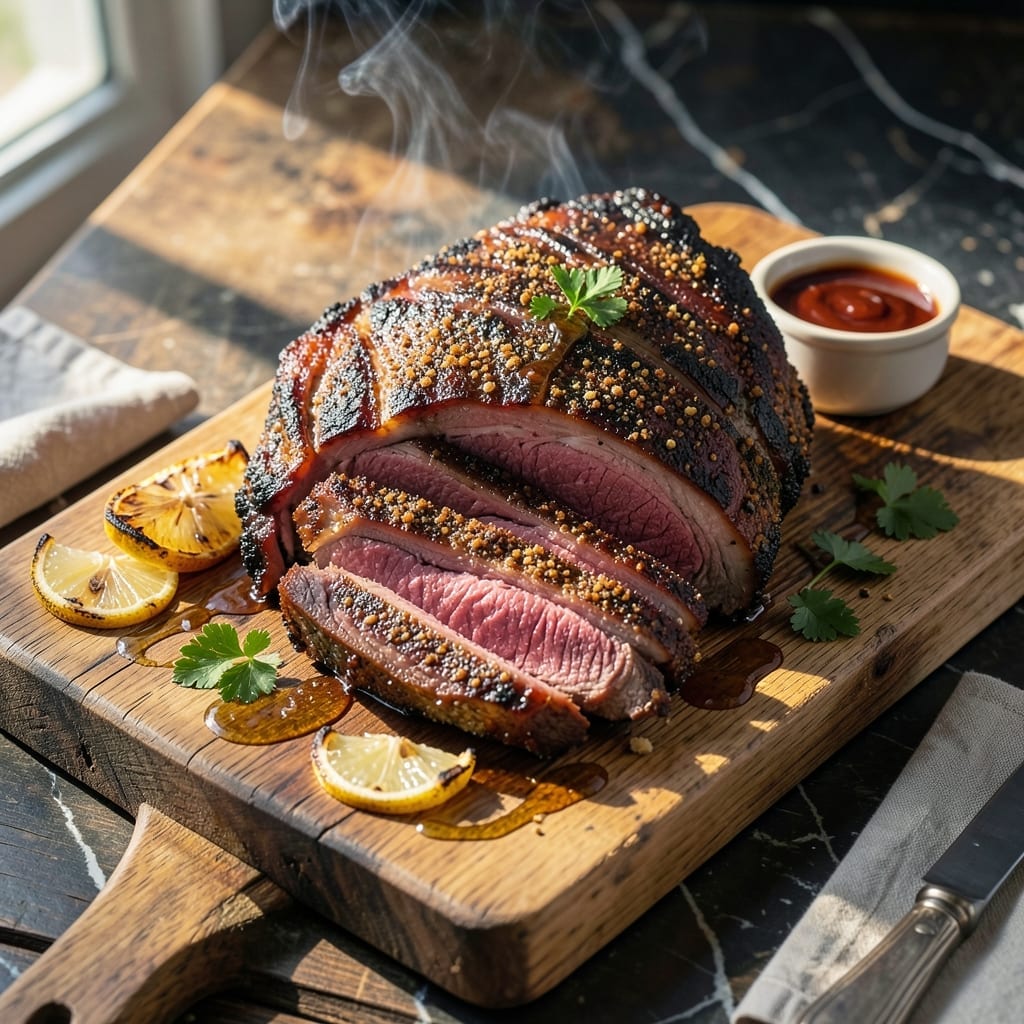
I fell in love with brisket the first time I smelled hickory smoke curling from my family’s backyard pit. This recipe captures that tender perfection through a low and slow process.
Patience is the key—hours of careful smoking transform tough beef into buttery, fall-apart slices that need no sauce to shine.
Ingredients for Barbecue Beef Brisket
A few quality ingredients and time transform beef into that tender, smoky masterpiece you crave.
| Ingredient | Amount | Notes |
|---|---|---|
| Beef Brisket 🥩 | 4 lb | Whole packer cut preferred |
| Kosher Salt 🧂 | ¼ cup | Diamond Crystal preferred |
| Coarse Black Pepper 🌶️ | ¼ cup | Freshly ground for best flavor |
| Brown Sugar 🍚 | ½ cup | Light or dark variety |
| Smoked Paprika 🌶️ | 2 tbsp | For deep smoke flavor |
| Garlic Powder 🧄 | 2 tbsp | Not garlic salt |
| Onion Powder 🧅 | 2 tbsp | Fresh ground preferred |
| Mustard Powder 🟡 | 1 tbsp | Helps bark formation |
| Hickory Wood Chunks 🪵 | 4 pieces | For authentic smoke flavor |
| Apple Cider Vinegar 🍏 | ½ cup | For spritzing during cook |
| Beef Broth 🥩 | 2 cups | Low sodium preferred |
| Unsalted Butter 🧈 | ½ cup | For wrapping brisket |
| Yellow Mustard 🟡 | ¼ cup | Binder for dry rub |
[recipe_ingredient_scaler]
The brisket is everything here. Whole packer cut (both point and flat) gives the best results, though flat alone works in a pinch. Look for good marbling—Costco or a local butcher usually have the best selection. I avoid pre-trimmed brisket (the fat cap protects the meat during that long cook). The salt should be kosher salt, and I swear by Diamond Crystal for its texture and purity.
No hickory wood? Pecan or oak work beautifully too—just avoid softwoods like pine. If you’re short on time, pellets in an electric smoker can mimic the flavor. Brown sugar can be swapped for white in a pinch, but you’ll lose some caramelization. The beef broth is flexible—water with bouillon cubes does the trick. And yes, the butter wrap at the end is non-negotiable for that competition-style bark.
Brisket needs to rest at least 1 hour before slicing (2 hours is better). Store leftovers wrapped in foil for up to 5 days in the fridge, or freeze for 3 months. Reheat gently in a low oven with a splash of broth to keep it moist.
Why You’ll Love This Recipe
- Set It & Forget: I rub the brisket with salt, pepper, and brown sugar the night before, then let the smoker do the work.
- Smoky Sweet Crust: That bark from the smoked paprika and brown sugar? Ridiculously good—crunchy outside, tender inside.
- Feeds a Crowd: Between us, this brisket stretches to sandwiches, tacos, and chili for days.
- Leftovers Gold: Honestly, it tastes even better the next day—shred it for quick meals all week.
Step-by-Step Instructions for Barbecue Beef Brisket
Here’s the method. Straightforward, tested, works every time.
Step 1: Prepare and Season the Brisket
Start by trimming the beef brisket fat cap to about ¼ inch thickness. I use a sharp boning knife for precision—this gives you control while leaving enough fat to protect the meat during the long cook.
In a bowl, combine the 0.25 cup Kosher Salt, 0.25 cup Coarse Black Pepper, 0.5 cup Brown Sugar, 2 tbsp Smoked Paprika, 2 tbsp Garlic Powder, 2 tbsp Onion Powder, and 1 tbsp Mustard Powder. Rub the 0.25 cup Yellow Mustard over the entire surface of the brisket as a binder, then apply the spice mixture generously, pressing it into the meat. Let it sit at room temperature for 1 hour to allow the rub to adhere properly.
Step 2: Set Up Your Smoker for Low and Slow Cooking
Preheat your smoker to 225-250°F using the 4 pieces Hickory Wood Chunks. I’ve found this temperature range delivers that perfect balance of smoke flavor without drying out the meat. Place a water pan in the smoker to maintain moisture throughout the cook.
When the smoker reaches temperature and you see clean, thin blue smoke, you’re ready to add the brisket. Position it fat-side up so the rendering fat bastes the meat as it cooks. Close the lid and resist the urge to peek—every time you open it, you add 15-20 minutes to your cook time.
Step 3: Monitor and Spritz for Moisture
Smoke the brisket undisturbed for 6-8 hours until the internal temperature hits 165-170°F. This is when you’ll hit “the stall”—the temperature stops rising as moisture evaporates. Don’t panic; this is normal.
During the cook, spritz the brisket every 2-3 hours with a mixture of 0.5 cup Apple Cider Vinegar and 2 cups Beef Broth to keep it moist. This step is crucial for developing that perfect bark while maintaining juiciness inside.
Step 4: Wrap and Finish the Cook
At the stall, wrap the brisket tightly in pink butcher paper (not foil—paper breathes better and preserves the bark). Add 0.5 cup Unsalted Butter on top of the brisket before wrapping. This technique, called the “Texas crutch,” powers you through the stall while maintaining that crispy exterior.
Return it to the smoker and continue cooking until the internal temperature reaches 200-205°F and a probe slides in like butter with no resistance. This usually takes another 4-6 hours, but trust the probe test over the thermometer—tenderness matters more.
Step 5: Rest and Slice for Maximum Juiciness
Remove the brisket from the smoker and let it rest in the butcher paper for at least 1 hour (I prefer 2 hours wrapped in towels in a cooler). This resting period allows the juices to redistribute throughout the meat.
Unwrap the brisket and locate the grain direction. Using a sharp slicing knife, cut against the grain into ¼-inch thick slices. Serve immediately while still warm, ensuring each slice is tender enough to pull apart with a gentle tug.
Pro Tips For Making Barbecue Beef Brisket
- Low and Slow Wins: Keep your smoker or oven at 225°F—any hotter and the brisket tightens up like a drum. I learned this the hard way after pulling a dry, chewy disaster at 275°F.
- Trim the Fat Cap: Leave about 1/4-inch fat, but trim the rest—too much and the rub won’t penetrate, too little and it dries out. Sounds tedious, but it actually changes the outcome.
- Resist the Urge to Rush: Wrapping in foil at 165°F internal temp speeds it up, but skip it too early and you’ll lose that coveted bark. I was skeptical until I tried it both ways.
- Rest Like You Mean It: Let it sit wrapped in a towel for at least an hour—yes, even if you’re starving. My grandmother swore by this, and she was right: juices redistribute or they’ll end up on the cutting board.
Wine and Beer Pairings for These Flavors
Bold Red Wines
Brisket’s rich, smoky flavors pair beautifully with bold reds. I love a Texas Tempranillo—its dark fruit notes and soft tannins complement the meat without overpowering. William Chris Vineyards makes an excellent one that’s become my go-to for local BBQ competitions. 🍷
Big Cabernets
For those who prefer more structure, a Napa Valley Cabernet Sauvignon stands up to the fat and spice. Look for one with 14-15% ABV and prominent blackcurrant flavors. I decant mine for 30 minutes before serving to let it breathe.
Malbec Magic
An Argentine Malbec brings plum and cocoa notes that echo the brisket’s bark. The Catena Zapata is my favorite—its velvety texture mirrors the meat’s tenderness. Serve slightly cooler than room temperature, around 60-65°F.
Craft Beer Options
For beer lovers, a robust porter or stout works wonders. I recommend Live Oak Primus, a local Austin brew with coffee and chocolate notes. The carbonation cuts through the fat while the dark malt complements the smoke. 🍺
Hoppy Alternatives
A double IPA with 8% ABV or higher can stand up to the intensity. Fireman’s 4 from Real Ale Brewing has the piney hop profile that balances the sweetness in the rub. Just avoid light lagers—they’ll get lost.
Non-Alcoholic Pair
For a non-alcoholic option, try a smoked black tea like Lapsang Souchong. Its campfire aroma mirrors the hickory smoke. Brew it strong and serve over ice with a lemon wedge for a refreshing contrast.
Nutrition Facts
Frequently Asked Questions
How long should I let the rub sit on the brisket before cooking?
Let the seasoned brisket rest at room temperature for 1 hour before smoking. This allows the spices to adhere and begin penetrating the meat for maximum flavor.
What’s the best way to know when it’s done?
The brisket is ready when it reaches 200-205°F internally and a probe slides in like butter. Always trust the probe test over temperature alone for perfect tenderness.
Can I cook brisket in the oven instead of a smoker?
Yes! Use 225-250°F in your oven with a water pan for moisture. Add liquid smoke to the spritz for authentic flavor, though a smoker is ideal.
Why does my brisket turn out dry?
Dryness usually comes from cooking too hot or slicing too soon. Maintain 225-250°F and let it rest 1-2 hours before cutting to retain juices.

Trained in classic French technique but raised on slow-cooked ribs and spicy rubs, she blends culinary skill with smoke and soul.
- Recipe for Boneless Pork Chops in Cast Iron Skillet: Sear and Baste to Juicy Perfection - October 3, 2026
- Recipe for Boneless Cross Rib Roast: Slow-Roasted Beef with Herb Crust - October 3, 2026
- Hamburgers in Sauce Recipe Crock Pot: Slow-Cooked Savory Delight - October 3, 2026