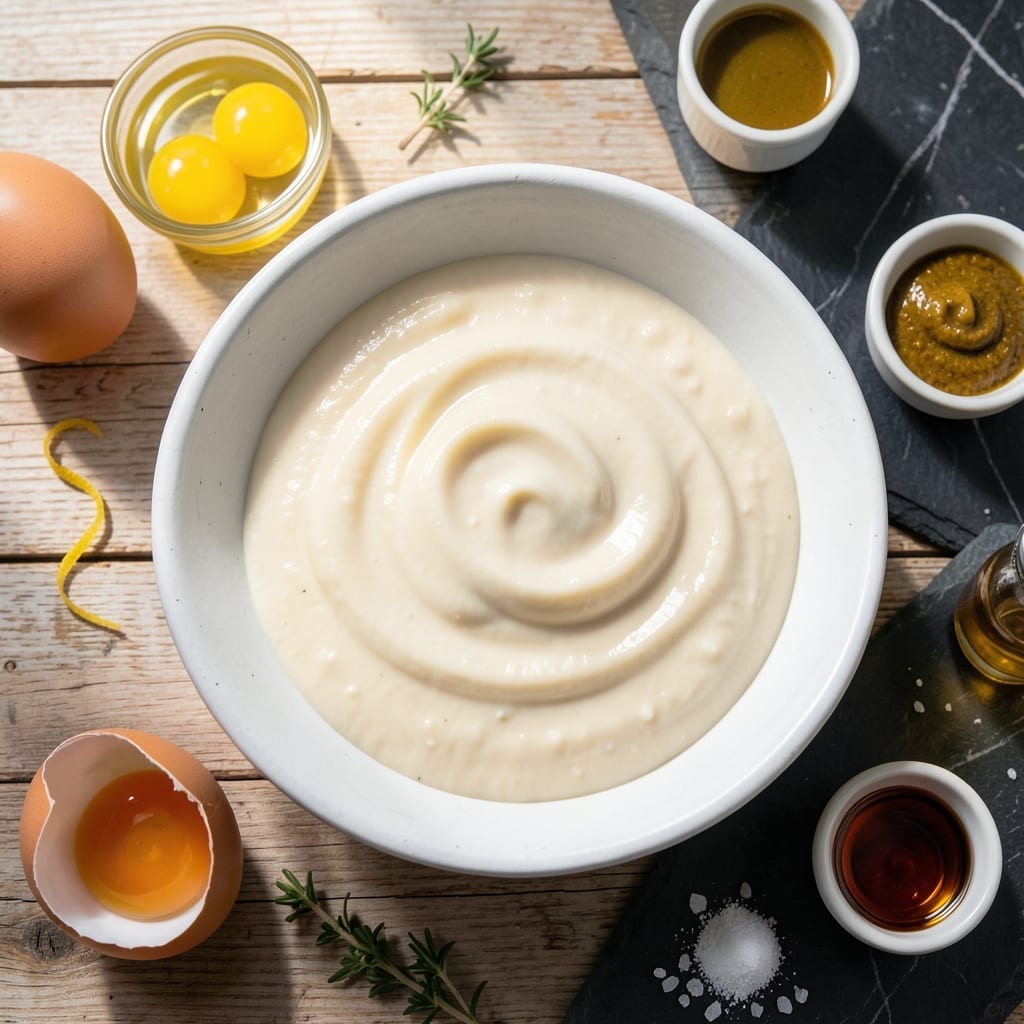
This homemade mayonnaise delivers the tangy Southern character that made Duke’s famous. The secret lies in precise ingredient ratios and proper emulsification.
With just a few pantry staples and a whisk, you’ll achieve that creamy, slightly sweet profile that elevates sandwiches and dips alike.
Ingredients for Copycat Duke’s Mayonnaise
Eight simple ingredients transform into that signature tangy Southern-style spread you crave.
| Ingredient | Amount | Notes |
|---|---|---|
| Large Egg Yolks 🥚 | 2 whole | Room temperature essential |
| Whole Egg 🥚 | 1 whole | Room temperature essential |
| Dijon Mustard 🟡 | 1 tbsp | Smooth, not whole grain |
| Apple Cider Vinegar 🍏 | 2 tbsp | For authentic tangy flavor |
| Granulated Sugar 🍚 | 1 tsp | Balances acidity perfectly |
| Salt 🧂 | ¾ tsp | Fine sea salt preferred |
| Neutral Oil 🫒 | 1 ½ cups | Avocado or light olive oil |
| Lemon Juice 🍋 | 1 tbsp | Freshly squeezed for brightness |
[recipe_ingredient_scaler]
The oil matters most here. Avocado oil gives the cleanest flavor, but any neutral oil (like light olive oil or vegetable oil) works. Don’t use extra-virgin—it’s too assertive. For the vinegar, apple cider nails Duke’s signature tang, but white vinegar works in a pinch. Eggs at room temp emulsify better (cold eggs can break your mayo).
No Dijon? Yellow mustard at half the amount gets you close—just expect slightly less depth. Out of apple cider vinegar? White vinegar or lemon juice both work (adjust to taste). The sugar isn’t optional—it’s what gives Duke’s that subtle sweetness that balances the tang. Want it sweeter? Add up to 1/2 tsp more.
Mayo keeps 1 week in the fridge in a sealed jar. Don’t freeze it—it’ll separate. For best texture, let it sit 24 hours before using so flavors meld. Always use a clean spoon to avoid contamination.
Why You’ll Love This Recipe
- One-Bowl Wonder: I can make this in a single bowl with a whisk—no fancy equipment, just egg yolks and a little elbow grease.
- Tangy Perfection: The apple cider vinegar and Dijon mustard give it that signature Duke’s zing I crave on sandwiches and fries.
- Endless Uses: Honestly, I slather this on burgers, mix it into potato salad, and even use it as a base for dressings.
- Pantry Staples: Between us, I always have these ingredients on hand, and it’s way cheaper than buying specialty mayo.
Step-by-Step Instructions for Southern-Style Mayonnaise
Here’s the method I use to nail that signature tangy richness every time.
Step 1: Whisk Eggs and Seasonings Until Smooth
In a medium bowl, combine the 2 whole Large Egg Yolks and 1 whole Whole Egg at room temperature. I always let my eggs sit out for 30 minutes first—cold eggs can break your emulsion.
Add the 1 tbsp Dijon Mustard, 2 tbsp Apple Cider Vinegar, 1 tsp Granulated Sugar, and 0.75 tsp Salt. Whisk vigorously until the mixture turns pale yellow and slightly thickened, about 1-2 minutes. You want it completely smooth before adding oil.
Step 2: Begin Emulsifying with Oil
Start adding the 1.5 cups Neutral Oil one drop at a time while whisking constantly. I know it seems tedious, but this slow start is crucial for a stable emulsion. After about ¼ cup of oil is incorporated, you can switch to a thin, steady stream.
Keep whisking continuously—the mixture will begin to thicken and turn opaque as the oil combines with the egg base. If it starts to separate, stop adding oil and whisk vigorously until it comes back together. This usually takes 3-5 minutes total for the initial phase.
Step 3: Complete the Emulsion
Once about half the oil is incorporated, you can add it slightly faster, but maintain that constant whisking motion. The mayonnaise will become noticeably thicker and paler as more oil is absorbed.
When all the 1.5 cups Neutral Oil is added, whisk for an additional 30 seconds to ensure complete emulsification. The finished product should be thick, creamy, and glossy.
Step 4: Finish with Acid and Adjust
Stir in the 1 tbsp Lemon Juice. This final touch brightens the flavor and helps stabilize the emulsion. Taste and adjust seasoning if needed, though the initial salt measurement should be spot-on for most palates.
The mayonnaise will be at its best consistency now—thick but still spreadable. If it’s too thick, you can thin it with a teaspoon of water, but I’ve found this ratio works perfectly with the 1.5 cups Neutral Oil.
Step 5: Rest and Store Properly
Transfer to a clean jar and let it rest at room temperature for 10 minutes before refrigerating. This allows the flavors to meld completely. The mayonnaise will thicken slightly more as it chills.
Store in the refrigerator for up to 1 week. The surface might separate slightly over time—just give it a good stir before using. The tang from the 2 tbsp Apple Cider Vinegar and brightness from the 1 tbsp Lemon Juice will intensify after a day, giving you that authentic Duke’s flavor profile.
Pro Tips For Making Copycat Duke’S Mayonnaise
- Use Room-Temp Eggs: I learned this the hard way—cold eggs won’t emulsify as smoothly, and you’ll end up with a broken mayo. Pull them out 30 minutes before starting.
- Stream Oil Slowly: Sounds tedious, but a thin, steady drizzle of oil is the only way to get that thick, creamy texture Duke’s is known for. Rush it and it’ll separate on you.
- Skip the Substitutions: Dijon mustard isn’t just for flavor—it’s your emulsifier. Swapping it for yellow mustard or skipping it entirely means your mayo won’t hold.
- Balance the Vinegar: Apple cider vinegar adds the tang, but too much makes it taste harsh. Stick to 1 tablespoon for the egg/yolk combo, then adjust to taste.
Wine and Beer Pairings for This Recipe
Classic Sandwich Pairings
This mayo shines brightest with Southern classics. I slather it on fried chicken sandwiches—the tang cuts through the richness perfectly. It also transforms pulled pork sandwiches, adding that signature Duke’s zing to each bite. 🔥
Beer Recommendations
A crisp lager like Pabst Blue Ribbon balances the creaminess beautifully. For craft lovers, try a Kolsch from your local brewery—its light, clean profile lets the mayo’s flavor shine without competing with it.
Wine Choices
Surprisingly, a dry Riesling works wonders with dishes featuring this mayo. The wine’s acidity mirrors the apple cider vinegar tang. I also enjoy a chilled Sauvignon Blanc—its citrus notes complement the subtle sweetness in the recipe.
Dip and Veggie Matches
Use this as a dip for crudité platters—it pairs especially well with raw carrots and bell peppers. The mayo’s slight sweetness enhances the natural sugars in the vegetables. I always make extra when I’m foraging wild herbs for garnishes.
Burger Perfection
For burgers, this mayo elevates both beef and veggie patties. I love it on a classic cheeseburger with just lettuce and tomato—the tangy profile makes every bite sing. The emulsification stays stable even under a hot, juicy burger. ✨
Nutrition Facts
Frequently Asked Questions
Why does my mayo break when making it?
This usually happens if oil is added too quickly or eggs are cold. Start with room temperature eggs and add oil drop by drop at first. If it separates, stop adding oil and whisk vigorously to re-emulsify.
Can I use a blender or food processor?
These actually help create a more stable emulsion. Blend the eggs and seasonings first, then slowly drizzle in the 1.5 cups oil while running. It takes about 30 seconds total.
What can I substitute for Dijon mustard?
Use ½ tbsp yellow mustard instead. The flavor will be milder but still effective. Avoid spicy mustards—they’ll overpower the delicate balance of sweet and tangy.
How long does homemade mayo last?
It stays fresh in the fridge for about 1 week in a sealed jar. For best results, use clean utensils every time to prevent contamination.

Trained in classic French technique but raised on slow-cooked ribs and spicy rubs, she blends culinary skill with smoke and soul.
- Recipe for Boneless Pork Chops in Cast Iron Skillet: Sear and Baste to Juicy Perfection - October 3, 2026
- Recipe for Boneless Cross Rib Roast: Slow-Roasted Beef with Herb Crust - October 3, 2026
- Hamburgers in Sauce Recipe Crock Pot: Slow-Cooked Savory Delight - October 3, 2026