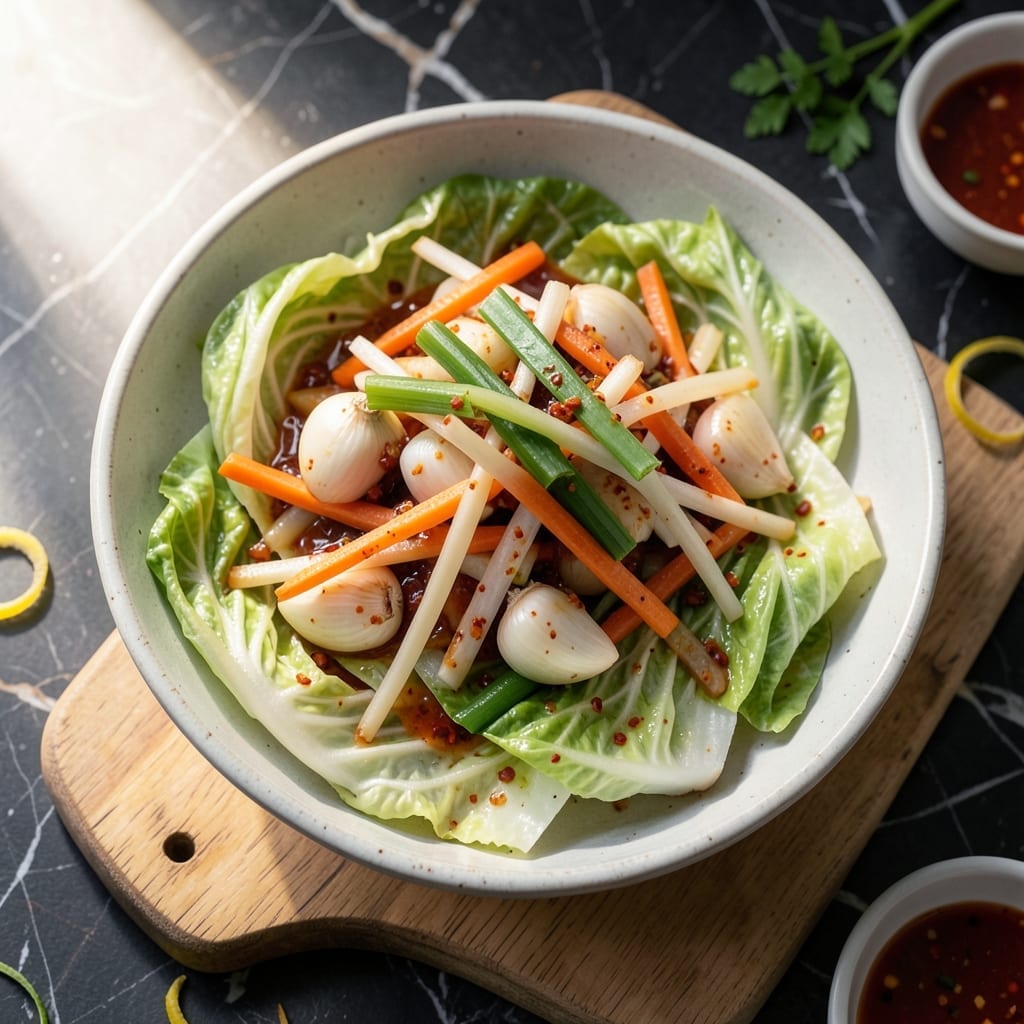
I’ve perfected a simple method for making kimchi at home without rice flour. This approach uses everyday ingredients to create that signature tangy, spicy fermented flavor.
With just a few steps and minimal effort, you’ll have a batch of crunchy, flavorful kimchi ready to enjoy in days. The process is straightforward and delivers authentic results every time.
Ingredients for Easy Kimchi Recipe Without Rice Flour
Everyday ingredients deliver that signature tangy, spicy fermented kimchi you love at home.
| Ingredient | Amount | Notes |
|---|---|---|
| Napa Cabbage 🥬 | 2 lb | Cored and quartered lengthwise |
| Kosher Salt 🧂 | ½ cup | Diamond Crystal preferred for texture |
| Daikon Radish 🥕 | 8 oz | Peeled and cut into matchsticks |
| Carrots 🥕 | 2 whole | Peeled and julienned |
| Green Onions 🧅 | 6 whole | Cut into 2-inch pieces |
| Garlic Cloves 🧄 | 8 cloves | Peeled and minced |
| Fresh Ginger 🌿 | 2 tbsp | Peeled and finely grated |
| Gochugaru 🌶️ | ½ cup | Korean red pepper flakes, fine or coarse |
| Fish-Free Soy Sauce 🫒 | ¼ cup | Or tamari for gluten-free |
| Sugar 🍚 | 3 tbsp | White or turbinado, dissolves easily |
| Rice Vinegar 🍶 | ¼ cup | Or apple cider vinegar |
| Water 💧 | 4 cups | For saltwater brine |
[recipe_ingredient_scaler]
The cabbage is key—Napa cabbage gives the best texture and crunch. Look for firm heads with vibrant green leaves at Asian markets or well-stocked grocers like Whole Foods or H Mart. Avoid any with wilting or yellowing. The gochugaru (Korean red pepper flakes) is non-negotiable for authentic flavor. Korean grocery stores carry it, or order from Amazon if you’re in a pinch.
No gochugaru? Crushed red pepper flakes work but the flavor won’t be as complex. Swap fish-free soy sauce for coconut aminos if needed. Sugar can be maple syrup or agave for a liquid sweetener (use 2 tbsp per 3 tbsp sugar). The daikon and carrots add crunch—zucchini or cucumber can stand in if that’s what you’ve got.
Kimchi ferments at room temp for 1-2 days, then moves to the fridge for 1-4 weeks. Store in airtight jars with a bit of headspace. The brine will bubble—that’s normal! Keeps for up to 1 month refrigerated (but it’s usually gone way before then).
Why You’ll Love This Recipe
- No Fuss Prep: I skip the rice flour slurry entirely—just salt, veggies, and time do all the work.
- Tangy Crunch: The daikon and carrots stay crisp while the napa soaks up that bold, fermented kick.
- Fridge Staple: I toss it into fried rice, soups, or straight from the jar for a quick flavor bomb.
- Budget Friendly: A whole head of cabbage and a few roots make gallons. Honestly, it costs less than store-bought.
Step-by-Step Instructions for Easy Kimchi Without Rice Flour
Here’s the method. Straightforward, tested, works every time.
Step 1: Salt the Cabbage Properly
Place the 2 lb Napa Cabbage quarters in a large bowl and sprinkle the 0.5 cup Kosher Salt between each leaf, focusing on the thick white stems. I’ve found that Diamond Crystal salt dissolves faster and gives a better texture.
Pour the 4 cups Water over the cabbage, ensuring all pieces are submerged. Let this sit at room temperature for 1-2 hours, flipping the cabbage halfway through. You’ll know it’s ready when the thickest part of the stem bends easily without snapping.
Step 2: Prepare the Vegetable Add-Ins
While the cabbage brines, prep your vegetables: cut the 8 oz Daikon Radish into matchsticks, julienne the 2 whole Carrots, and slice the 6 whole Green Onions into 2-inch pieces. This uniform size ensures even fermentation.
Combine these in a large mixing bowl. The radish and carrots add crunch while the green onions contribute a mild bite. I always use a mandoline for perfect matchsticks—it’s faster and more consistent than knife work.
Step 3: Create the Flavorful Paste
In a separate bowl, combine the 8 cloves Garlic Cloves (minced), 2 tbsp Fresh Ginger (grated), 0.5 cup Gochugaru, 0.25 cup Fish-Free Soy Sauce, 3 tbsp Sugar, and 0.25 cup Rice Vinegar. Stir until it forms a thick, vibrant red paste.
The sugar and vinegar balance the heat from the gochugaru, while the garlic and ginger add depth. I prefer coarse gochugaru for more texture in the finished kimchi. Make sure there are no dry spots in your paste—every bite should be flavorful.
Step 4: Combine and Pack for Fermentation
Drain the cabbage thoroughly, rinsing it under cold water if it tastes too salty. Gently squeeze out excess water, but don’t overdo it—you want some moisture for fermentation. Add the cabbage to the vegetable bowl and mix in the paste, using your hands to work it between all the leaves.
Pack everything tightly into clean jars, pressing down to remove air pockets. Leave 1-2 inches of headspace at the top. The kimchi will expand slightly as it ferments, and this space prevents overflow.
Step 5: Ferment to Perfection
Seal the jars loosely (or use fermentation lids) and leave at room temperature for 1-2 days. You’ll see bubbles forming within 24 hours—that’s the fermentation starting. After the initial ferment, move to the fridge to slow the process.
The kimchi is ready when it smells tangy and the cabbage is slightly translucent. I taste test after 48 hours at room temperature. Remember, the flavor continues to develop in the fridge, becoming more complex over time.
Pro Tips For Making Easy Kimchi Recipe Without Rice Flour
- Salt the cabbage twice: After the initial salt, rinse and drain the cabbage, then give it a light re-salt before mixing with other veggies—this keeps the crunch without making it soggy.
- Squeeze out all water: I learned this the hard way—after salting, wring the cabbage hard in the sink to remove excess liquid, or your kimchi will turn watery in days.
- Grate the daikon fine: Sounds weird, but it works: shred the daikon and carrots on the finest side of your grater so they soften quickly and distribute evenly through the batch.
- Use green onion ends: Skip wasting the dark green tops—chop them thin and toss them in for extra flavor and a pop of color, no extra cost.
Creative Variations of These Flavors
Quick Radish Kimchi
Swap the Napa cabbage for 1 lb Korean radish (mu) or daikon cut into 1-inch cubes. Reduce the brine to 2 cups water with ¼ cup Kosher Salt. Radish kimchi ferments faster—taste after 24 hours at room temperature. The texture stays crisp longer in the fridge. 🌟
Spicy Cucumber Kimchi
Use 4 Persian cucumbers instead of cabbage, sliced into ½-inch rounds. Skip the initial saltwater brine and toss cucumbers directly with 2 tbsp Kosher Salt. Let sit for 30 minutes, then rinse and mix with the paste. This version is ready in just 12-18 hours.
Vegan Fruit Kimchi
Add 1 Asian pear (peeled and thinly sliced) or 1 cup pineapple chunks to the vegetable mix. The natural sugars accelerate fermentation and add subtle sweetness. Reduce the added sugar to 1 tbsp since fruits contribute their own. This pairs beautifully with grilled tofu.
White Kimchi (Baechu)
Omit the gochugaru entirely for a mild, non-spicy version. Increase the garlic to 10 cloves and add 1 tbsp fish-free soy sauce for depth. The fermentation process remains the same, but the flavor profile is cleaner and brighter. Perfect for those sensitive to heat.
Lacto-Fermented Greens
Use 1 lb bok choy or baby kale instead of cabbage. Blanch the greens in boiling water for 30 seconds, then shock in ice water before salting. This softens the texture while maintaining vibrant color. Ferment for 2-3 days before refrigerating. 💡
Kimchi with Apple
Add 1 grated Fuji apple to the paste mixture for natural sweetness and a touch of acidity. The pectin in apples helps thicken the paste slightly, mimicking the texture rice flour would provide. This version ferments a bit faster due to the apple’s natural enzymes.
Nutrition Facts
Frequently Asked Questions
What can I use instead of gochugaru?
Crushed red pepper flakes work but lack complexity. For best results, mix ½ cup crushed red pepper with 1 tbsp smoked paprika to mimic the depth. The flavor won’t be identical, but it’ll still be tasty
How do I know when it’s ready?
Taste after 48 hours at room temperature. It’s ready when it smells tangy and the cabbage is slightly translucent. The flavor deepens over 1-4 weeks in the fridge
Can I use table salt instead of kosher?
Yes, but reduce the amount by 25% since table salt is finer. For this recipe, use 6 tbsp table salt instead of ½ cup kosher. Too much salt inhibits fermentation
Why is my kimchi not bubbling?
Check the temperature—fermentation needs 65-75°F. If your kitchen is cold, place jars near a warm spot. Also ensure the cabbage was properly salted and rinsed before mixing with paste

Trained in classic French technique but raised on slow-cooked ribs and spicy rubs, she blends culinary skill with smoke and soul.
- Recipe for Boneless Pork Chops in Cast Iron Skillet: Sear and Baste to Juicy Perfection - October 3, 2026
- Recipe for Boneless Cross Rib Roast: Slow-Roasted Beef with Herb Crust - October 3, 2026
- Hamburgers in Sauce Recipe Crock Pot: Slow-Cooked Savory Delight - October 3, 2026