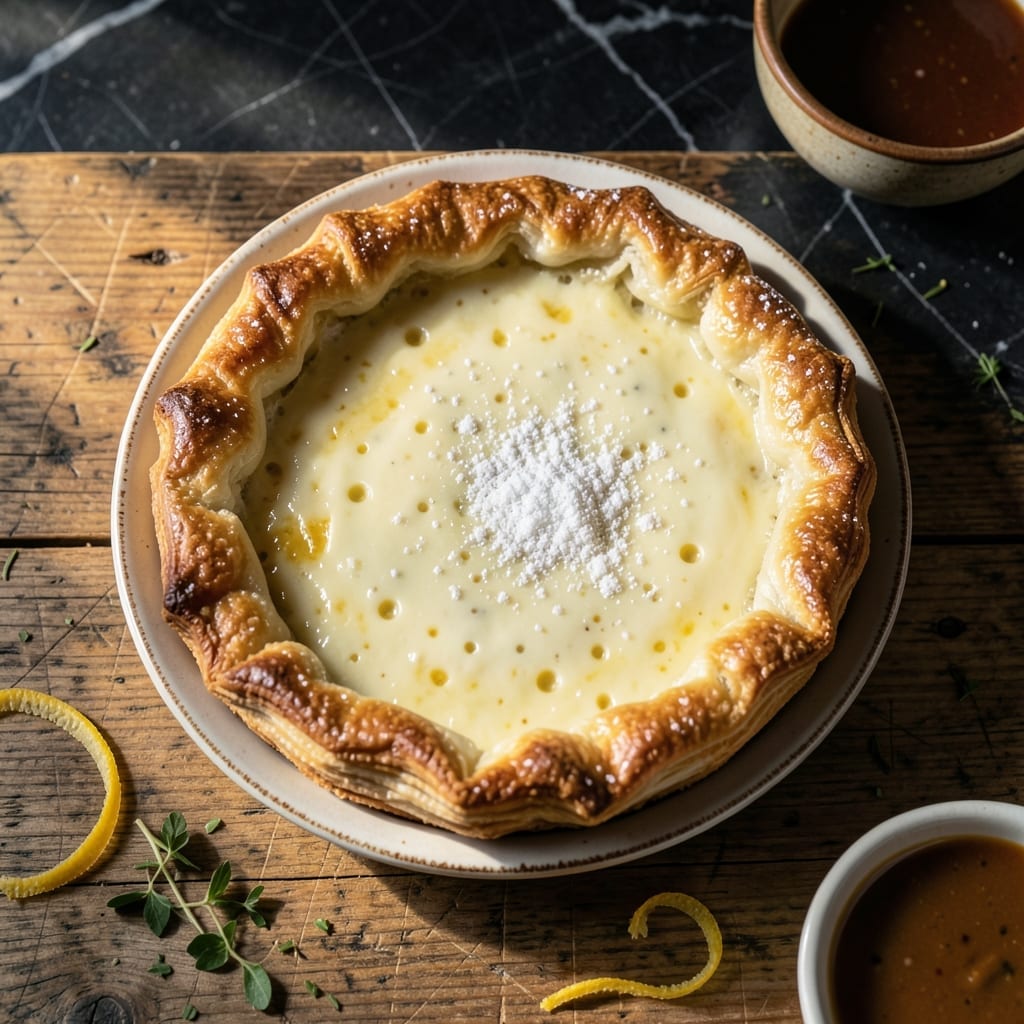
This Filipino egg pie delivers a flaky crust with a rich custard filling that’s beloved across the islands.
I’ve adapted the traditional method to ensure consistent results, focusing on the perfect balance between buttery pastry and creamy center.
The filling uses just eggs, sugar, and milk, baked until set and golden. The crust stays crisp and delicate, never soggy.
Serve warm or at room temperature for a treat that’s simple yet impressive. This version stays true to the original while being foolproof for home bakers.
Ingredients for Egg Pie Recipe Philippines
Buttery crust meets creamy custard with just a few pantry staples and fridge basics.
| Ingredient | Amount | Notes |
|---|---|---|
| All-Purpose Flour 🌾 | 2 cups | Plus extra for dusting |
| Unsalted Butter 🧈 | 1 cup | Cold, cut into small cubes |
| Granulated Sugar 🍚 | ¾ cup | Divided for crust and filling |
| Salt 🧂 | ½ tsp | Fine sea salt preferred |
| Ice Water 💧 | ¼ cup | For pastry dough |
| Large Eggs 🥚 | 6 whole | Room temperature preferred |
| Whole Milk 🥛 | 2 cups | Full-fat for richness |
| Vanilla Extract 🌿 | 1 tsp | Pure extract recommended |
| Condensed Milk 🥛 | ½ cup | Sweetened, for custard |
| Lemon Zest 🍋 | 1 tsp | Optional, for brightness |
[recipe_ingredient_scaler]
The butter is non-negotiable here. Plugra or Kerrygold give you that flaky, delicate texture the intro promises. Most grocery stores carry these, but any high-fat European-style butter works. Cut it cold and keep it cold until mixing—warm butter means tough crust. The flour should be all-purpose, nothing fancy. If you’re in the Philippines, local brands like San Miguel or Maya are perfect.
No condensed milk? Evaporated milk plus 2 tbsp sugar gets you close, though the texture won’t be quite as rich. Out of whole milk? 2% works in a pinch, but the custard won’t set as firmly. For a deeper flavor, swap vanilla for pandan extract—it’s a common Filipino twist. The eggs must be fresh; old eggs won’t give you that vibrant, set center.
The crust dough can rest overnight in the fridge—actually improves the flakiness. Baked pies keep at room temperature for 2 days or in the fridge for 4 days. Reheat slices in a toaster oven to revive the crust. For make-ahead, freeze unbaked pies (wrapped tight) for up to 1 month.
Why You’ll Love This Recipe
- One Bowl Wonder: I just dump the flour, butter, sugar, and ice water in a bowl—no fancy tools, no mess.
- Buttery Crust: That flaky, buttery shell made with unsalted butter and a pinch of salt? It’s what makes this egg pie irresistible.
- Crowd Pleaser: I bring this to potlucks and it’s always the first to disappear—kids and adults alike.
- Budget Friendly: Honestly, a few pantry staples and eggs are all it takes to make something this good.
Step-by-Step Instructions for Egg Pie
Here’s the method for achieving a flaky crust and rich custard filling that defines this classic treat.
Step 1: Prepare the Flaky Pastry Dough
In a large bowl, combine the 2 cups All-Purpose Flour, 0.5 tsp Salt, and 1 cup Unsalted Butter cut into small cubes. Use your fingertips to work the butter into the flour until the mixture resembles coarse crumbs with pea-sized butter pieces visible.
Gradually add the 0.25 cup Ice Water, 1 tablespoon at a time, mixing gently with a fork until the dough just comes together. Avoid overworking it—stop as soon as the dough holds when pressed. This ensures the layers of butter stay intact for a flaky texture.
Divide the dough into two equal portions, flatten into discs, and wrap in plastic. Chill for at least 1 hour—this resting period relaxes the gluten and solidifies the butter, which is essential for that desired flaky result.
Step 2: Roll Out and Blind-Bake the Crust
On a lightly floured surface, roll one dough disc into a 12-inch circle. Transfer it to a 9-inch pie dish, pressing gently into the bottom and sides. Trim the edges, leaving a slight overhang, and crimp decoratively.
Line the crust with parchment paper and fill with pie weights or dried beans. Preheat your oven to 375°F and bake for 15 minutes. Remove the weights and parchment, then bake for another 5-7 minutes until the crust is lightly golden but not fully cooked.
This blind-baking step prevents a soggy bottom when the custard filling is added. Let the crust cool slightly while you prepare the filling.
Step 3: Make the Rich Custard Filling
In a large bowl, whisk together the 6 whole Large Eggs, 0.75 cup Granulated Sugar, 2 cups Whole Milk, 0.5 cup Condensed Milk, 1 tsp Vanilla Extract, and 1 tsp Lemon Zest (if using). Whisk vigorously for 2-3 minutes until the mixture is smooth and slightly frothy.
Strain the custard through a fine-mesh sieve to remove any lumps or zest bits—this ensures an ultra-smooth texture. Pour the strained custard into the pre-baked crust, filling it to just below the rim to prevent spillage during baking.
Step 4: Bake Until Set and Golden
Return the pie to the 375°F oven and bake for 35-40 minutes. You’re looking for the center to be just set with a slight jiggle when gently shaken. The top should be a deep golden brown with no wet spots.
If the edges of the crust begin to darken too quickly, cover them loosely with aluminum foil to prevent over-browning. The custard will continue to set as it cools, so don’t overbake—it should be creamy, not firm, when removed from the oven.
Step 5: Cool and Serve
Let the pie cool completely on a wire rack, which takes about 2 hours. This cooling period is crucial—it allows the custard to fully set and develop its signature creamy texture. Slicing too soon will result in a runny filling.
Once cooled, chill the pie in the refrigerator for at least 1 hour before serving. This enhances the flavors and makes for cleaner slices. Serve chilled for the best experience, with the flaky crust and rich custard perfectly balanced.
Pro Tips For Making Egg Pie Recipe Philippines
- Chill the Dough: Let the pie crust rest in the fridge for at least 30 minutes before rolling—this prevents the butter from melting too soon and keeps the layers flaky. I learned this the hard way after my first few pies turned out tough.
- Use Ice-Cold Water: When mixing the dough, make sure your water is truly ice-cold—about 3-4 ice cubes in a cup of water. This keeps the butter solid and guarantees a crumbly, non-greasy crust.
- Skip Warm Butter: Resist the urge to soften the butter too much; it should be cold but still workable. Warm butter blends into the flour instead of creating those buttery flakes everyone loves.
- Blind Bake First: Pre-bake the crust for 10 minutes at 350°F before adding the egg filling—this prevents a soggy bottom. Sounds weird, but it works every time.
Regional Styles of This Dish
Manila Classic
In the capital, this dish is a staple at Goldilocks and Red Ribbon bakeries. Their version uses a slightly sweeter custard with more condensed milk—about 1 cup instead of ½ cup. The crust is often pressed thinner for a crispier texture that contrasts beautifully with the rich filling. 💛
Pampanga Style
Kapampangan bakers add queso de bola (Edam cheese) to their filling, creating a marbled effect. They also incorporate 1 tbsp ube halaya for a subtle purple hue and earthy flavor. The result is a pie that’s as visually stunning as it is delicious.
Cebu Variation
In Cebu, they love adding a tropical twist with ½ cup coconut milk replacing some of the whole milk. The crust often includes 1 tbsp toasted coconut flakes for extra texture. This version has a lighter, almost floral note that’s distinctly Visayan.
Baguio High Altitude
Bakers in Baguio adjust for the elevation by reducing sugar slightly—about ⅔ cup instead of ¾ cup—and adding 1 extra egg to compensate for the drier climate. The crust is often brushed with egg wash for a deeper golden color.
Ilocos Version
Ilocano cooks use carabao milk (water buffalo milk) for an even richer custard. They also add 1 tsp calamansi zest instead of lemon for that distinct Filipino citrus note. The crust is traditionally made with lard for extra flakiness.
Nutrition Facts
Frequently Asked Questions
Can I use store-bought crust for this?
Yes, but the texture won’t be as flaky. If using pre-made, choose a buttery all-purpose crust and blind-bake it first for 10 minutes to prevent sogginess.
How do I know when the custard is fully set?
The center should jiggle slightly when shaken, like soft gelatin. It will firm up completely as it cools for 2 hours at room temperature. Overbaking makes it rubbery.
Why did my filling crack on top?
This happens with overmixing or baking at too high a temperature. Next time, whisk just until combined and bake at 350°F instead of 375°F. The cracks don’t affect taste.
Can I make this ahead of time?
Bake the pie and store it in the fridge for up to 4 days. For best results, reheat slices in a toaster oven for 5 minutes to restore crust crispness.

Trained in classic French technique but raised on slow-cooked ribs and spicy rubs, she blends culinary skill with smoke and soul.
- Recipe For Diced Pork In Slow Cooker: Melt-In-Your-Mouth Tenderness All Day - October 3, 2026
- Recipe for Crock Pot Lasagna Using Ravioli: No-Boil Cheese Layers - October 3, 2026
- Recipe for Cut Up Chicken: One-Pan Crispy Bites - October 3, 2026