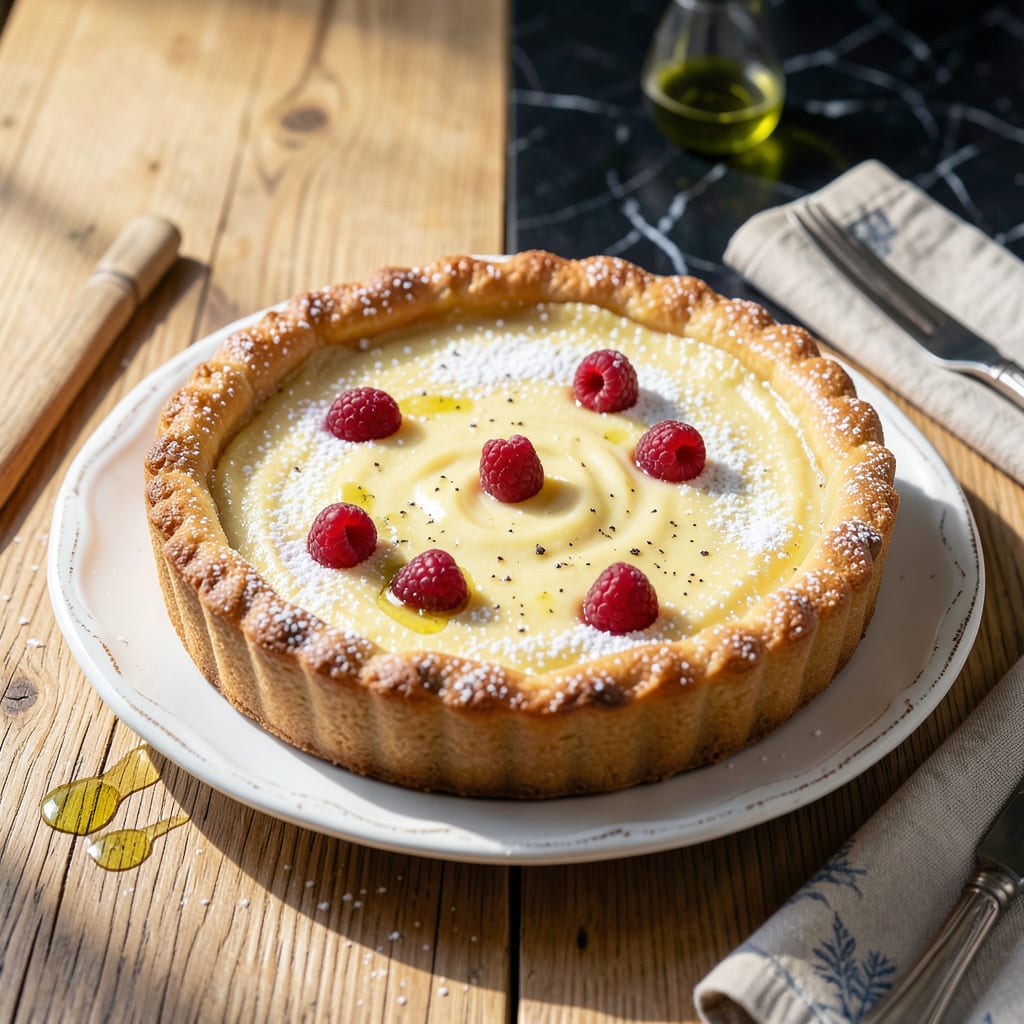
This traditional German custard cake brings bakery-style sweetness to your kitchen with a buttery crust and rich, creamy filling. I’ve refined this recipe to capture the authentic texture and flavor.
The secret lies in the balance between the tender base and the smooth custard topping. This version stays true to the classic method while ensuring foolproof results every time.
Ingredients for German Custard Kuchen
Traditional ingredients create bakery-style sweetness with buttery crust and creamy filling.
| Ingredient | Amount | Notes |
|---|---|---|
| All-Purpose Flour 🌾 | 2 cups | Plus extra for dusting |
| Granulated Sugar 🧂 | ¾ cup | Divided for dough and custard |
| Unsalted Butter 🧈 | ¾ cup | Cold, cubed for crust |
| Large Eggs 🥚 | 3 whole | Divided, 1 for dough, 2 for custard |
| Vanilla Extract 🌿 | 1 tsp | Pure extract preferred |
| Baking Powder 🧂 | 1 ½ tsp | For fluffy base |
| Salt 🧂 | ¼ tsp | Fine grain preferred |
| Whole Milk 🥛 | 1 ½ cups | Full-fat for creaminess |
| Cornstarch 🌾 | 2 tbsp | Thickens custard filling |
| Lemon Zest 🍋 | 1 tsp | Freshly grated for brightness |
| Powdered Sugar 🧂 | 2 tbsp | For dusting finished cake |
[recipe_ingredient_scaler]
The butter must be cold and high-quality—European-style from Whole Foods or Trader Joe’s gives the best flakiness. All-purpose flour works perfectly, but avoid self-rising as it throws off the texture. For the milk, whole milk is non-negotiable—lower fat percentages won’t give you that rich custard. I always use Nielsen-Massey vanilla for that authentic bakery depth.
No whole milk? Half-and-half mixed with a splash of water works in a pinch. Out of cornstarch? All-purpose flour at double the amount can substitute, though the texture won’t be quite as smooth. For the lemon zest, bottled juice won’t cut it—fresh zest adds the bright note that balances the sweetness. The eggs should be room temperature for even mixing.
This keeps beautifully at room temperature for 2 days under a cake dome. For longer storage, refrigerate for up to 5 days. The custard sets fully as it cools, so resist cutting until completely cool. Dust with powdered sugar just before serving for that fresh-baked look.
Why You’ll Love This Recipe
- One Bowl Wonder: I just dump flour, sugar, eggs, and butter in one bowl—no fancy tools, no fuss.
- Vanilla Dream: That real vanilla extract makes the custard taste like a cozy bakery fresh out of the oven.
- Brunch Star: I serve it warm for weekend brunches, but honestly it’s just as good cold the next day.
- Pantry Friendly: All the ingredients are already in my kitchen, so I can bake this on a whim without a store run.
Step-by-Step Instructions for German Custard Kuchen
Traditional technique meets bakery-style results with these carefully tested steps.
Step 1: Prepare the Crust Base
In a food processor, pulse the 2 cups All-Purpose Flour, 0.25 tsp Salt, and 1.5 tsp Baking Powder until combined. Add the 0.75 cup Unsalted Butter (cold and cubed) and pulse until the mixture resembles coarse crumbs.
Transfer to a bowl and add 1 whole Large Egg and 0.25 cup Granulated Sugar (reserving the rest for custard). Mix until the dough just comes together. Press it evenly into a greased 9×13-inch pan, building up a slight edge. Chill for 15 minutes to prevent shrinking.
Step 2: Blind Bake the Crust
Preheat oven to 375°F. Prick the chilled crust all over with a fork to prevent air bubbles. Line with parchment paper and fill with pie weights or dried beans.
Bake for 12-15 minutes until the edges are just beginning to turn light golden brown. Remove the weights and parchment, then bake for an additional 5 minutes until the base is set but not fully browned. Cool slightly while preparing the custard.
Step 3: Create the Custard Filling
In a saucepan, heat the 1.5 cups Whole Milk and 1 tsp Lemon Zest over medium heat until steaming. In a separate bowl, whisk the remaining 0.5 cup Granulated Sugar, 2 tbsp Cornstarch, and 2 whole Large Eggs until smooth.
Slowly temper the egg mixture by whisking in about ½ cup of the hot milk. Return this to the saucepan and cook, stirring constantly, for 3-4 minutes until the custard thickens to a pudding-like consistency. Remove from heat and stir in the 1 tsp Vanilla Extract.
Step 4: Assemble and Finish
Pour the warm custard over the partially baked crust, spreading evenly. Return to the 375°F oven and bake for 18-22 minutes until the custard is set and the top develops a light golden color.
Cool completely to room temperature, then refrigerate for at least 2 hours to allow the custard to fully set. Dust with 2 tbsp Powdered Sugar just before serving. The contrast of creamy custard and buttery crust makes this worth every minute.
Pro Tips For Making German Custard Kuchen
- Pre-warm the eggs: Take your eggs out of the fridge 30 minutes before starting—room temperature eggs blend smoother into the custard and prevent the butter from clumping.
- Cream butter thoroughly: Beat the butter and sugar for a full 3-4 minutes until pale and fluffy. I learned this the hard way—skipping this step leaves the kuchen dense instead of light.
- Avoid overbaking: Pull it from the oven when the center still has a slight wobble, around 35-40 minutes. The custard sets as it cools, and overbaking turns it rubbery.
- Use real vanilla: Splurge on pure vanilla extract instead of imitation—it adds a depth of flavor that cheap versions just can’t match. Sounds small, but it’s the difference between good and great.
Serving Suggestions for This german custard kuchen
Plating Perfection
For a bakery-style finish, dust with 2 tbsp Powdered Sugar through a fine sieve just before serving. I use a snowflake pattern stencil for special occasions—it adds a touch of elegance without much effort. 💫
Fresh Fruit Pairing
Serve with a side of macerated berries—toss 1 cup mixed berries with 1 tbsp Granulated Sugar and let sit for 15 minutes. The tartness cuts through the richness beautifully.
Beverage Complements
Pair with a light, sweet Moscato d’Asti or a strong black coffee. The wine enhances the custard’s vanilla notes, while coffee provides a bold contrast. I always prefer coffee with my afternoon slice. ☕
Temperature Matters
This dessert tastes best served chilled but not ice-cold. Remove from the fridge 10 minutes before serving to let the flavors bloom. The texture is creamy yet firm at this temperature.
Garnish Ideas
A sprinkle of Lemon Zest adds a bright pop of color and citrus aroma. Fresh mint leaves or edible flowers from my foraging trips also make stunning, natural garnishes.
Portion Sizes
Cut into 2-inch squares for perfect bite-sized portions at gatherings. For a more rustic presentation, serve larger 3-inch squares with a dollop of whipped cream.
Nutrition Facts

Trained in classic French technique but raised on slow-cooked ribs and spicy rubs, she blends culinary skill with smoke and soul.
- Recipe for Boneless Pork Chops in Cast Iron Skillet: Sear and Baste to Juicy Perfection - October 3, 2026
- Recipe for Boneless Cross Rib Roast: Slow-Roasted Beef with Herb Crust - October 3, 2026
- Hamburgers in Sauce Recipe Crock Pot: Slow-Cooked Savory Delight - October 3, 2026