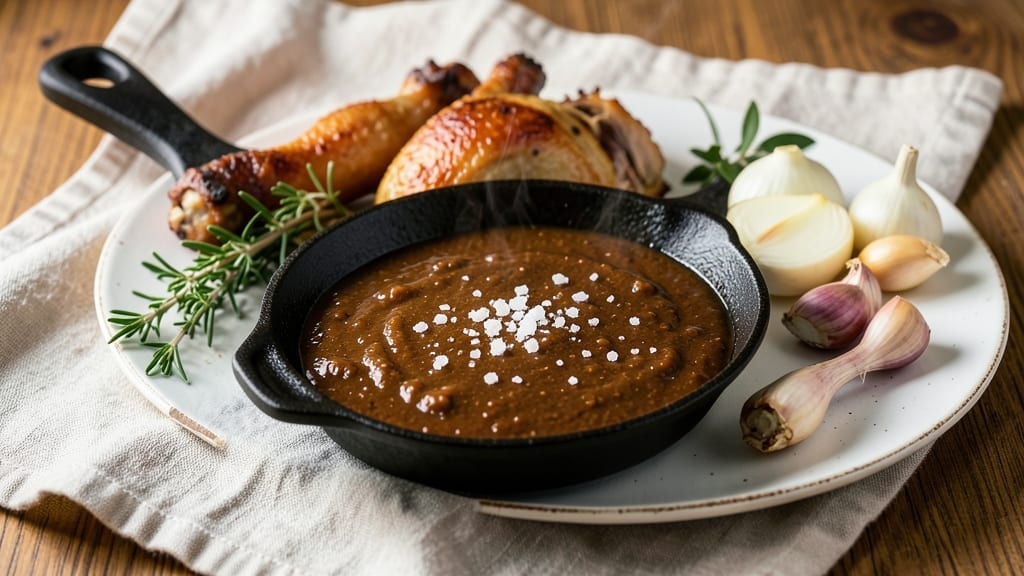
Transforming leftover turkey drippings into gravy recipe for smoked turkey is where the magic happens after a perfect holiday meal.
Standing on a step stool in my grandmother’s kitchen in Sicily, I learned how to coax rich, velvety sauce from what others might discard—this technique elevates every bite with depth and warmth. The key lies in deglazing the pan properly and building layers of flavor through reduction and aromatics.
What sets this gravy apart is its restaurant-quality richness achieved through a simple roux and cornstarch slurry, ensuring a smooth yet thick consistency without lumps. I’ve perfected this method over years of holiday cooking, balancing turkey juices with high-quality broth and a touch of Dijon mustard for complexity.
The result? A sauce so flavorful it turns leftovers into a centerpiece dish.
This gravy isn’t just for Thanksgiving—it’s a versatile foundation for weeknight meals, stuffing drizzles, or even mashed potato topping. With just 30 minutes of hands-on time and pantry staples, you’ll have a sauce that tastes like it simmered all day.
The secret? Patience in straining and reducing, and always tasting as you go—just like Nonna taught me.
Store leftovers in the fridge for up to 5 days or freeze for months, ready to reheat with a splash of broth to restore its silky texture.
Whether you’re serving it over turkey, biscuits, or roasted vegetables, this gravy delivers the kind of comfort that turns any meal into a celebration. Let’s create something memorable together.
Ingredients for gravy recipe for smoked turkey
Simple ingredients transform turkey scraps into restaurant-quality gravy perfection.
| Ingredient | Amount | Notes |
|---|---|---|
| Turkey Drippings 🍗 | 2 cups | From roasted smoked turkey |
| Chicken or Turkey Broth 🍲 | 2 cups | Low-sodium preferred |
| All-Purpose Flour 🌾 | 2 tbsp | For roux consistency |
| Cornstarch 🌾 | 1 tbsp | For slurry thickness |
| Dijon Mustard 🍯 | 1 tbsp | For tangy depth |
| Unsalted Butter 🧈 | 2 tbsp | Cold, cut into pieces |
| Garlic Cloves 🧄 | 2 cloves | Minced, aromatic base |
| Fresh Sage Leaves 🌿 | 4 whole | Tied in cheesecloth |
| Salt 🧂 | ½ tsp | Kosher, to taste |
| Black Pepper 🌶️ | ½ tsp | Freshly ground |
[recipe_ingredient_scaler]
The turkey drippings are your star ingredient—strained through cheesecloth for a silky finish. I always save them in a jar after roasting, but if you’re short, use about 1.5 cups drippings + 0.5 cup broth. For broth, Homestyle or Swanson are my go-tos—they’ve got depth without overpowering. The sage leaves? Tie them in a little cheesecloth—no need to remove them if you like that herbal note. If you’re in a pinch, dried sage works at one-third the amount, but fresh is always better.
No Dijon mustard? A splash of apple cider vinegar adds tang, or use regular yellow mustard at half the amount. The cornstarch slurry is non-negotiable for thickness, but if you’re avoiding gluten, arrowroot powder works 1:1. Butter matters here—cold pieces create better emulsification than melted. Want extra richness? Add 1 tbsp heavy cream at the end. The garlic can be minced roughly—no need to chop finely unless you’re obsessed with texture.
This gravy keeps beautifully for 5 days in the fridge, but honestly, it tastes even better the next day. For freezing, portion into ice cube trays—thaw in the fridge and reheat with a splash of broth. The texture might thicken slightly, but it’ll emulsify right up. I always make extra—it’s the perfect topping for biscuits or roasted veggies later in the week. Just remember: taste as you go—that’s Nonna’s rule, and it’s foolproof.
Why You’ll Love This Recipe
- No Panic, Just Pan: I’ve roasted a turkey only to stare at a mountain of drippings and think, what now? This recipe turns that into gravy in under 20 minutes—no fancy tools, just a skillet and a whisk. The turkey drippings do all the heavy lifting, so you’re basically just thickening and seasoning what’s already there.
- Sage-Worthy Depth: That little bundle of sage in cheesecloth? Game-changer. It infuses the gravy with that earthy, aromatic magic that makes smoked turkey taste like it was meant for a feast. Pair it with the Dijon mustard’s tang and garlic’s punch, and you’ve got a sauce that’s rich but never heavy—more like a hug for your plate.
- Budget’s Your Bottom Line: You already have turkey drippings—this recipe just needs flour, broth, and a few pantry staples. No expensive ingredients, no shortcuts that taste like they cost extra. It’s the kind of gravy that makes you feel like a pro without breaking the bank, and honestly, that’s the kind of win I live for.
Step-by-step instructions for gravy recipe for smoked turkey
Here’s how to transform your turkey drippings into velvety, aromatic gravy everyone will beg for.
Make the Roux with Turkey Drippings and Flour
Pour the 2 cups turkey drippings into a large skillet set over medium heat. Let it come to a gentle simmer, then gradually whisk in the 2 tablespoons all-purpose flour. Here’s the thing—you want to cook this mixture slowly until it turns a rich, nutty golden brown color. This takes about 5-7 minutes of constant stirring.
If the roux gets too dark, you’ll end up with a bitter flavor. Watch it closely and lower the heat if it starts to brown too quickly. The goal is a smooth, thick paste that coats the back of a spoon. This forms the flavor foundation for your gravy, so don’t rush it.
Build Flavor with Broth, Mustard, and Aromatics
Once your roux reaches that perfect golden color, slowly pour in the 2 cups chicken or turkey broth while whisking constantly. This prevents lumps from forming and helps create a silky texture. Stir in the 1 tablespoon Dijon mustard, 2 minced garlic cloves, and the 4 fresh sage leaves tied in cheesecloth.
Bring the mixture to a gentle boil, then reduce heat to low and let it simmer for 10-12 minutes. You’ll notice the sauce thickening as it cooks. This is where all the flavors meld together—don’t skip this step. The mustard adds tang, the garlic brings depth, and the sage infuses that classic holiday aroma.
Finish with Butter and Seasoning
Remove the cheesecloth with the sage leaves and stir in the 2 tablespoons cold unsalted butter, cut into small pieces. The butter should melt into the sauce, creating a beautiful sheen and adding richness. Season with ½ teaspoon salt and ½ teaspoon black pepper, then taste and adjust if needed.
For extra thickness, mix the 1 tablespoon cornstarch with 2 tablespoons cold water to make a slurry. Slowly whisk this into the gravy while it simmers. The sauce should coat the back of a spoon but still be pourable. If it’s too thick, thin it with a splash of hot broth.
Strain and Serve Warm
Strain the gravy through a fine-mesh sieve into a clean saucepan to remove any impurities. Return it to low heat and keep it warm until serving. The gravy should be smooth, glossy, and have that perfect balance of savory, tangy, and aromatic flavors.
Ladle the gravy over your smoked turkey and watch it disappear. The secret to great gravy is patience—rushing the process leads to lumps or thin sauce. This method guarantees a rich, flavorful gravy that will elevate every bite of your holiday meal.
Pro Tips For Making Gravy Recipe For Smoked Turkey
- Whisk Like You Mean It: DESCRIPTION: The second your broth hits the roux, grab that whisk and move it like you’re stirring a pot of gold—slow, steady, and constant. I used to think a quick stir here and there would do, but lumps are the enemy, and they’ll turn your silky gravy into a sad, grainy mess. (Yes, even if you’re impatient like me.)
- Cold Butter Wins: DESCRIPTION: Cut those 2 tablespoons of unsalted butter into tiny cubes and let them stay cold when you add them—this isn’t the time to melt them in your hands. The butter should slide in like ice cubes, then slowly bloom into that glossy sheen as it melts. I learned this the hard way after adding warm butter and ending up with a greasy, separated sauce.
- Sage Bag Hack: DESCRIPTION: Tying those 4 fresh sage leaves in cheesecloth isn’t just for looks—it keeps the leaves from tearing into bits and turning your gravy into a leafy soup. If you’re lazy and skip the cheesecloth, at least strain the gravy twice afterward. (Your future self will thank you.)
- Slurry Last, Not First: DESCRIPTION: Save that cornstarch slurry for the very end—whisk it in after the gravy has already thickened from simmering. Adding it too early can make the sauce gluey or clump up. A few slow drizzles while the pot’s on low heat is all it takes to get that perfect coat-the-back-of-a-spoon consistency.
Flavor customization for this recipe
Herbal Depth Boost
For extra aromatic complexity, I like to add 1 sprig of fresh thyme alongside the sage leaves. Tie them together in the cheesecloth for a subtle herbal note that pairs beautifully with smoked turkey’s natural smokiness.
If you’re feeling adventurous, ½ tsp ground cinnamon adds warmth—just whisk it in during the simmering step. Nonna always swore by a pinch of nutmeg for that festive touch, but use sparingly. 🌿
Smoky Infusion
Want to amplify the smoky flavor? Add 1 tsp smoked paprika to the roux while cooking, or steep ½ tsp liquid smoke in the broth before adding it to the pan. Both methods deepen the smoky essence without overpowering.
I’ve also experimented with 1 tsp liquid hickory or applewood smoke—just a splash in the final minutes of simmering. The key is balance; too much smoke can turn the gravy bitter.
Umami Enhancement
For a richer, more savory gravy, stir in 1 tbsp soy sauce or 1 tsp fish sauce during the simmering step. These add depth without altering the flavor profile dramatically.
I’ve also tried adding 1 tbsp miso paste (dissolved in a splash of warm water) for an umami kick that’s especially nice with smoked turkey. The miso works best if you simmer it in for 5-7 minutes to avoid a grainy texture. 💫
Sweet Heat Balance
If you love a touch of sweetness to cut through the richness, add 1 tsp honey or ½ tsp maple syrup at the end, right before straining.
For heat lovers, I recommend ½ tsp hot sauce or ¼ tsp cayenne pepper—just whisk it in during the final minutes of simmering. A splash of apple cider vinegar (about 1 tbsp) also brightens the flavor and balances the richness beautifully.
The vinegar should be added after the cornstarch slurry but before straining.
Creamy Luxe Variation
For a decadent twist, stir in ¼ cup heavy cream or ½ cup crème fraîche at the very end, after removing the cheesecloth. This creates a silky, luxurious texture that’s perfect for drizzling over mashed potatoes or biscuits.
I’ve also experimented with adding 1 oz cream cheese (softened) for extra richness, but be sure to whisk it in gently to avoid curdling. The cream should be added off the heat to prevent scrambling. 🧈
Nutrition facts
Frequently asked questions
Why does my gravy turn out lumpy?
Lumps happen when flour isn’t whisked smoothly into the drippings or broth is added too quickly. Always cook the roux until golden brown and whisk constantly when adding broth. For extra smoothness, strain the gravy through a fine-mesh sieve after simmering. This removes any bits that could make it grainy.
Can I make this gravy ahead of time?
This gravy tastes even better the next day. Store it in an airtight container in the fridge for up to 5 days. When reheating, warm it gently on low heat and stir in a splash of broth if it thickens too much. The flavors deepen overnight, making it perfect for holiday leftovers.
What if I don’t have fresh sage?
Dried sage works in a pinch—just use one-third the amount (about 1 teaspoon) and add it during the simmering step. For extra depth without sage, try ½ teaspoon dried thyme tied in cheesecloth. The key is to keep the herb infusion intact for that aromatic kick.
How do I fix gravy that’s too thin?
Thin gravy can be saved with the cornstarch slurry (mix 1 tablespoon cornstarch with 2 tablespoons cold water) and whisk it into the simmering gravy. Alternatively, simmer uncovered for 5-7 minutes to reduce naturally. Avoid adding flour directly—it can create clumps.
Can I use turkey drippings from other poultry?
Yes! Chicken drippings work perfectly in this recipe, though the flavor will be slightly lighter. For smoked turkey gravy, I recommend using at least 75% turkey drippings mixed with chicken drippings if needed. The smoky notes will still shine through, especially with the Dijon mustard and sage infusion.

Trained in classic French technique but raised on slow-cooked ribs and spicy rubs, she blends culinary skill with smoke and soul.
- Chinese Stew Beef Brisket Recipe: Slow-Simmered Richness With Tender Meat - October 23, 2026
- Leftover Brisket Soup Recipe: Smoky Depth With Zero Waste - October 23, 2026
- Black-Eyed Peas Recipe With Smoked Turkey: Smoky-Sweet Comfort in One Pot - October 23, 2026