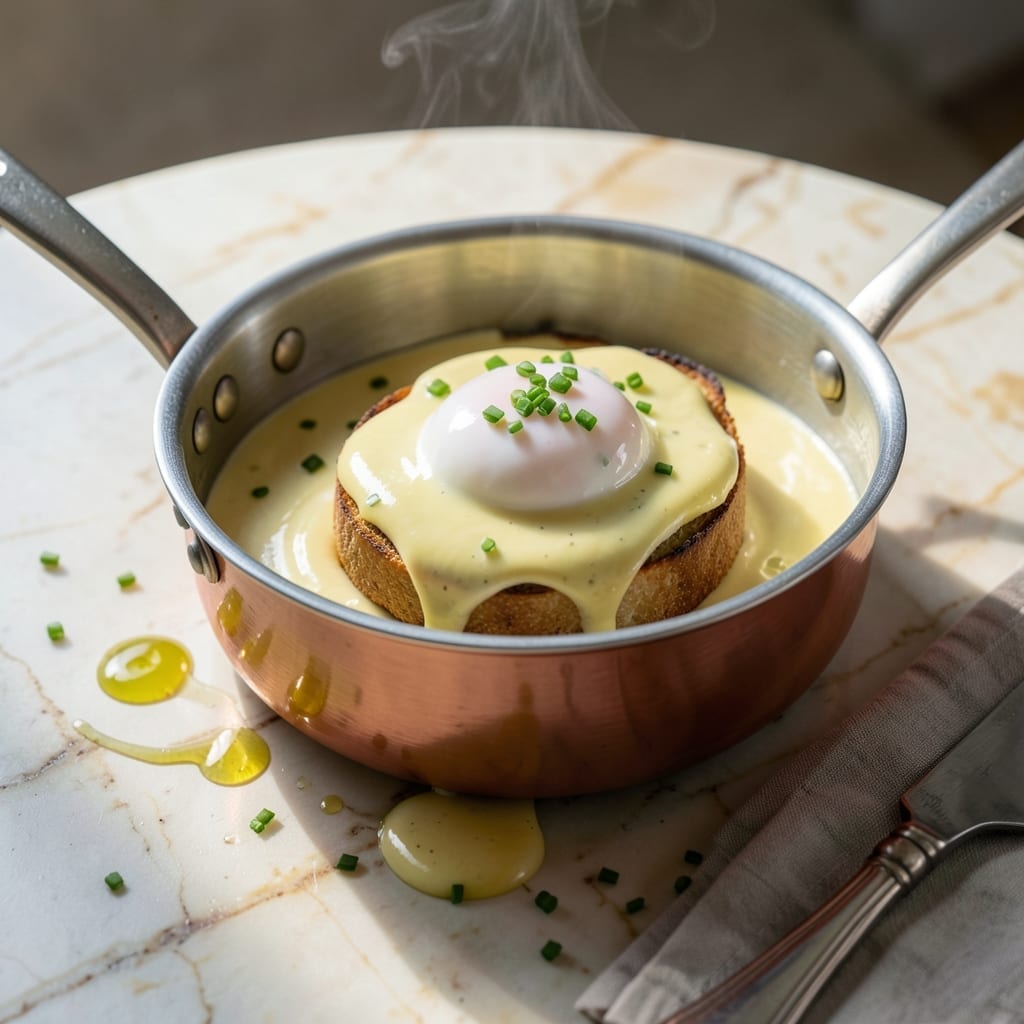
Mastering hollandaise sauce transforms eggs Benedict and asparagus into restaurant-quality dishes. This classic French sauce delivers a rich, velvety texture with bright lemon notes.
Using a precise whisking technique creates a stable emulsion that won’t break. The secret lies in temperature control and gradual butter incorporation for silky results.
Ingredients for Hollandaise Sauce Recipe Gordon Ramsay
Eight ingredients create this velvety French sauce with bright citrus and rich depth.
| Ingredient | Amount | Notes |
|---|---|---|
| Unsalted Butter 🧈 | 1 cup | Cut into small cubes, room temperature |
| Large Egg Yolks 🥚 | 3 whole | Fresh, room temperature |
| Lemon Juice 🍋 | 2 tbsp | Freshly squeezed, strained |
| Lemon Zest 🍋 | 1 tsp | Finely grated from organic lemon |
| White Wine Vinegar 💧 | 1 tbsp | Or substitute white vinegar |
| Kosher Salt 🧂 | ¼ tsp | Diamond Crystal preferred |
| Cayenne Pepper 🌶️ | 0.125 tsp | Pinch, adjust for heat preference |
| White Pepper 🌶️ | 0.125 tsp | Freshly ground for subtle heat |
[recipe_ingredient_scaler]
The butter quality is non-negotiable here. European-style unsalted butter (like Plugrá or Kerrygold) delivers superior flavor and higher fat content for a stable emulsion. Room temperature is critical—cold butter won’t incorporate properly. Egg yolks must be ultra-fresh; the fresher they are, the more vibrant your hollandaise will be. Whole Foods or local farmers markets often carry the best quality.
No white wine vinegar? Tarragon vinegar adds complexity, while plain white vinegar works in a pinch. For a brighter profile, increase lemon juice to 3 tbsp and omit vinegar entirely. The cayenne and white pepper are subtle but essential—skip the black pepper (its specks ruin the sauce’s silky appearance). If using salted butter, reduce kosher salt to a pinch to avoid over-salting.
Hollandaise waits for no one. Serve immediately or keep warm in a thermos or over a pot of warm water (not simmering) for up to 1 hour. Never microwave to reheat—it will break. Refrigerate leftovers (rare, but possible) for 2 days max, then gently rewarm with a splash of water.
Why You’ll Love This Recipe
- I’ll be real: leftovers taste just as luscious the next day, and it’s cheaper than store-bought versions with weird preservatives.
- One Bowl Wonder: I can make this in a single heatproof bowl over simmering water—no fancy equipment, just a whisk and patience.
- Bright & Buttery: The mix of lemon zest and white wine vinegar cuts through the rich egg yolks and butter in the most addictive way.
- Brunch MVP: Honestly, it turns eggs Benedict from good to restaurant-worthy, but I also drizzle it on asparagus or fish.
Step-by-Step Instructions for Hollandaise Sauce
Master the classic French emulsion technique for a velvety, restaurant-quality result every time.
Step 1: Reduce the Vinegar and Prepare the Base
In a small saucepan, combine the 1 tbsp White Wine Vinegar, 2 tbsp Lemon Juice, and 1 tsp Lemon Zest. Simmer over medium heat until the mixture reduces by half, about 3-4 minutes. This concentrates the acidity and brightens the flavor profile.
Pour the reduction into a heatproof bowl and let it cool slightly. The warmth should be just above body temperature—110-115°F—to properly emulsion with the egg yolks without scrambling them.
Step 2: Whisk the Yolks to Ribbon Stage
Add the 3 whole Large Egg Yolks to the vinegar reduction. Using a wire whisk, beat vigorously until the mixture thickens and turns a pale, creamy yellow. This ribbon stage, where the whisk leaves visible trails, indicates the yolks are properly aerated and ready to accept the butter.
I maintain constant motion here—this builds the foundation for a stable emulsion. The texture should resemble a light custard before introducing the fat.
Step 3: Create the Emulsion with Melted Butter
Melt the 1 cup Unsalted Butter in a separate saucepan over low heat until it reaches 180-190°F. The butter should be hot but not boiling, with the milk solids settled at the bottom. Skim off any foam from the surface.
With the yolk mixture over a bain-marie or double boiler (ensure the bowl doesn’t touch the water), slowly drizzle in the melted butter in a thin, steady stream while whisking constantly. This gradual incorporation is critical—the fat must be absorbed drop by drop to prevent the sauce from breaking.
Step 4: Season and Adjust Consistency
Once all the butter is incorporated, remove the bowl from the heat. Add the 0.25 tsp Kosher Salt, 0.125 tsp Cayenne Pepper, and 0.125 tsp White Pepper. These seasonings should enhance, not overpower, the delicate lemon and butter flavors.
If the sauce is too thick, whisk in a teaspoon of warm water to loosen it to the desired consistency. The finished hollandaise should coat the back of a spoon and have a glossy, satin-like sheen. Taste and adjust salt if needed—the acidity should be bright but balanced.
Step 5: Hold and Serve Immediately
Keep the sauce warm in a thermos or over a bain-marie at 140-150°F until ready to serve. Hollandaise will thicken as it cools, so maintain gentle heat without exceeding 160°F to prevent separation.
Serve immediately over eggs Benedict, asparagus, or grilled fish. The sauce should have a smooth, velvety texture with a bright lemon finish. If it begins to separate, whisk in a teaspoon of hot water to re-emulsify before serving.
Pro Tips For Making Hollandaise Sauce Recipe Gordon Ramsay
- Keep It Warm, Not Hot: Use a double boiler and make sure the water is just simmering—any hotter and you’ll scramble the yolks. I learned this the hard way after ruining two batches with water that was too aggressive.
- Clarify Your Butter: Melt the unsalted butter slowly, then skim off the milk solids. Sounds tedious, but it’s the only way to get that silky, restaurant-quality texture.
- Skip the Cold Eggs: Take your egg yolks out of the fridge 30 minutes before starting. Cold yolks resist emulsifying, and you’ll spend twice as long whisking for half the results.
- Add Vinegar Last: Stir in the white wine vinegar at the very end to balance the richness. Adding it too early can make the sauce break—ask me how I know.
Essential Equipment for Perfect Results
Must-Have Tools 🔪
To nail Gordon Ramsay’s hollandaise, start with a heatproof bowl for the double boiler setup—stainless steel or glass works best. A whisk is non-negotiable for that silky emulsion, and a small saucepan ensures precise temperature control.
Don’t skip a fine-mesh strainer to remove any lumps, and keep a thermometer handy to monitor the butter’s temperature (aim for 160–180°F).
Nice-to-Have Upgrades 🌡️
For effortless whisking, a stand mixer or immersion blender can save your arm. A double boiler insert (like All-Clad’s) simplifies the process, and a zester adds fresh lemon brightness with ease.
Prefer precision? A kitchen scale ensures accurate butter and egg ratios every time.
Budget Alternatives ✨
No double boiler? Use a heatproof glass bowl over a pot of simmering water. Swap a whisk for a fork in a pinch, though it’ll take more elbow grease. Skip the thermometer? Test butter temperature by dipping a spoon—it should feel warm, not hot.
For straining, a slotted spoon can work if you’re careful. Hollandaise is forgiving with creativity!
Nutrition Facts

Trained in classic French technique but raised on slow-cooked ribs and spicy rubs, she blends culinary skill with smoke and soul.
- Recipe for Boneless Pork Chops in Cast Iron Skillet: Sear and Baste to Juicy Perfection - October 3, 2026
- Recipe for Boneless Cross Rib Roast: Slow-Roasted Beef with Herb Crust - October 3, 2026
- Hamburgers in Sauce Recipe Crock Pot: Slow-Cooked Savory Delight - October 3, 2026