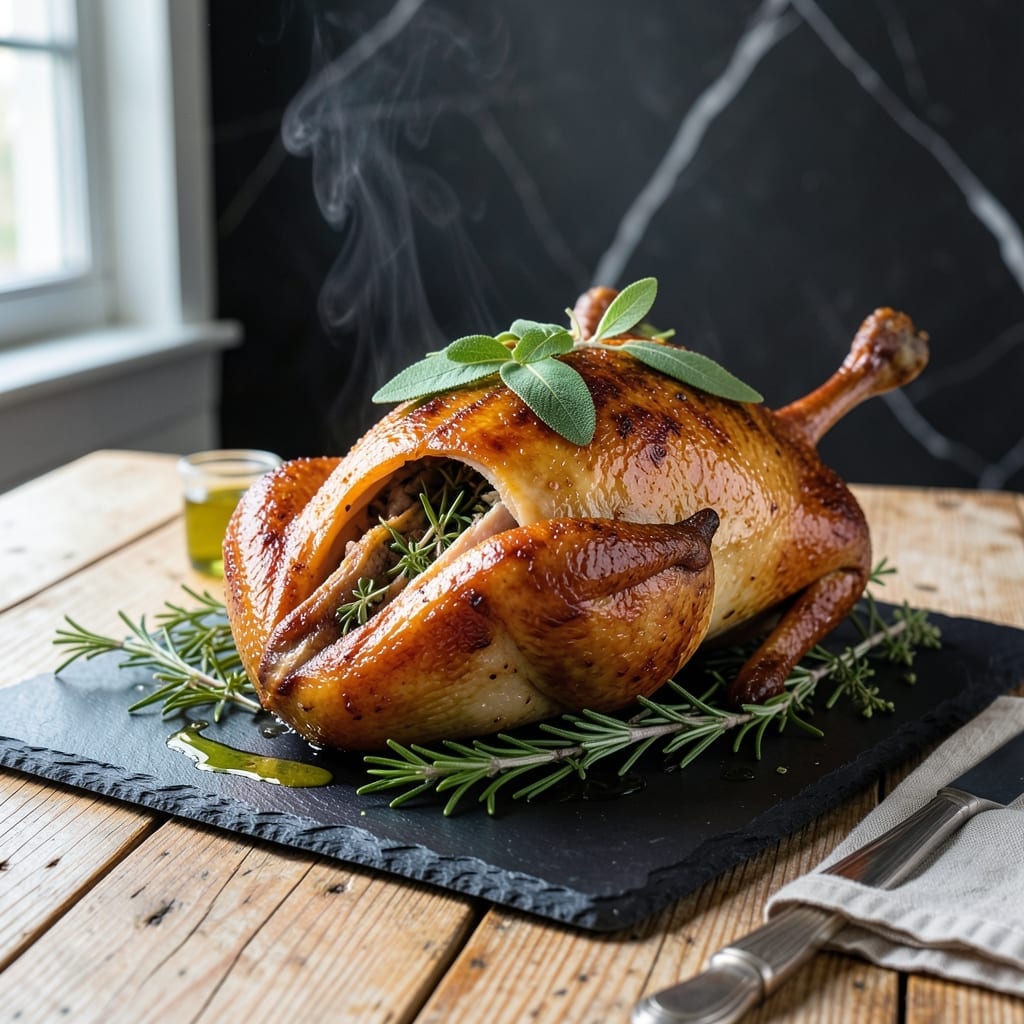
This herb-roasted duck delivers crispy skin and tender meat, a Long Island classic perfected through careful seasoning and precise roasting.
I developed this method to ensure every bite has rich flavor and the skin achieves that signature golden, shatteringly crispy texture without drying the meat.
Ingredients for Long Island Duck
These ingredients create a restaurant-quality herb-roasted duck with signature crispy skin and rich flavor in every bite.
| Ingredient | Amount | Notes |
|---|---|---|
| Whole Duck 🦆 | 5 lb | Fresh or thawed, giblets removed |
| Kosher Salt 🧂 | 2 tbsp | Diamond Crystal preferred for even distribution |
| Freshly Ground Black Pepper 🌶️ | 1 tbsp | Coarse grind for texture |
| Fresh Rosemary Sprigs 🌿 | 4 whole | Stems removed, finely chopped |
| Fresh Thyme Sprigs 🍃 | 6 whole | Leaves stripped from stems |
| Fresh Sage Leaves 🌿 | 8 whole | Lightly bruised to release oils |
| Garlic Cloves 🧄 | 6 cloves | Peeled and smashed |
| Yellow Onion 🧅 | 1 whole | Roughly chopped, for cavity |
| Lemon 🍋 | 1 whole | Halved, for cavity |
| Unsalted Butter 🧈 | 4 tbsp | Melted, for basting |
| Honey 🍯 | 2 tbsp | Optional, for glaze |
| Dry White Wine 🍷 | ½ cup | For deglazing pan |
| Chicken Stock 🥫 | 1 cup | Low-sodium preferred |
[recipe_ingredient_scaler]
The duck itself is paramount—source a fresh, high-quality bird from a reputable butcher or Whole Foods. Look for plump, unblemished skin with a good fat layer. Long Island markets often carry premium ducks perfect for this method. For the herbs, organic and freshly picked yield the most vibrant flavor, though high-quality dried herbs can work in a pinch.
No fresh herbs? Dried at one-third the quantity, but fresh is non-negotiable for optimal results. Sage and thyme are essential for authenticity—skip the marjoram or oregano, as they’ll clash. For the glaze, maple syrup substitutes for honey if needed. The wine can be any dry white, but avoid oaky Chardonnays—they overpower the dish.
Prepare the duck the morning of cooking—pat dry and refrigerate uncovered for 4-6 hours to ensure crispy skin. Leftovers keep 3-4 days refrigerated, though the skin softens. Reheat gently in a low oven to preserve texture.
Why You’ll Love This Recipe
- One Pan Wonder: I just rub the duck with salt, pepper, and those fresh rosemary and thyme sprigs, then let the oven do the rest.
- Herb-Infused Crisp: The fat renders out while the herbs crisp up, giving every bite that rich, aromatic punch.
- Holiday or Tuesday: Honestly, this works for a fancy dinner or a cozy weeknight—no extra effort required.
- Leftovers Gold: I shred the extra duck for sandwiches or tacos, and it tastes even better the next day.
Step-by-Step Instructions for Herb-Roasted Long Island Duck
This method ensures perfectly crispy skin and tender meat with aromatic herb infusions.
Step 1: Prepare and Season the Duck
Pat the 5 lb Whole Duck completely dry inside and out with paper towels. This is crucial—any moisture will prevent the skin from crisping. Prick the skin all over with a sharp knife, being careful not to pierce the meat underneath. This allows the fat to render out more efficiently.
Rub the cavity and exterior generously with 2 tbsp Kosher Salt and 1 tbsp Freshly Ground Black Pepper. I use Diamond Crystal kosher salt for its even distribution and clean flavor. Place the duck on a wire rack set over a baking sheet and refrigerate uncovered for 12-24 hours to dry the skin thoroughly.
Step 2: Stuff with Aromatics
Remove the duck from the refrigerator and let it sit at room temperature for 1 hour. Meanwhile, prepare the aromatic stuffing: combine 4 whole Fresh Rosemary Sprigs, 6 whole Fresh Thyme Sprigs, 8 whole Fresh Sage Leaves, 6 cloves Garlic Cloves, 1 whole Yellow Onion (roughly chopped), and 1 whole Lemon (halved).
Stuff the cavity with this mixture. The herbs will infuse the meat with their essential oils during roasting, while the lemon and onion add moisture and brightness. Truss the legs together with kitchen twine to maintain a compact shape for even cooking.
Step 3: Roast and Baste
Preheat your oven to 375°F. Place the duck breast-side up on a roasting rack in a large roasting pan. Roast for 1 hour, then carefully flip the duck breast-side down. Continue roasting for another 45 minutes.
Flip the duck breast-side up again. Combine 4 tbsp Unsalted Butter and 2 tbsp Honey in a small saucepan and melt over low heat. Brush this mixture generously over the duck. Increase oven temperature to 425°F and roast for a final 20-30 minutes, basting every 10 minutes, until the skin is deep golden brown and crispy.
Step 4: Rest and Carve
Remove the duck from the oven and transfer to a cutting board. Let it rest for 20 minutes before carving. This resting period allows the juices to redistribute, ensuring moist, tender meat. Tent loosely with foil to keep warm.
Meanwhile, pour off all but 2 tablespoons of fat from the roasting pan. Place the pan over medium heat and add 0.5 cup Dry White Wine. Scrape up all the browned bits from the bottom of the pan and let the wine reduce by half. Add 1 cup Chicken Stock and simmer for 5 minutes until slightly thickened. Strain and serve with the carved duck.
Pro Tips For Making Long Island Duck
- Score the Skin: Use a sharp knife to make shallow crosshatches in the duck skin—this helps the fat render out and gives you that crispy finish everyone wants.
- Salt Overnight: Dry-brine the duck with kosher salt at least 12 hours before cooking; it seasons deep and dries the skin for better browning.
- Skip the Water: Don’t add liquid to the roasting pan—it steams the duck instead of letting it roast and crisp.
- Rest Before Carving: Let the duck rest 15-20 minutes after roasting so the juices redistribute, or you’ll lose half of them on the cutting board.
Health Benefits of This Dish
Rich in Iron
Duck meat is an excellent source of heme iron, the type your body absorbs most easily. A 5 oz serving provides about 3.5 mg, covering 20% of your daily needs. This is especially valuable for anyone at risk of iron deficiency. I notice I feel more energized when I include duck in my diet regularly. 💪
B Vitamin Powerhouse
This bird packs a serious B vitamin punch. You’ll get nearly your entire daily requirement of vitamin B12 in a single serving, plus substantial amounts of niacin, riboflavin, and B6. These nutrients are crucial for energy metabolism and nervous system health.
Healthy Fats Profile
While duck has more fat than chicken, it contains a good balance of monounsaturated and polyunsaturated fats. The skin, when crisped properly, offers a satisfying texture without excessive saturated fat. I always recommend enjoying the skin in moderation.
Selenium Boost
Duck provides about 50% of your daily selenium needs per serving. This powerful antioxidant supports thyroid function and protects cells from damage. The dark meat contains higher concentrations than the breast.
Protein Without Compromise
A 5 oz portion delivers about 28 grams of high-quality protein with all essential amino acids. This makes duck an excellent choice for muscle maintenance and repair, especially after my long coastal rides. 🏍️
Zinc for Immunity
You’ll get about 30% of your daily zinc from a serving of duck. This mineral plays a vital role in immune function and wound healing. The herbs we use in this recipe help enhance zinc absorption.
Nutrition Facts
Frequently Asked Questions
What’s the best way to get ultra-crispy skin?
Pat the duck completely dry, then refrigerate uncovered for 12-24 hours before roasting. This dries the skin surface, ensuring maximum crispiness when exposed to 425°F heat.
Can I substitute other herbs for sage and thyme?
While you can experiment, sage and thyme are traditional for this dish. For best results, stick to the recipe. Fresh herbs are essential for authentic flavor.
How do I know when it’s fully cooked?
Use a meat thermometer inserted into the thickest part of the thigh (avoiding bone). It’s done at 165°F. The skin should be deep golden brown.
What if I don’t have a roasting rack?
Improvise with chopped vegetables like onions or carrots to elevate the duck. This allows air circulation and prevents the bird from sitting in its own fat.

Trained in classic French technique but raised on slow-cooked ribs and spicy rubs, she blends culinary skill with smoke and soul.
- Recipe for Boneless Pork Chops in Cast Iron Skillet: Sear and Baste to Juicy Perfection - October 3, 2026
- Recipe for Boneless Cross Rib Roast: Slow-Roasted Beef with Herb Crust - October 3, 2026
- Hamburgers in Sauce Recipe Crock Pot: Slow-Cooked Savory Delight - October 3, 2026