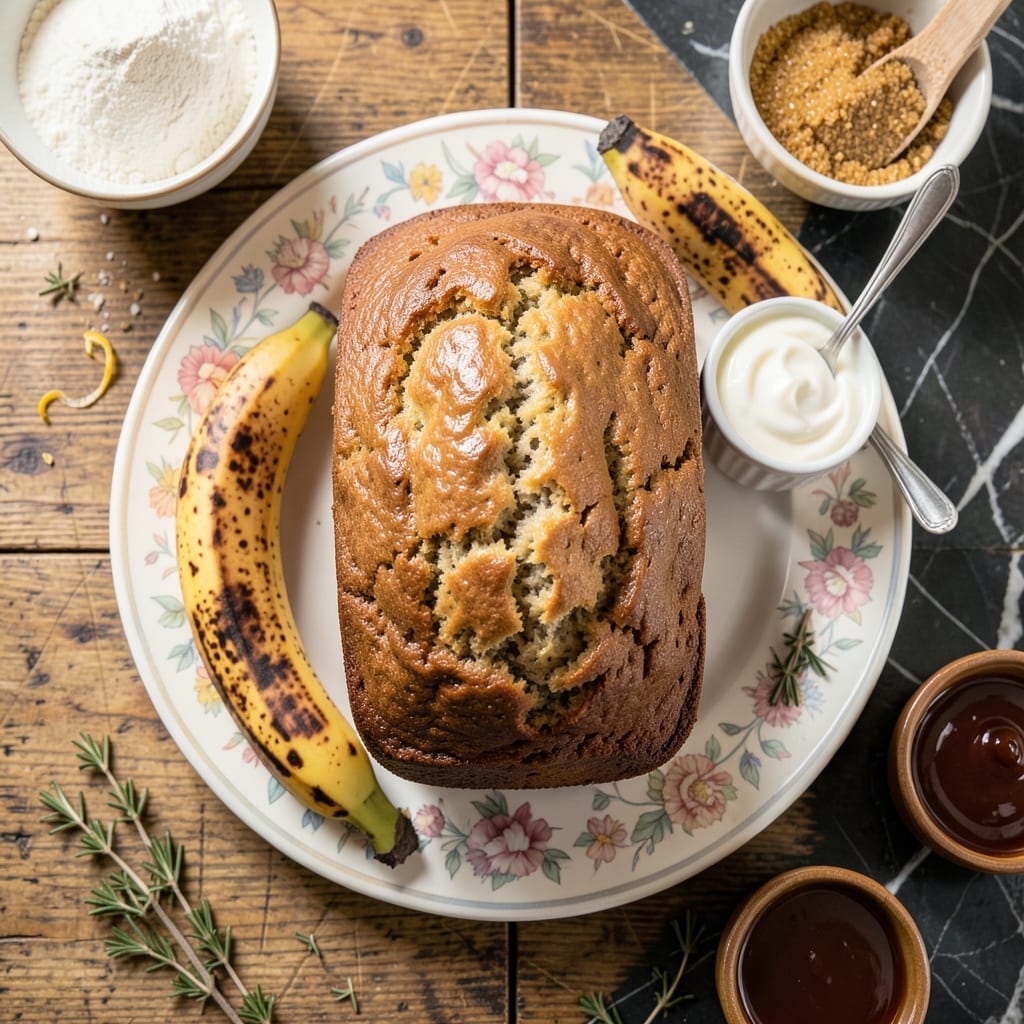
This banana bread delivers all the classic flavor and moist texture without the guilt, thanks to a simple yet effective substitution. Greek yogurt replaces traditional fats while adding a protein boost that enhances both nutrition and structure.
The secret lies in the balance—overripe bananas provide natural sweetness, while the yogurt keeps the crumb tender. A touch of vanilla and cinnamon adds warmth without extra calories, making every slice satisfying and wholesome.
Baked to golden perfection, this loaf stays moist for days and offers a healthier way to enjoy a beloved treat. The result is a bread that’s as nourishing as it is delicious, perfect for breakfast or an afternoon snack.
With straightforward steps and familiar ingredients, this recipe proves that lighter baking can still be incredibly rewarding. Here’s how to make it.
Ingredients for Low Fat Banana Bread Recipe with Greek Yogurt
Familiar pantry staples plus a protein-packed twist create this nourishing loaf with classic appeal.
| Ingredient | Amount | Notes |
|---|---|---|
| Overripe Bananas 🍌 | 3 whole | Mashed, very ripe with brown spots |
| Plain Greek Yogurt 🥛 | 1 cup | Non-fat or low-fat, unsweetened |
| All-Purpose Flour 🌾 | 1 ¾ cups | Sifted for even texture |
| Granulated Sugar 🍚 | ½ cup | Can reduce to 1/3 cup |
| Brown Sugar 🟤 | ¼ cup | Packed, for moisture |
| Large Eggs 🥚 | 2 whole | Room temperature for even mixing |
| Vanilla Extract 🫒 | 1 tsp | Pure extract for best flavor |
| Ground Cinnamon 🌿 | 1 tsp | Freshly ground preferred |
| Baking Soda 🧂 | 1 tsp | Ensures proper rise |
| Salt 🧂 | ½ tsp | Fine sea salt or table salt |
| Vegetable Oil 🫒 | ¼ cup | Or melted coconut oil |
| Chopped Walnuts 🌰 | ½ cup | Optional, for crunch and texture |
[recipe_ingredient_scaler]
The Greek yogurt is non-negotiable here—Fage Total 0% or Chobani Plain Non-Fat deliver the best texture without added fat. Overripe bananas (the spottier, the better) contribute natural sweetness and moisture, so resist the urge to use fresh ones. King Arthur Flour is my go-to for all-purpose, but any reliable brand works. The sugar can be reduced slightly if your bananas are exceptionally sweet (test one first).
No Greek yogurt? Sour cream or applesauce can substitute, though texture will differ slightly. For a nut-free version, swap walnuts for dried cranberries or chocolate chips. The oil can be replaced with unsweetened applesauce at a 1:1 ratio, but the crumb will be denser. Cinnamon is key for warmth, but pumpkin pie spice adds a nice variation (use the same amount).
Baked loaves stay fresh at room temperature for 2 days or up to 1 week refrigerated. For longer storage, wrap tightly and freeze for 3 months. Slice before freezing for easy single servings (trust me on this).
Why You’ll Love This Recipe
- One Bowl Wonder: I just dump everything in, mix, and pour—no fancy steps, and the Greek yogurt keeps it light.
- Sweet Comfort: That caramelized brown sugar crust with the soft, banana-packed middle? I’ve made it three times this week.
- Breakfast to Dessert: Honestly, it’s my grab-and-go breakfast, but also passes for dessert when warmed with a scoop of vanilla ice cream.
- No Waste Win: Between us, I always have overripe bananas sitting on the counter—this recipe saves them every time.
Step-by-Step Instructions for Low Fat Banana Bread With Greek Yogurt
This method ensures a perfectly moist loaf with ideal texture and rise every time.
Step 1: Prepare Wet Ingredients and Mash Bananas
In a large mixing bowl, mash the 3 whole overripe bananas until smooth with only small lumps remaining. The bananas should be very ripe with brown spots for natural sweetness and easy mashing. Add the 1 cup plain Greek yogurt, 0.5 cup granulated sugar, 0.25 cup brown sugar, 2 whole large eggs, 1 tsp vanilla extract, and 0.25 cup vegetable oil.
Whisk vigorously for 1-2 minutes until the mixture is completely smooth and emulsified. The yogurt adds moisture and protein while keeping the fat content low, and the sugars should fully dissolve into the wet base. This creates the foundation for a tender, evenly textured loaf.
Step 2: Combine Dry Ingredients and Fold into Wet Mixture
In a separate bowl, sift together the 1.75 cups all-purpose flour, 1 tsp ground cinnamon, 1 tsp baking soda, and 0.5 tsp salt. Sifting prevents lumps and ensures even distribution of leavening agents for consistent rise.
Gradually add the dry ingredients to the wet mixture, folding gently with a silicone spatula just until the flour disappears. Avoid overmixing—a few streaks of flour are acceptable at this stage. Overworking the batter develops gluten, which would make the bread dense rather than light and tender.
Step 3: Incorporate Nuts and Prepare for Baking
Fold the 0.5 cup chopped walnuts into the batter, distributing them evenly throughout. The walnuts add crunch and healthy fats, balancing the bread’s moisture. If the batter seems too thick, let it rest for 5 minutes to allow the flour to hydrate fully.
Pour the batter into a greased 9×5-inch loaf pan, smoothing the top with the spatula. The pan should be filled about two-thirds full to allow room for rising. Tap the pan gently on the counter 2-3 times to remove any large air pockets for an even texture.
Step 4: Bake to Golden Perfection
Preheat the oven to 350°F and bake the loaf on the center rack for 50-60 minutes. Rotate the pan 180 degrees halfway through baking to ensure even browning. The bread is done when a toothpick inserted into the center comes out clean or with a few moist crumbs attached.
The top should be deep golden brown and the loaf should pull slightly away from the sides of the pan. The internal temperature should read 200-205°F on an instant-read thermometer for guaranteed doneness.
Step 5: Cool and Slice for Optimal Texture
Remove the pan from the oven and let the bread cool in the pan for 10 minutes. This brief rest allows the structure to set without becoming gummy. Then, transfer the loaf to a wire rack to cool completely, which takes about 1 hour.
Slicing too soon will result in a crumbly texture, as the bread needs time for the starches to fully set. Once cooled, the loaf should be uniformly moist with a tender crumb. Store leftovers wrapped tightly at room temperature for up to 3 days or refrigerated for up to 1 week.
Pro Tips For Making Low Fat Banana Bread Recipe With Greek Yogurt
- Mash Bananas Thoroughly: Use a fork to mash the overripe bananas until they’re nearly liquid—lumpy bits make for uneven texture in the finished bread.
- Use Full-Fat Yogurt: I learned this the hard way: low-fat Greek yogurt can dry out the bread, so stick with full-fat for moisture without extra oil.
- Test for Doneness: A toothpick in the center should come out with a few moist crumbs, not wet batter—overbaking dries out low-fat versions fast.
- Swap Half the Flour: Replace 50% of the all-purpose flour with whole wheat for extra fiber—it keeps the crumb tender and adds depth without extra fat.
Essential Equipment for low fat banana bread recipe with greek yogurt
Loaf Pan Essentials
Invest in a 9×5-inch loaf pan with a non-stick coating—I use USA Pan for even heat distribution. Avoid glass pans as they can cause over-browning on the bottom. Light-colored metal pans are ideal for this recipe.
Mixing Bowls
A large mixing bowl (at least 4-quart capacity) gives you space to whisk wet ingredients without splashing. I prefer stainless steel with a wide rim for easy folding. The size matters because banana bread batter expands as you mix.
Whisk and Spatula
A sturdy balloon whisk helps emulsify the wet ingredients thoroughly. For folding, a silicone spatula with a flexible head scrapes every bit of batter from the bowl. These two tools make mixing effortless and efficient.
Cooling Rack
Never skip the wire cooling rack—it prevents soggy bottoms by allowing air circulation. I keep a stainless steel rack from OXO on my counter permanently. Proper cooling is just as important as baking for texture. 💡
Measuring Tools
Accurate measurements matter in low-fat baking. Use dry measuring cups for flour and liquid measuring cups for yogurt and oil. A kitchen scale (I love Escali) ensures precision for ingredients like bananas.
Toothpick Tester
An old-fashioned wooden toothpick is the best way to test doneness. Insert it into the center—if it comes out clean or with a few moist crumbs, your bread is ready. This simple tool beats any fancy gadget for reliability.
Nutrition Facts
Frequently Asked Questions
Can I use regular yogurt instead of Greek?
Regular yogurt will work but may make the bread denser. Greek yogurt’s thickness adds structure while keeping fat low. For best results, stick with non-fat Greek for the ideal texture.
How do I store leftovers?
Wrap tightly in plastic or foil and keep at room temperature for up to 3 days. For longer storage, refrigerate for up to 1 week or freeze for 3 months.
Why did my bread turn out dry?
Overbaking or using underripe bananas can cause dryness. Check doneness at 50 minutes and use very ripe, spotted bananas for natural moisture.
Can I make this gluten-free?
Yes! Substitute all-purpose flour with a 1:1 gluten-free baking blend. Add 1/2 tsp xanthan gum if your blend doesn’t include it.

Trained in classic French technique but raised on slow-cooked ribs and spicy rubs, she blends culinary skill with smoke and soul.
- Sanjeev Kapoor Egg Biryani Recipe: Fragrant Spiced Rice With Boiled Eggs - October 3, 2026
- Recipe for French Pork Spread Gorton: Savory Gallic Flavors in a Spreadable Delight - October 3, 2026
- Recipe for Pan Fried: Golden Crust with Savory Depth - October 3, 2026