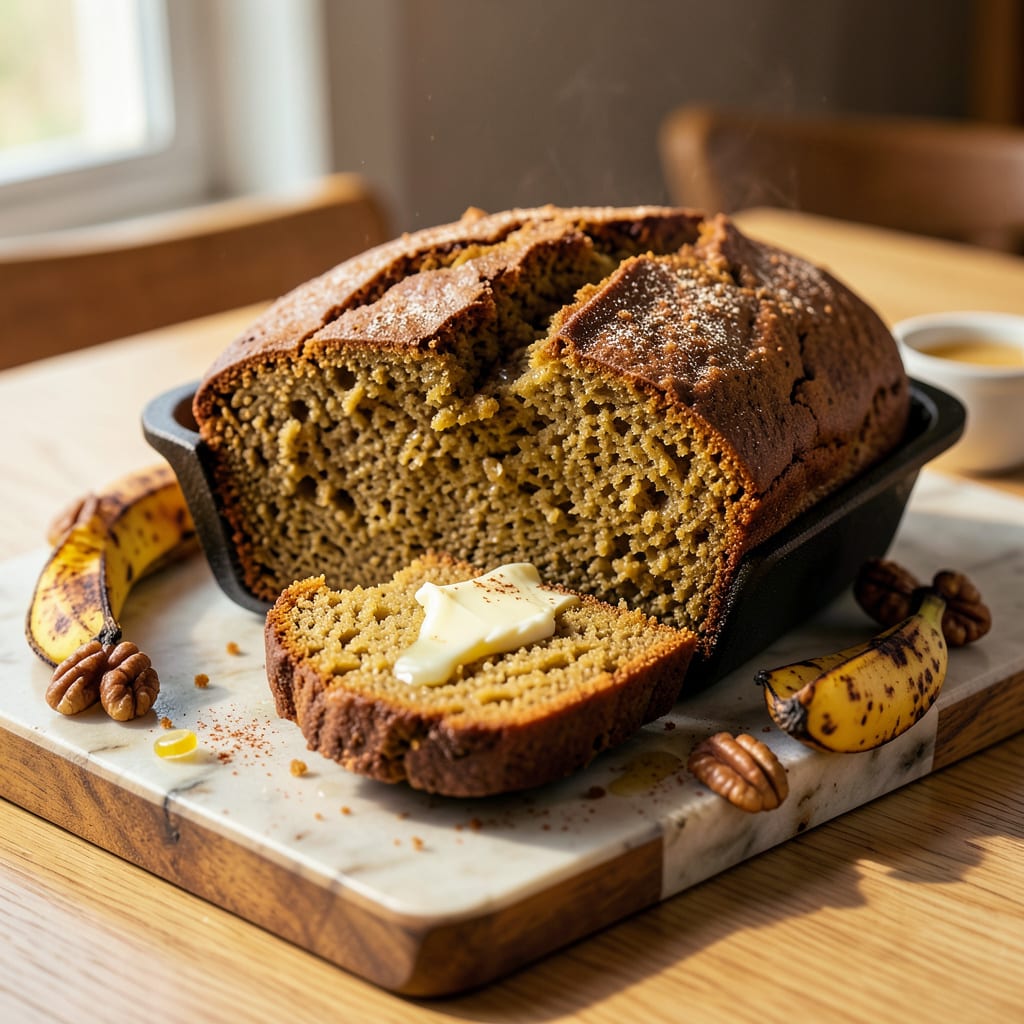
Without baking soda, banana bread becomes dense, flat, and heavy with a gummy texture. The batter won’t rise properly, leaving the final product compact and potentially undercooked in the center.
This happens because baking soda triggers a crucial chemical reaction with the acidic components in your batter—think ripe bananas, yogurt, or buttermilk. 🔥 Without that reaction, no carbon dioxide bubbles form to create those air pockets that give banana bread its signature lightness. I’ve seen this firsthand when testing recipes: the loaf emerges from the oven looking sad and stunted, almost like a pancake that forgot to fluff up. The interior often stays moist to the point of being sticky, which can fool you into thinking it’s underbaked when it’s really just lacking structure.
💡 In This Article
- Why Baking Soda Is Essential for Banana Bread Texture
- How to Fix Banana Bread Without Baking Soda
Why Baking Soda Is Essential for Banana Bread Texture
Baking soda acts as the chemical catalyst that transforms dense batter into light, airy banana bread. When it meets acidic ingredients like mashed bananas (pH ~5.0) or buttermilk (pH ~4.6), it triggers an immediate reaction producing carbon dioxide gas. These tiny bubbles expand during baking, creating the characteristic crumb structure we expect.
Without this reaction, your batter remains a heavy, unstructured mass—imagine trying to inflate a balloon without blowing air into it.
The science gets fascinating when you consider the timing. Baking soda reacts instantly with acids, which is why you’ll notice banana bread batter starts bubbling slightly even before it hits the oven. At 350°F, these bubbles expand rapidly, doubling the batter’s volume within the first 10-15 minutes of baking.
Omit the baking soda, and you lose this crucial early rise. The result? A loaf that might reach 1-1.5 inches tall instead of the ideal 2.5-3 inches, with a texture closer to banana pudding than bread.
What you’re left with is a product that’s technically edible but texturally disappointing. The crumb becomes so tight that moisture can’t escape properly during baking, leading to that gummy, almost gluey mouthfeel. I’ve tested this in my own kitchen—without baking soda, the center remains disturbingly moist even when the edges are overbaked.
The flavor concentrates differently too, with the banana taste becoming overwhelmingly intense because there’s no airy structure to distribute it evenly.
The structural problems extend beyond just height. Without proper leavening, the gluten network can’t form correctly, making slices crumble instead of holding their shape. This is particularly noticeable when you try to toast it—the lack of internal structure causes it to either turn to mush or burn on the outside while staying raw inside.
Even the crust suffers, developing a tough, leathery quality instead of that perfect golden-brown crispness we all love.
Here’s what’s happening at the molecular level: baking soda neutralizes acids while creating those all-important gas bubbles. Without it, the batter’s pH remains too low, which affects protein coagulation and starch gelatinization. These processes normally work together to set the bread’s structure, but without proper pH balance, they occur unevenly.
The result is a product that’s simultaneously undercooked and overstructured in all the wrong ways.
Consider the visual differences too. Properly leavened banana bread has an open, honeycomb-like interior when sliced. Without baking soda, you’ll see a uniform, dense matrix with no air pockets—almost like a banana-flavored brick.
The color changes as well, often appearing paler because the Maillard reaction (which gives baked goods their golden hue) occurs differently without the alkaline environment baking soda provides.
The aroma suffers too. Those beautiful caramelized notes that develop during baking come from complex reactions between sugars and proteins. Baking soda helps regulate these reactions, so without it, you’re left with a one-dimensional banana scent rather than the rich, toasty aroma we associate with perfect banana bread.
It’s like comparing a fresh-baked loaf to microwave banana pudding—the depth just isn’t there. 💫

Trained in classic French technique but raised on slow-cooked ribs and spicy rubs, she blends culinary skill with smoke and soul.
- Recipe for Boneless Pork Chops in Cast Iron Skillet: Sear and Baste to Juicy Perfection - October 3, 2026
- Recipe for Boneless Cross Rib Roast: Slow-Roasted Beef with Herb Crust - October 3, 2026
- Hamburgers in Sauce Recipe Crock Pot: Slow-Cooked Savory Delight - October 3, 2026