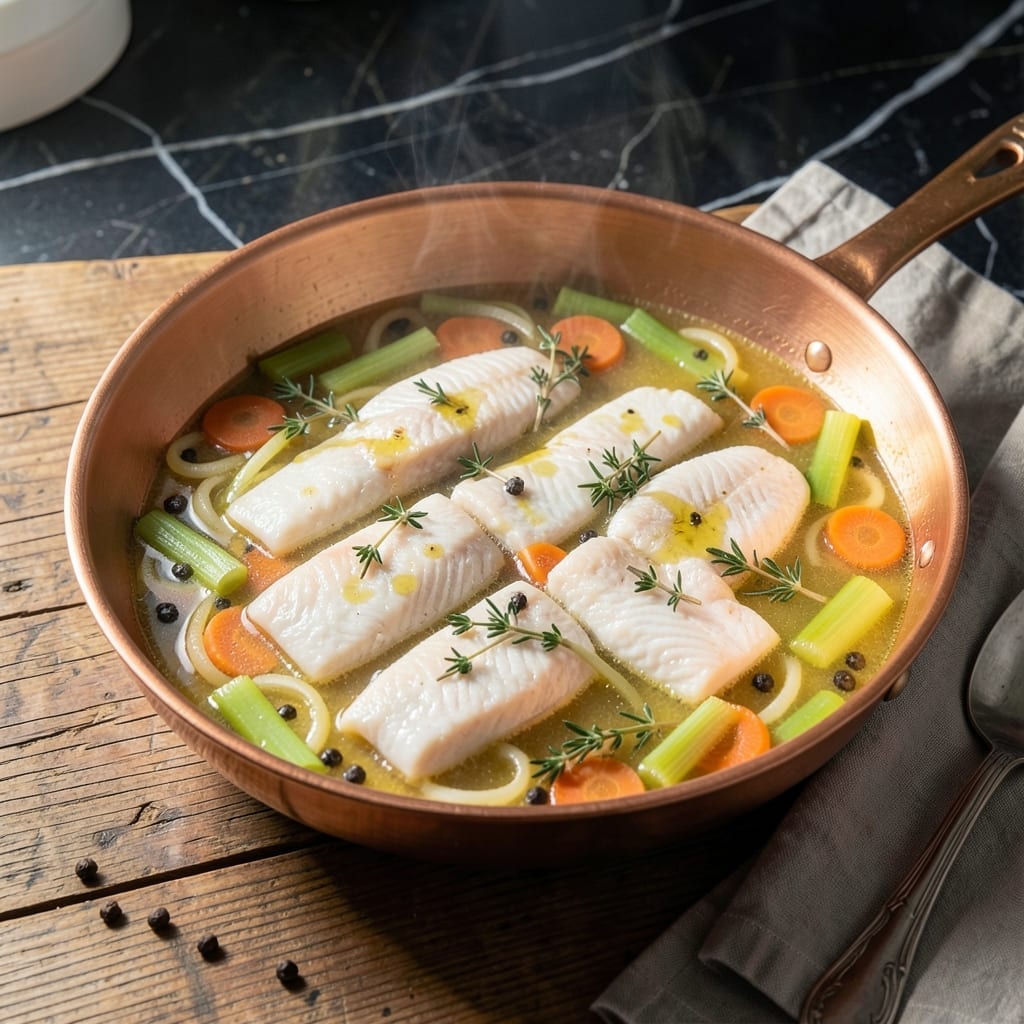
Classic French technique transforms simple ingredients into an elegant poached fish dish. This court bouillon creates a delicate, aromatic broth that enhances seafood without overpowering it.
I learned this method during my French training—it’s all about precise timing and temperature control. The broth infuses with herbs, wine, and vegetables to create a subtle yet complex base.
The result is perfectly cooked fish with a moist, tender texture. The poaching liquid can also be strained and reduced into a light, flavorful sauce to finish the dish.
Serve with steamed vegetables or crusty bread to soak up every drop of the fragrant broth.
Ingredients for Melting Pot Court Bouillon
Elegant French poaching starts with these classic court bouillon ingredients.
| Ingredient | Amount | Notes |
|---|---|---|
| White Fish Fillets 🐟 | 1 ½ lb | Firm white fish like cod, halibut, or haddock |
| Dry White Wine 🍷 | 2 cups | Sauvignon Blanc or Pinot Grigio preferred |
| Water 💧 | 2 cups | Filtered for best flavor |
| Yellow Onion 🧅 | 1 whole | Thinly sliced for even infusion |
| Carrots 🥕 | 2 whole | Peeled and sliced into rounds |
| Celery Stalks 🌿 | 2 whole | Cut into large pieces |
| Fresh Parsley 🌿 | ½ cup | Stems and leaves, roughly chopped |
| Fresh Thyme Sprigs 🌿 | 4 whole | Whole sprigs for easy removal |
| Bay Leaves 🍃 | 2 whole | Dried or fresh |
| Lemon 🍋 | 1 whole | Sliced, peel on for flavor |
| Black Peppercorns 🌶️ | 1 tsp | Lightly crushed for broth |
| Kosher Salt 🧂 | 1 tbsp | Diamond Crystal preferred |
| Whole Cloves 🌿 | 2 whole | Optional for depth |
| Olive Oil 🫒 | 1 tbsp | For finishing the sauce |
[recipe_ingredient_scaler]
The fish quality is paramount for court bouillon. Wild-caught cod or halibut from Whole Foods or local seafood markets ensures optimal texture and flavor. Look for fillets with vibrant color and no fishy odor. For the wine, a crisp Sauvignon Blanc from Trader Joe’s provides the necessary acidity without overpowering the delicate broth.
No white wine? Dry vermouth at equal volume works as a substitute. Fresh herbs are ideal, but dried at one-third the amount can be used in a pinch. The onion, carrot, and celery form the classic mirepoix base—organic produce adds depth. If lemon feels too bright, a splash of white wine vinegar achieves similar balance without the citrus notes.
The broth can be made 1 day ahead—flavors intensify overnight. Store strained liquid in an airtight container for up to 48 hours in the fridge. Poached fish is best served immediately, but the broth freezes beautifully for 3 months if reduced to a sauce first.
Why You’ll Love This Recipe
- One Pot Wonder: I just toss the fish, wine, and veggies in a single pot and let it work its magic.
- Bright & Clean: The white wine and fresh veggies give the fish this light, aromatic flavor that’s impossible to resist.
- Weeknight Lifesaver: Honestly, it’s my go-to for busy evenings when I need something healthy and fast.
- Budget Friendly: A few affordable ingredients stretch to feed my whole family without breaking the bank.
Step-by-Step Instructions for French Poached Fish
Master this classic technique for perfectly cooked fish with delicate, aromatic flavor.
Step 1: Prepare the Aromatic Broth Base
In a wide, deep skillet or sauté pan, combine the 2 cups water, 2 cups dry white wine, 1 tbsp kosher salt, 1 tsp black peppercorns, and 2 whole cloves. Add the 1 whole yellow onion, 2 whole carrots, and 2 whole celery stalks, ensuring they’re submerged in the liquid.
This combination creates a flavorful court bouillon that will infuse the fish with subtle complexity. The vegetables should release their aromas as the liquid heats, but don’t let it reach a full boil yet—gentle simmering is key to preserving the delicate flavors.
Step 2: Infuse with Herbs and Citrus
Add the 4 whole fresh thyme sprigs, 2 whole bay leaves, 0.5 cup fresh parsley, and 1 whole lemon (sliced, peel on) to the broth. Bring the mixture to a very gentle simmer over medium heat—you should see small bubbles forming at the edges, not a rolling boil.
Let the broth simmer for 15 minutes to allow the herbs and citrus to fully infuse. The lemon slices will soften and release their oils, while the parsley and thyme will lend a fresh, aromatic backbone to the liquid. This step ensures every bite of fish carries layered, balanced flavor.
Step 3: Poach the Fish Fillets
Gently lower the 1.5 lb white fish fillets into the simmering broth, ensuring they’re fully submerged. The liquid should just barely cover the fish—if not, add a splash of water. Reduce the heat to low to maintain a very gentle simmer, just enough to keep the liquid shimmering.
Poach the fillets for 8-10 minutes, depending on thickness, until the fish is opaque and flakes easily with a fork. Avoid stirring or moving the fillets, as this can break them apart. The fish is done when it reaches an internal temperature of 145°F and the flesh separates cleanly along the natural segments.
Step 4: Finish and Serve
Using a slotted spatula, carefully transfer the poached fillets to a serving platter. Strain the broth through a fine-mesh sieve into a saucepan, discarding the solids. Return the strained broth to a gentle simmer and let it reduce by half, about 5-7 minutes.
Whisk in the 1 tbsp olive oil to emulsify the sauce, giving it a silky finish. Spoon the reduced broth over the fish just before serving to keep the fillets moist and infused with the aromatic flavors of the court bouillon.
Pro Tips For Making Melting Pot Court Bouillon
- Simmer, Don’t Boil: Keep the heat low enough that the liquid just shimmers—any harder boil and your white fish will turn tough and stringy. I learned this the hard way after my first batch came out rubbery.
- Slice Veggies Thin: Cut the onion and carrots into thin rounds or small dice so they infuse the broth quickly. Sounds fussy, but it actually changes the outcome, especially when time is tight.
- Skip Cheap Wine: Use a dry white wine you’d actually drink—if it tastes harsh straight, it’ll taste worse in your court bouillon. My grandmother swore by this, and she was right.
- Poach Just Until Opaque: Pull the fish out as soon as it flakes easily and turns opaque, usually 6-8 minutes. Resist the urge to overcook—it’ll finish in the hot broth even off the heat.
Essential Equipment for This Dish
Wide, Deep Skillet
A 12-inch wide, 3-inch deep skillet or sauté pan is ideal for even heat distribution. I prefer All-Clad stainless steel for its durability and precise temperature control. The wide surface allows the fish to lie flat, ensuring even cooking.
Fine-Mesh Sieve
Straining the broth requires a fine-mesh sieve to catch all herbs and aromatics. I use a 10-inch diameter sieve from OXO—it fits perfectly over my saucepan. This tool separates the clear, flavorful liquid from the solids efficiently. 💡
Slotted Spatula
A thin, flexible slotted spatula helps lift delicate fish fillets without breaking them. Look for one with a long handle to reach into deep pans. I keep a fish spatula from Mercer Culinary handy for this exact purpose.
Instant-Read Thermometer
Precision matters with poached fish—an instant-read thermometer ensures the broth stays at 160-180°F. I trust my ThermoWorks ThermaPen for accurate, fast readings. The fish is done at 145°F internal temperature.
Saucepan for Reduction
After straining, you’ll need a 2-3 quart saucepan to reduce the broth. A heavy-bottomed pan prevents scorching as the liquid concentrates. I use my Le Creuset for this step—it heats evenly and looks beautiful on the stove. 🔥
Kitchen Thermometer
Monitor the broth temperature with a candy or deep-fry thermometer clipped to the pan. This maintains the gentle simmer needed for perfect poaching. I check mine frequently to avoid overheating the delicate liquid.
Nutrition Facts
Frequently Asked Questions
Can I use a different type of fish?
Yes! Firm white fish like cod, halibut, or haddock work best. For a lighter option, try sole or flounder. Just adjust poaching time to 6-8 minutes for thinner fillets.
What if I don’t have white wine?
Substitute with dry vermouth at equal volume, or use 1.5 cups water + 0.5 cup white vinegar. The acidity mimics wine’s role in balancing flavors.
How do I prevent the fish from breaking apart?
Ensure the broth stays at a gentle simmer, not a boil. Use a slotted spatula to carefully lift fillets, and pat them dry before poaching to help them hold shape.
Can I make the broth ahead of time?
Prepare and strain the broth up to 1 day ahead. Store in an airtight container in the fridge. Reheat gently before poaching.

Trained in classic French technique but raised on slow-cooked ribs and spicy rubs, she blends culinary skill with smoke and soul.
- Recipe for Boneless Pork Chops in Cast Iron Skillet: Sear and Baste to Juicy Perfection - October 3, 2026
- Recipe for Boneless Cross Rib Roast: Slow-Roasted Beef with Herb Crust - October 3, 2026
- Hamburgers in Sauce Recipe Crock Pot: Slow-Cooked Savory Delight - October 3, 2026