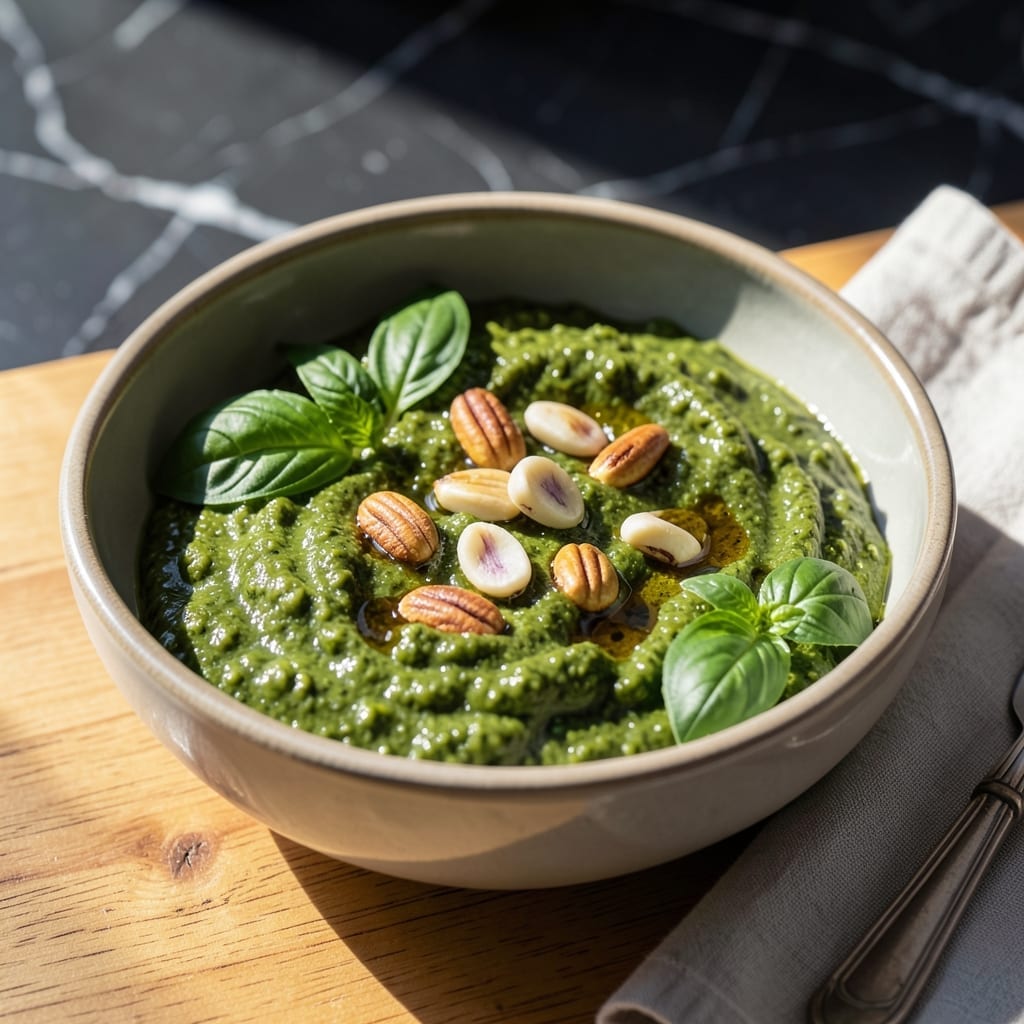
This dairy-free pesto delivers all the bright, herbaceous flavor of traditional versions without a single ounce of cheese. The secret lies in balancing fresh basil with nutritional yeast and pine nuts for depth.
You’ll achieve a smooth, vibrant sauce that clings perfectly to pasta, drizzles over vegetables, or elevates sandwiches. Store in the fridge for up to 5 days or freeze for longer preservation.
Ingredients for Pesto Sauce Recipe Without Cheese
Eight ingredients transform into a vibrant, dairy-free sauce with serious flavor.
| Ingredient | Amount | Notes |
|---|---|---|
| Fresh Basil Leaves 🌿 | 2 cups | Packed, stems removed |
| Pine Nuts 🥜 | ½ cup | Toasted for depth |
| Nutritional Yeast 🧀 | ¼ cup | Adds cheesy umami flavor |
| Garlic Cloves 🧄 | 3 cloves | Peeled, rough chopped |
| Extra-Virgin Olive Oil 🫒 | ¾ cup | High quality, fruity |
| Lemon Juice 🍋 | 1 tbsp | Freshly squeezed for brightness |
| Sea Salt 🧂 | ½ tsp | Fine grain preferred |
| Black Pepper 🌶️ | ¼ tsp | Freshly ground |
[recipe_ingredient_scaler]
Basil is non-negotiable here—farmers market bunches are ideal, but grocery store works if it’s fresh and fragrant (those sad, wilted clamshells won’t cut it). Pine nuts? Trader Joe’s or Costco for the best prices, or sub walnuts if they’re out of budget. The nutritional yeast is your cheese stand-in, so grab Bragg or Bob’s Red Mill—both have that nutty, umami punch you need.
No pine nuts? Raw cashews or walnuts blend just as smooth. Short on basil? Half spinach, half basil still tastes bright. Lemon juice can be bottled in a pinch, but fresh is better. The olive oil should be something you’d drizzle on good bread—this isn’t the time for that dusty bottle in the back of your cabinet.
Pesto oxidizes fast. Press plastic wrap right on the surface before sealing—stays green for the full 5 days in the fridge. Freeze in ice cube trays for 3 months of easy portions (just pop out what you need).
Why You’ll Love This Recipe
- One-Blend Wonder: I toss everything in the food processor—basil, pine nuts, nutritional yeast, garlic, oil—and it’s done in under five minutes.
- Rich and Nutty: The pine nuts and nutritional yeast give it this deep, savory flavor that’s just as satisfying as the cheesy version.
- Endless Uses: I slather it on sandwiches, mix it into pasta, or drizzle over roasted veggies. Honestly, it’s my kitchen multitasker.
- Keeps for Days: This pesto stays fresh in the fridge for nearly a week, so I always have a jar ready for last-minute meals.
Step-by-Step Instructions for Pesto Sauce Without Cheese
Here’s the method I use to blend vibrant basil flavor with rich, nutty depth every time.
Step 1: Toast the Pine Nuts for Maximum Flavor
Heat a dry skillet over medium-low heat and add the 0.5 cup Pine Nuts. Toast them for 3-5 minutes, stirring frequently, until they turn golden brown and release their rich, buttery aroma. Watch them closely—pine nuts go from perfectly toasted to burnt in seconds.
I’ve found that toasting brings out their natural oils and adds a depth that raw pine nuts just can’t match. The moment you smell that nutty fragrance, remove them from the pan and set aside to cool. This prevents them from continuing to cook and potentially becoming bitter.
Step 2: Pulse the Garlic and Basil for Perfect Texture
In a food processor, add the 3 cloves Garlic Cloves and pulse until finely minced. Then add all 2 cups Fresh Basil Leaves and pulse in 1-second bursts until the basil is finely chopped but not puréed. You want to see some texture—this gives the pesto its characteristic body.
Here’s the thing—over-processing the basil can make it bitter and turn the pesto an unappetizing dark green. I stop pulsing when the leaves are broken down into tiny pieces but still have some visible flecks. This step usually takes about 10-15 pulses.
Step 3: Incorporate the Nutritional Yeast and Pine Nuts
Add the toasted 0.5 cup Pine Nuts and 0.25 cup Nutritional Yeast to the food processor. Pulse again for 10-15 seconds until the mixture becomes a coarse paste. The nutritional yeast adds that cheesy umami flavor, so don’t be tempted to skip it.
You’ll notice the mixture starting to come together as the oils from the pine nuts release. If it looks too dry at this point, that’s okay—we’ll fix that in the next step. The texture should be grainy but not powdery.
Step 4: Emulsify with Olive Oil and Seasonings
With the food processor running on low, slowly drizzle in the 0.75 cup Extra-Virgin Olive Oil. This slow addition is crucial—it creates an emulsion that gives the pesto its silky, creamy texture. Stop once or twice to scrape down the sides of the bowl with a spatula.
Once the olive oil is fully incorporated, add the 1 tbsp Lemon Juice, 0.5 tsp Sea Salt, and 0.25 tsp Black Pepper. Pulse a few more times to combine. The lemon juice brightens all the flavors, while the salt and pepper bring everything into balance.
Step 5: Adjust Consistency and Taste
Taste the pesto and adjust the seasoning if needed. If it’s too thick, add a little more olive oil, 1 tablespoon at a time, until it reaches your desired consistency. For a thinner sauce, you can also add a splash of water, but I find the olive oil adds better flavor.
Let the pesto sit for 10 minutes before using to allow the flavors to meld together. You’ll find that the taste deepens and becomes more harmonious after this short rest. This dish is best used fresh but can be stored in an airtight container in the refrigerator for up to 5 days.
Pro Tips For Making Pesto Sauce Recipe Without Cheese
- Toast the Pine Nuts: Lightly toasting the pine nuts in a dry pan for 2-3 minutes brings out their natural oils and adds depth—skip this and your pesto will taste flat.
- Blanch the Basil: I learned this the hard way—blanching basil leaves for 10 seconds in boiling water keeps them vibrant green and prevents bitterness in the finished sauce.
- Skip the Overcrowding: Resist the urge to stuff all the basil in the blender at once; pulse in batches for a smoother, more consistent texture without turning it into a sad, watery paste.
- Use Room-Temp Oil: Cold olive oil can make the pesto separate, so let it sit out for 10-15 minutes before blending—sounds fussy, but it actually changes the outcome.
Creative Variations of This Recipe
🔥 Spicy Texas Style
Kick up the heat with a Southwestern twist! Replace traditional pine nuts with ½ cup toasted pecans and add 1-2 chopped jalapeños (seeds removed for milder heat). Swap olive oil for ¼ cup avocado oil for a neutral base, and blend in 1 tsp smoked paprika and ½ tsp cumin for depth. This bold variation pairs perfectly with grilled meats or as a zesty dip for tortilla chips. 🌶️
🍯 Sweet and Savory Fusion
Balance earthy basil with a touch of sweetness. Use ¼ cup cashews instead of pine nuts, and add 1 tbsp honey or maple syrup to the blend. A splash of 1 tsp apple cider vinegar brightens the flavors, while ½ tsp cinnamon adds warmth. This unexpected combo shines in desserts like pesto-drizzled fruit salads or as a glaze for roasted carrots. 🍎
💪 Healthy Lighter Version
Cut calories without sacrificing flavor by using ¼ cup unsalted sunflower seeds instead of nuts and reducing oil to 2 tbsp. Boost nutrition with 1 cup spinach blended alongside the basil, and add 1 tbsp lemon juice for tang. This lightened-up pesto is ideal for tossing with zucchini noodles or spreading on whole-grain wraps. 🥗
🍂 Seasonal Twist
Embrace autumn with a hearty twist. Substitute basil for 1 cup arugula and add ½ cup roasted butternut squash for natural sweetness. Use ¼ cup walnuts for a rich, earthy crunch, and finish with 1 tsp nutmeg for warmth. This seasonal pesto elevates pasta dishes or serves as a cozy dip for crusty bread. 🎃
Nutrition Facts

Trained in classic French technique but raised on slow-cooked ribs and spicy rubs, she blends culinary skill with smoke and soul.
- Recipe for Boneless Pork Chops in Cast Iron Skillet: Sear and Baste to Juicy Perfection - October 3, 2026
- Recipe for Boneless Cross Rib Roast: Slow-Roasted Beef with Herb Crust - October 3, 2026
- Hamburgers in Sauce Recipe Crock Pot: Slow-Cooked Savory Delight - October 3, 2026