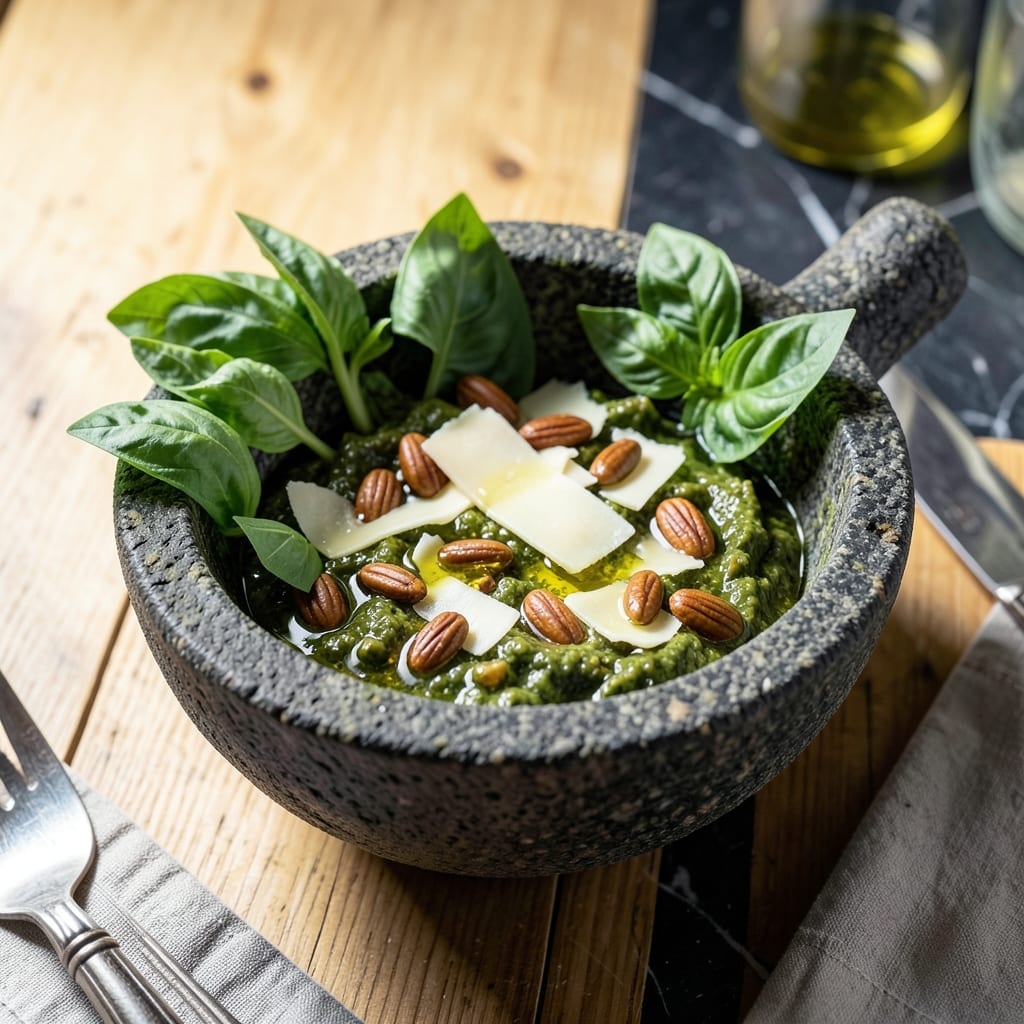
There’s something deeply satisfying about making pesto by hand, where each chop releases the basil’s fragrant oils. This method delivers perfect texture and flavor without any appliances.
Using a knife and cutting board, you control every element—from the size of the garlic to the consistency of the herbs. The result is a vibrant, aromatic sauce that tastes fresher than any processed version.
Ingredients for Pesto Sauce Recipe Without Food Processor
Eight simple ingredients transform into vibrant, hand-crafted pesto with unmatched freshness and texture.
| Ingredient | Amount | Notes |
|---|---|---|
| Fresh Basil Leaves 🌿 | 2 cups | Packed, stems removed |
| Pine Nuts 🥜 | ½ cup | Toasted for depth |
| Garlic Cloves 🧄 | 3 cloves | Peeled, minced finely |
| Parmesan Cheese 🧀 | ¾ cup | Freshly grated from block |
| Extra-Virgin Olive Oil 🫒 | ¾ cup | High quality, fruity |
| Lemon Juice 🍋 | 1 tbsp | Freshly squeezed |
| Sea Salt 🧂 | ½ tsp | Fine grain preferred |
| Black Pepper 🌶️ | ¼ tsp | Freshly ground |
[recipe_ingredient_scaler]
Basil is the foundation, so select bright green, fragrant leaves without bruising. Whole Foods or farmers markets often have the best quality. Pine nuts add richness, but Trader Joe’s offers them at a more accessible price point. Parmesan should be Parmigiano-Reggiano for authentic flavor—avoid pre-grated, as it lacks the necessary texture for hand-chopping.
No pine nuts? Walnuts or raw cashews work well (toast them first for depth). Short on basil? Supplement with fresh spinach or parsley. If Parmesan isn’t available, Pecorino Romano adds a sharper note. The olive oil should be high-quality and robust—this is not the place for neutral oils.
Pesto oxidizes quickly, so press plastic wrap directly onto the surface before sealing. Refrigerate for up to 5 days or freeze in ice cube trays for 6 months. The hand-chopped texture holds up beautifully, unlike machine-blended versions.
Why You’ll Love This Recipe
- No Fuss Chopping: I crush the pine nuts and garlic with a mortar and pestle—no equipment, just elbow grease and the scent of fresh basil filling my kitchen.
- Rich and Nutty: That first taste with the sharp Parmesan and buttery pine nuts? Honestly, it’s the reason I make it weekly.
- Endless Uses: Toss it with pasta tonight, spread it on sandwiches tomorrow, or stir into soup next week. Between us, it never lasts that long.
- Budget Stretch: A handful of basil and a small wedge of cheese turn into a sauce that feeds us for days. I’ll be real: it’s cheaper than store-bought and twice as good.
Step-by-Step Instructions for Pesto Sauce Without Food Processor
Achieve restaurant-quality results using traditional hand methods and simple tools.
Step 1: Toast the Pine Nuts
Heat a dry skillet over medium-low heat for 2 minutes to preheat evenly. Add the 0.5 cup Pine Nuts in a single layer, stirring frequently with a wooden spoon. You’ll notice the nuts begin to turn light golden brown and release a nutty aroma after 3-4 minutes.
Watch closely—pine nuts burn easily. Remove them from the pan immediately when they’re uniformly lightly toasted and transfer to a small bowl to cool. This step deepens their flavor and adds a satisfying crunch to your finished sauce.
Step 2: Crush Garlic and Sea Salt into a Paste
Place the 3 cloves Garlic Cloves and 0.5 tsp Sea Salt on a cutting board. Using the flat side of a chef’s knife, press down firmly and drag the blade across the garlic to create a coarse paste. This technique, known as smashing, breaks down the garlic fibers completely.
Continue until the mixture forms a smooth, wet paste. The salt acts as an abrasive, helping to grind the garlic into a fine consistency. This ensures even distribution in your sauce without large, pungent chunks.
Step 3: Hand-Chop the Fresh Basil Leaves
Stack the 2 cups Fresh Basil Leaves in small batches on your cutting board. Using a sharp chef’s knife, slice them thinly lengthwise into ribbons, then turn and chop crosswise until finely minced. The leaves should be reduced to very small, uniform pieces.
Avoid bruising the basil—use a gentle rocking motion with your knife rather than pressing down hard. Fresh basil releases its aromatic oils when cut, so work quickly to preserve its vibrant color and flavor.
Step 4: Combine and Emulsify the Ingredients
In a large bowl, combine the minced basil, toasted pine nuts, and garlic paste. Add the 0.75 cup Parmesan Cheese, 0.25 tsp Black Pepper, and 1 tbsp Lemon Juice. Stir gently with a wooden spoon to mix evenly.
Drizzle in the 0.75 cup Extra-Virgin Olive Oil slowly, about 2 tablespoons at a time, stirring constantly in a circular motion. This gradual addition helps create a stable emulsion. Continue until the mixture thickens and becomes smooth, with a glossy, vibrant green appearance.
Step 5: Adjust and Rest for Optimal Flavor
Taste and adjust seasoning if needed, though the garlic and salt should provide adequate flavor. If the sauce is too thick, stir in 1-2 teaspoons of water to reach your desired consistency. The texture should cling to pasta or a spoon without being runny.
Let the pesto rest at room temperature for 10-15 minutes before serving. This allows the flavors to meld together fully. Use immediately for the freshest taste, or store in an airtight container in the refrigerator for up to 3 days.
Pro Tips For Making Pesto Sauce Recipe Without Food Processor
- Crush Pine Nuts First: Start by crushing the pine nuts with the side of your knife or a mortar—this gives the oil something to cling to before you add the basil. I learned this the hard way after ending up with a greasy, separated mess.
- Dry the Basil: Pat the basil leaves dry with a paper towel before chopping—excess water makes the pesto thin and dull. My grandmother swore by this, and she was right.
- Skip the Garlic Press: Mince the garlic by hand instead of pressing it to avoid bitter, overpowering flavors that can dominate the pesto. Sounds weird, but it works.
- Grate the Parmesan Fine: Use a microplane for the Parmesan so it melts seamlessly into the sauce. This isn’t the prettiest method, but it’s the tastiest.
Serving Suggestions for This pesto sauce recipe without food processor
Plating Styles 🍽️
For a casual meal, drizzle your handmade pesto over a warm bowl of pasta and toss lightly. For a more formal presentation, use a squeeze bottle to artfully swirl the sauce around the plate before adding other elements like grilled chicken or roasted vegetables. At a buffet, serve the pesto in a small ceramic dish with a spoon for easy self-serving.
Garnishing Techniques ✨
Enhance the visual appeal by topping your dish with fresh basil leaves, a sprinkle of grated Parmesan, or a drizzle of olive oil. For a rustic touch, add toasted pine nuts or crushed red pepper flakes. Use a fine-mesh sieve to dust a light layer of Pecorino Romano over the pesto for an elegant finish.
Portion Sizes
For individual servings, a tablespoon or two of pesto per portion is enough to coat pasta or spread on sandwiches. For family-style dining, prepare a larger batch and serve it in a communal bowl, allowing everyone to add as much as they like. Adjust quantities based on whether the pesto is the star or a supporting element in the dish.
Serving Temperature 🌡️
Pesto is best served at room temperature to allow the flavors to fully shine. If stored in the fridge, let it sit out for 10-15 minutes before using. Avoid heating the sauce directly, as it can cause the basil to turn bitter. Instead, toss it with warm pasta or spread it on hot dishes just before serving.
Nutrition Facts

Trained in classic French technique but raised on slow-cooked ribs and spicy rubs, she blends culinary skill with smoke and soul.
- Recipe for Boneless Pork Chops in Cast Iron Skillet: Sear and Baste to Juicy Perfection - October 3, 2026
- Recipe for Boneless Cross Rib Roast: Slow-Roasted Beef with Herb Crust - October 3, 2026
- Hamburgers in Sauce Recipe Crock Pot: Slow-Cooked Savory Delight - October 3, 2026