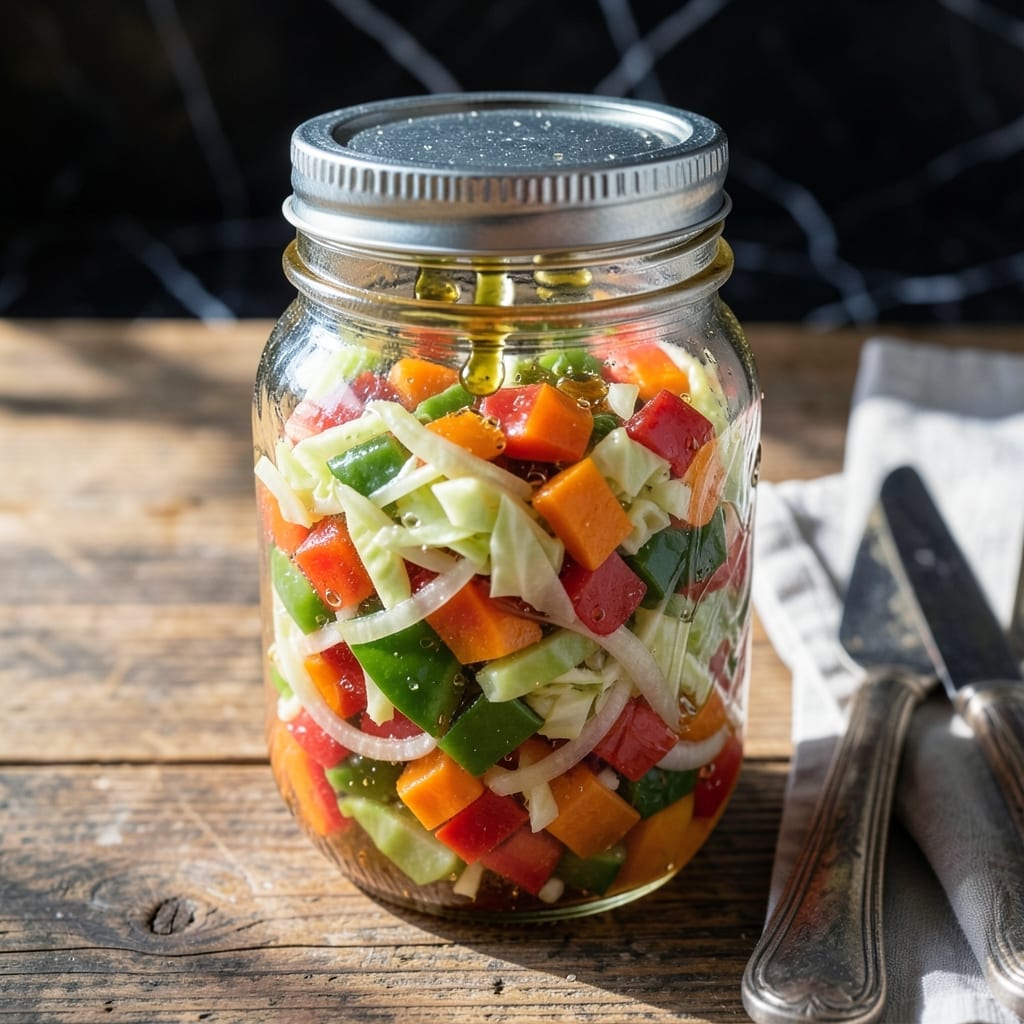
This sweet and tangy relish captures the essence of Southern canning tradition. I developed this version after tasting a jar at a local BBQ competition.
It balances crisp vegetables with a bright vinegar base, creating a versatile condiment that elevates sandwiches, hot dogs, and charcuterie boards. The flavor deepens as it rests, making it perfect for make-ahead entertaining.
Ingredients for Pioneer Woman Chow Chow
Ten ingredients, one jar. Southern comfort in every crunchy, tangy bite.
| Ingredient | Amount | Notes |
|---|---|---|
| Green Cabbage 🥬 | 4 cups | Finely chopped, core removed |
| Red Bell Pepper 🌶️ | 1 whole | Diced, seeds removed |
| Green Bell Pepper 🌶️ | 1 whole | Diced, seeds removed |
| Yellow Onion 🧅 | 1 whole | Finely diced |
| Granulated Sugar 🧂 | 1 cup | Fine white sugar preferred |
| Apple Cider Vinegar 💧 | 1 ½ cups | 5% acidity for balance |
| White Vinegar 💧 | ½ cup | Distilled, for sharpness |
| Mustard Seeds 🌿 | 1 tbsp | Yellow or brown variety |
| Celery Seeds 🌿 | 1 tsp | Whole, not ground |
| Turmeric 🌶️ | ½ tsp | Ground, for color |
[recipe_ingredient_scaler]
Cabbage is the backbone here—Napa or savoy won’t work. You want the crisp texture of green cabbage, and it should be fresh (the outer leaves firm, not wilting). Bell peppers add sweetness and color, so grab ones that are vibrant and unblemished. Most grocery stores carry all the veggies year-round, but farmers markets in late summer have the best selection. I always pick up extra cabbage since it keeps so well in the fridge.
No apple cider vinegar? White vinegar plus a splash of apple juice gets you close. Mustard seeds can be swapped for ground mustard at half the amount, though the texture changes. Celery seed is non-negotiable for that classic chow chow flavor—Penzeys has great quality. The turmeric is mostly for color, so skip it if you’re out. Sugar can be reduced slightly, but the sweet-tang balance is key.
This keeps 4-6 weeks in the fridge once opened. Unopened jars? Up to 1 year in a cool, dark place. The flavor gets better after a week, so make it ahead. Perfect for gifting—just tie a ribbon on the jar.
Why You’ll Love This Recipe
- Minimal Chopping Required: I just dice the cabbage, peppers, and onion—no fancy knife skills needed, and the food processor makes it even faster.
- Sweet-Tangy Crunch: The sugar balances the veggies perfectly, giving that classic chow chow zing I crave with every bite.
- Jars for Days: I make a big batch and it keeps for ages in the fridge, so I always have some on hand for sandwiches or snacks.
- Budget Stretcher: Honestly, a head of cabbage and a few peppers give me quarts of this for pennies—way cheaper than store-bought.
Step-by-Step Instructions for Sweet and Tangy Southern Chow Chow
Here’s my trusted method for this classic relish that balances sweetness and tang perfectly.
Step 1: Prepare and Chop All Vegetables
Start by finely chopping the 4 cups Green Cabbage after removing the core. I like to cut it into small, even pieces so they soften uniformly during cooking. Dice the 1 whole Red Bell Pepper and 1 whole Green Bell Pepper after removing seeds and membranes.
Finely dice the 1 whole Yellow Onion—this should be a fine dice, not coarse, so it blends seamlessly into the relish. I’ve found that using a sharp chef’s knife makes this process much easier and safer. Set all chopped vegetables aside in a large bowl while you prepare the brine.
Step 2: Create the Sweet-Tangy Brine
In a medium saucepan, combine the 1 cup Granulated Sugar, 1.5 cups Apple Cider Vinegar, and 0.5 cup White Vinegar. The sugar should dissolve completely as the mixture heats. I prefer fine white sugar as it incorporates more smoothly into the liquid.
Add the 1 tbsp Mustard Seeds, 1 tsp Celery Seeds, and 0.5 tsp Turmeric to the saucepan. The turmeric will give the relish its characteristic golden color, while the mustard and celery seeds add depth of flavor. Bring this mixture to a gentle boil over medium heat, stirring occasionally to ensure the sugar fully dissolves.
Step 3: Simmer Vegetables in the Brine
Once the brine reaches a boil, add all the chopped vegetables to the saucepan. Stir well to ensure all pieces are submerged in the liquid. The vegetables should be completely covered by the brine—if not, add a splash of water to help.
Reduce the heat to maintain a gentle simmer and cook for 20-25 minutes. You’ll notice the cabbage becoming translucent and the peppers softening. Stir occasionally during cooking to prevent sticking and ensure even cooking. The relish is ready when the vegetables are tender but still have a slight crunch.
Step 4: Cool and Store the Chow Chow
Remove the saucepan from heat and let the chow chow cool to room temperature. This usually takes about 1 hour at room temperature. As it cools, the flavors will meld together beautifully.
Once completely cooled, transfer the chow chow to clean, airtight jars or containers. I like to use mason jars for storage—they’re perfect for this. The relish will keep in the refrigerator for up to 3 weeks, and the flavors actually improve after a day or two as they continue to develop.
Pro Tips For Making Pioneer Woman Chow Chow
- Shred Cabbage Fine: Use a sharp knife or mandoline to get thin, even strips—about 1/8-inch thick. I learned this the hard way after ending up with chunky chow chow that just wouldn’t soften properly.
- Salt the Veggies First: Toss the shredded cabbage, peppers, and onion with 1 tablespoon of salt and let them sit for 30 minutes. My grandmother swore by this, and she was right: it draws out excess water so your chow chow stays crisp.
- Skip the Overcooking: Once the veggies hit the vinegar-sugar brine, cook just until tender—about 10-12 minutes. After burning a batch by walking away, I now set a timer to avoid mushy chow chow.
- Use a Wide Pot: A broad, heavy-bottomed pot lets the mixture reduce evenly and prevents scorching. Sounds weird, but it works: I switched from a narrow saucepan and finally stopped stirring constantly.
Storing and Reheating This pioneer woman chow chow
Refrigerator Storage
Once cooled, transfer this relish to sterilized mason jars with airtight lids. I prefer pint-sized jars for easy serving. Store in the fridge at 40°F or below for up to 3 weeks. The flavors deepen after 48 hours as the vegetables absorb the brine. ❄️
Freezer Storage
For longer storage, freeze in quart-sized freezer bags or airtight containers. Leave ½ inch headspace for expansion. It keeps well for 6 months without losing texture. Thaw overnight in the fridge before using.
Canning for Shelf Stability
For shelf-stable storage, use a water bath canner. Pack hot relish into sterilized jars, leaving ½ inch headspace. Process pint jars for 15 minutes and quart jars for 20 minutes. Check seals after 24 hours.
Room Temperature Serving
Let refrigerated chow chow sit at room temp for 10-15 minutes before serving. This brings out the full sweet-tangy flavor profile. I always give it a quick stir before serving to redistribute the spices.
Reheating Not Needed
This condiment is best served cold or at room temperature. No reheating required! If you must warm it, use a double boiler on low heat for 5-10 minutes to preserve texture. 💡
Nutrition Facts
Frequently Asked Questions
Can I use different vinegars?
Yes, but stick to 5% acidity vinegars for safety. White vinegar works alone, but apple cider adds depth. Avoid balsamic—it overpowers the flavor.
How fine should the vegetables be chopped?
Aim for 1/4-inch dice or smaller for even cooking. Uniform pieces ensure consistent texture and proper brine absorption.
Why did my chow chow turn brown?
This happens when vegetables aren’t fully submerged in brine. Always press them down to prevent oxidation. Adding a bit more vinegar helps too.
Is it safe to reduce the sugar?
You can cut sugar by 25% without issues, but the flavor balance changes. The sugar preserves texture and taste, so don’t omit it entirely.

Trained in classic French technique but raised on slow-cooked ribs and spicy rubs, she blends culinary skill with smoke and soul.
- Recipe for Boneless Pork Chops in Cast Iron Skillet: Sear and Baste to Juicy Perfection - October 3, 2026
- Recipe for Boneless Cross Rib Roast: Slow-Roasted Beef with Herb Crust - October 3, 2026
- Hamburgers in Sauce Recipe Crock Pot: Slow-Cooked Savory Delight - October 3, 2026