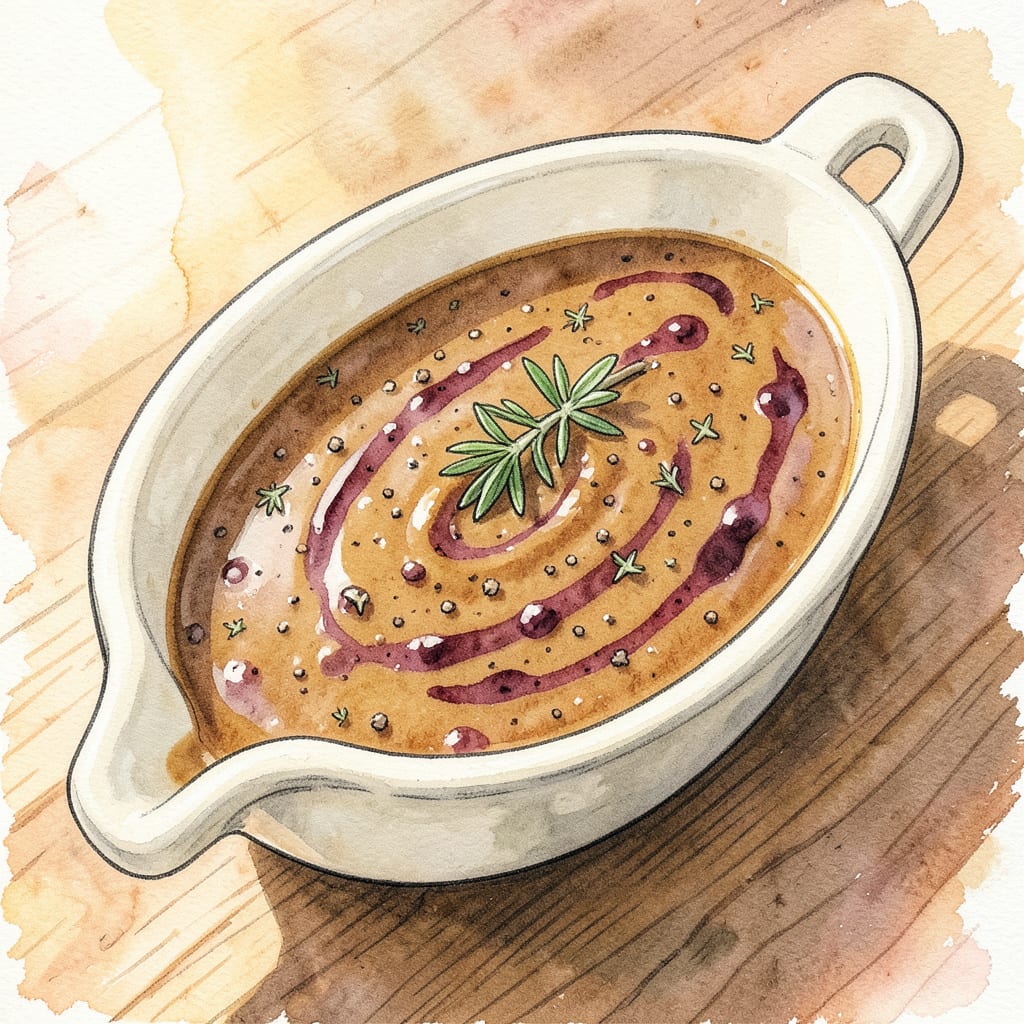
Nothing elevates a holiday roast like a rich, velvety gravy that ties the whole meal together. I’ve spent years perfecting this prime rib gravy, and the secret is all in those flavorful pan drippings—don’t you dare throw them away! With just a few simple ingredients and about 15 minutes, you can transform those browned bits into a sauce so good, people will ask for extra.
This isn’t your average thin gravy. We’re talking deep beefy flavor, silky smooth texture, and just enough body to cling beautifully to every slice of prime rib. I like to finish mine with a splash of red wine for complexity and a pat of butter for that restaurant-quality shine. Trust me, once you make this, store-bought gravy will never cut it again.
Ingredients for Prime Rib Gravy
Ten simple ingredients transform those precious pan drippings into holiday magic in minutes.
| Ingredient | Amount | Notes |
|---|---|---|
| Prime rib pan drippings 🥩 | 1 ½ cups | With browned bits included |
| Unsalted butter 🧈 | 4 tbsp | Divided for cooking and finishing |
| All-purpose flour 🌾 | ¼ cup | For thickening the gravy |
| Beef broth 💧 | 2 cups | Low-sodium preferred for control |
| Dry red wine 🍷 | ¼ cup | Cabernet or Merlot recommended |
| Fresh thyme sprigs 🌿 | 3 whole | Stems removed before serving |
| Garlic cloves 🧄 | 2 cloves | Minced for depth of flavor |
| Worcestershire sauce 💧 | 1 tsp | Adds umami complexity |
| Kosher salt 🧂 | ½ tsp | Adjust to taste at the end |
| Freshly ground black pepper 🌶️ | ½ tsp | Coarse grind preferred |
[recipe_ingredient_scaler]
The pan drippings are everything here—don’t skimp on scraping up all those browned bits (that’s where the flavor hides). I use low-sodium beef broth so I can control the salt level, and Cabernet Sauvignon for the wine (whatever you’re drinking works too). For the butter, Kerrygold gives that extra richness, but any good unsalted butter does the trick. Fresh thyme makes a difference—don’t use the dried stuff unless you’re desperate (and if you are, cut the amount in half).
No red wine? Extra beef broth with a splash of balsamic vinegar gets you 90% there. Out of Worcestershire? Soy sauce at half the amount adds that umami kick. The flour can be swapped for cornstarch if you need gluten-free—just mix it with cold water first. If your drippings are scarce, supplement with 1 tbsp beef base (like Better Than Bouillon) dissolved in hot water. And if you’re nervous about lumps, whisk the flour into cold broth before adding to the pan.
Gravy waits for no one—serve it hot, or it’ll thicken into glue. Keeps 3-4 days in the fridge (reheat gently with extra broth), or freeze for 3 months (thaw in fridge overnight). Pro tip: strain out the thyme sprigs before storing, and stir in that final pat of butter when reheating. It’s the holiday hero that’ll have everyone asking for your secret.
Step-by-Step Instructions for Prime Rib Gravy
Here’s how to transform those flavorful pan drippings into a luxurious gravy that will elevate your holiday meal.
Step 1: Strain and Prepare the Pan Drippings
Start by carefully pouring all 1.5 cups prime rib pan drippings through a fine-mesh strainer into a large measuring cup. I like to use a spoon to press down on the browned bits in the strainer—this ensures you capture all that rich, caramelized flavor. You should end up with about 1 cup of strained drippings after removing the solids.
Let the drippings sit for 2-3 minutes so the fat can rise to the top. Skim off and discard about 2 tablespoons of the fat—this prevents your gravy from becoming greasy while keeping all the flavor. The remaining fat is essential for building the roux in the next step.
Step 2: Create the Flavor Base with Aromatics
In a medium saucepan over medium heat, melt 2 tablespoons unsalted butter. Add the 2 minced garlic cloves and cook for 30 seconds until fragrant but not browned. Immediately add the 3 fresh thyme sprigs and stir for another 15 seconds to release their aroma.
Pour in the 0.25 cup dry red wine and let it simmer for 2-3 minutes until reduced by half. This step is crucial—it cooks off the alcohol while concentrating the wine’s fruitiness. You’ll know it’s ready when the sharp alcohol smell dissipates and you’re left with a rich, fragrant base.
Step 3: Make the Roux and Build the Gravy
Add the remaining 2 tablespoons unsalted butter to the saucepan. When it melts, whisk in the 0.25 cup all-purpose flour to create a roux. Cook this mixture over medium heat for 2-3 minutes, stirring constantly, until it turns a light golden color. This cooks out the raw flour taste and builds the foundation for your gravy.
Slowly pour in the strained pan drippings while whisking vigorously to prevent lumps. Then add the 2 cups beef broth, 1 teaspoon Worcestershire sauce, 0.5 teaspoon kosher salt, and 0.5 teaspoon freshly ground black pepper. Bring the mixture to a gentle simmer, then reduce heat to medium-low.
Step 4: Simmer to Perfection and Finish
Let the gravy simmer uncovered for 8-10 minutes, stirring occasionally, until it reaches your desired consistency. I like to drag a spoon through the gravy—if it leaves a clear path that slowly fills in, it’s perfect. For a thicker gravy, simmer a few minutes longer; for thinner, add a splash more broth.
Remove the thyme sprigs and taste. This is your moment to adjust the seasoning—I often add another pinch of salt or a grind of pepper at this stage. For an extra-rich finish, I like to swirl in the remaining 2 tablespoons unsalted butter at the very end, which gives the gravy a beautiful glossy sheen.
Step 5: Strain and Serve Warm
For the smoothest texture, pour the gravy through a fine-mesh strainer one more time to catch any remaining solids. Keep it warm in a heatproof container until ready to serve—I like to place mine in a bowl set over warm water.
Serve the gravy in a warm gravy boat alongside your prime rib. It should coat the back of a spoon and have a rich, velvety texture that complements the meat perfectly. Remember, gravy thickens as it cools, so if you’re making it ahead, you might need to thin it with a little extra broth when reheating.
Common Mistakes When Making This Recipe
Skipping the Drippings
I can’t stress this enough—those pan drippings are liquid gold! I’ve seen cooks toss them thinking they’re just grease, but you’re pouring flavor down the drain. Even if you only have ½ cup of drippings, use them and supplement with extra beef broth. The browned bits contain caramelized meat proteins that create depth no store-bought base can match. 💡
Rushing the Roux
A proper roux needs patience. I’ve burned more than my share by cranking up the heat to save time. Cook your flour-butter mixture on medium heat for the full 2-3 minutes until golden—not brown. Raw flour taste ruins gravy, and burnt flour makes it bitter. Stir constantly with a wooden spoon for even cooking.
Neglecting to Deglaze
That red wine isn’t just for drinking! When you pour in the ¼ cup wine, let it simmer until reduced by half—this takes about 2-3 minutes. Skipping this step means missing out on complex fruit notes that balance the richness. I use whatever wine I’m serving with dinner, usually a bold Cabernet Sauvignon.
Over-Salting Early
Beef drippings and broth already contain salt, so wait until the very end to season. I add just ½ teaspoon kosher salt initially, then adjust after simmering. Taste with a clean spoon—you can always add more, but you can’t take it out. Remember, the flavor concentrates as gravy reduces, so what tastes perfect now might be too salty later.
Ignoring the Simmer
A rolling boil turns gravy into glue. Maintain a gentle simmer where you see small bubbles breaking the surface occasionally. This takes about 8-10 minutes for perfect consistency. I test by dragging a spoon through—if the path holds for a second before filling, you’re there. Too thick? Thin with broth. Too thin? Simmer longer. 🔥
Forgetting the Final Butter
That last 2 tablespoons butter isn’t optional—it’s what gives gravy that restaurant-quality shine and richness. Remove the pan from heat and swirl it in at the very end. This technique, called monter au beurre, creates an emulsified, velvety texture that coats the back of a spoon beautifully. Skip this, and your gravy will taste flat.
Nutrition Facts

Trained in classic French technique but raised on slow-cooked ribs and spicy rubs, she blends culinary skill with smoke and soul.
- Recipe for Boneless Pork Chops in Cast Iron Skillet: Sear and Baste to Juicy Perfection - October 3, 2026
- Recipe for Boneless Cross Rib Roast: Slow-Roasted Beef with Herb Crust - October 3, 2026
- Hamburgers in Sauce Recipe Crock Pot: Slow-Cooked Savory Delight - October 3, 2026