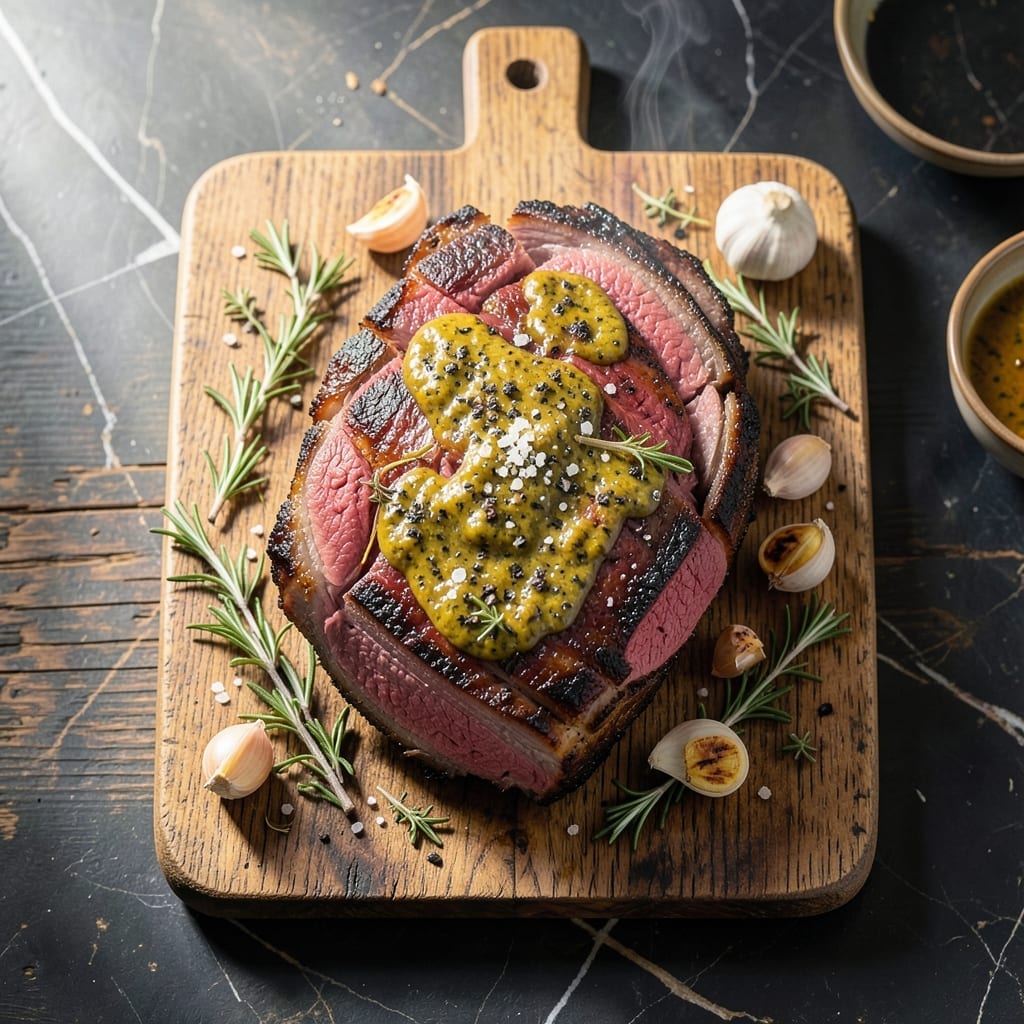
This oven-roasted prime rib delivers restaurant-quality elegance for your holiday table with minimal effort.
An herb crust seals in juices while creating a perfectly crisp exterior, making it the centerpiece any celebration deserves.
Ingredients for Prime Rib Recipe Oven
Prime rib plus fresh herbs equals holiday centerpiece with restaurant flair.
| Ingredient | Amount | Notes |
|---|---|---|
| Prime Rib Roast 🥩 | 5 lb | Bone-in, well-marbled preferred |
| Kosher Salt 🧂 | 2 tbsp | Diamond Crystal brand recommended |
| Freshly Ground Black Pepper 🌶️ | 2 tbsp | Coarse grind for crust |
| Garlic Cloves 🧄 | 6 cloves | Minced for herb paste |
| Fresh Rosemary 🌿 | 3 tbsp | Finely chopped, stems discarded |
| Fresh Thyme Leaves 🍃 | 3 tbsp | Stems removed before chopping |
| Dijon Mustard 🟡 | ¼ cup | For herb paste binding |
| Olive Oil 🫒 | ¼ cup | Extra-virgin for richness |
| Unsalted Butter 🧈 | 4 tbsp | Softened for herb paste |
| Red Wine 🍷 | 1 cup | Dry variety for deglazing |
| Beef Broth 🥣 | 1 cup | Low-sodium preferred |
| All-Purpose Flour 🌾 | 2 tbsp | For thickening pan sauce |
[recipe_ingredient_scaler]
The prime rib is star here. Bone-in roasts from Costco or your local butcher have the best marbling for juicy results (look for bright red meat with white fat streaks). Ask for the rib end—more flavor than the loin end. If buying pre-cut, get a 3-4 rib roast for even cooking. Let it sit at room temp for 2 hours before roasting—cold meat seizes up in the oven.
No red wine? Beef broth with a splash of balsamic vinegar works in a pinch. Fresh herbs are ideal but dried at one-third the amount gets you close (just rehydrate in the mustard). The butter can be swapped for olive oil if avoiding dairy, though the flavor will be less rich. No Dijon? Whole grain mustard adds a nice texture. The rosemary and thyme can be replaced with sage and marjoram for a different herb profile.
Leftovers keep 5 days wrapped tightly in the fridge, or freeze for 3 months. Slice before storing for easier reheating. The herb paste can be made a day ahead—just bring to room temp before spreading. Always rest the roast 30 minutes before carving (don’t skip this part).
Why You’ll Love This Recipe
- Minimal Effort: I just rub the roast with salt, pepper, garlic, and rosemary, then let the oven do the work.
- That Crust: The rosemary and garlic form this crazy flavorful crust that’s crispy outside, tender inside.
- Holiday Showstopper: It’s my go-to for Christmas dinner—everyone thinks I slaved for hours.
- Leftovers for Days: One prime rib feeds us for a week, and the sandwiches? Next level.
Step-by-Step Instructions for Prime Rib Roast
Here’s how I achieve that showstopping crust and perfect pink center every time.
Step 1: Prepare the Herb Crust Paste
In a small bowl, combine the 0.25 cup Dijon Mustard, 0.25 cup Olive Oil, 4 tbsp Unsalted Butter, 6 cloves Garlic Cloves (minced), 3 tbsp Fresh Rosemary (finely chopped), and 3 tbsp Fresh Thyme Leaves. Mix until it forms a thick, aromatic paste.
This paste will create that gorgeous herb crust that defines prime rib. The Dijon mustard acts as the perfect binder while adding a subtle tang that cuts through the richness of the beef. Let it sit for 5 minutes to let the flavors meld.
Step 2: Season and Coat the Prime Rib Roast
Pat the 5 lb Prime Rib Roast completely dry with paper towels. This is crucial – moisture on the surface will prevent proper browning. Season aggressively with the 2 tbsp Kosher Salt and 2 tbsp Freshly Ground Black Pepper, pressing the seasoning into the meat on all sides.
Now rub the herb paste all over the roast, creating an even layer. Don’t be shy – you want every bite to have that herby, garlicky flavor. Place the roast bone-side down on a rack in a roasting pan. This positioning allows the meat to cook more evenly and the bone acts as a natural rack.
Step 3: Roast to Perfection
Preheat your oven to 450°F. This high initial temperature will create that beautiful crust we’re after. Roast the prime rib for 20 minutes at this temperature, then reduce the heat to 325°F and continue roasting.
For medium-rare, cook until the internal temperature reaches 125-130°F on an instant-read thermometer (about 1.5-2 hours total). The meat will continue cooking as it rests. You’ll know it’s getting close when the crust is a deep golden brown and the herb paste has formed a beautiful crust.
Step 4: Make the Pan Sauce
Transfer the prime rib to a cutting board and tent loosely with foil. Place the roasting pan on the stovetop over medium heat. Add the 1 cup Red Wine and scrape up all those beautiful browned bits from the bottom of the pan.
Let the wine reduce by half, then whisk in the 1 cup Beef Broth. In a small bowl, mix the 2 tbsp All-Purpose Flour with a little water to make a slurry, then whisk it into the pan. Simmer for 5-7 minutes until the sauce thickens and coats the back of a spoon. Strain if you prefer a smoother sauce.
Step 5: Rest and Serve
Let the prime rib rest for at least 20 minutes before carving. This allows the juices to redistribute throughout the meat, ensuring every slice is moist and flavorful. I know it’s hard to wait when it smells this incredible, but it’s non-negotiable for the best results.
Carve the prime rib between the bones, then slice the meat against the grain into your desired thickness. Serve with the rich pan sauce spooned over the top. The meat should be a beautiful pink in the center with that fragrant herb crust on the outside – pure holiday perfection.
Pro Tips For Making Prime Rib Recipe Oven
- Start High, Finish Low: Sear the prime rib at 450°F for 20 minutes to build a deep crust, then drop to 325°F to finish cooking evenly—I learned this the hard way after serving dry, overcooked slices.
- Dry the Roast: Pat the prime rib thoroughly dry with paper towels before seasoning; even a little moisture prevents that perfect, crispy exterior we all want.
- Skip the Cold Roast: Let the prime rib sit at room temperature for 1-2 hours before cooking—this guarantees even cooking instead of a cold center and overdone edges.
- crush the garlic: Smash the garlic cloves with the side of your knife before mincing—they’ll release more flavor into the rosemary and pepper rub.
Health Benefits of This Recipe
Rich in Protein
This dish delivers an impressive 50 grams of protein per serving from the prime rib, supporting muscle maintenance and repair. Protein is essential for tissue building and immune function. The high-quality amino acids in beef make it a complete protein source. 💪
Iron and Zinc Boost
Beef is one of the best sources of heme iron, which your body absorbs more easily than plant-based iron. A serving provides about 15% of your daily iron needs along with 40% of daily zinc, crucial for immune health.
B Vitamin Powerhouse
You’ll get a significant dose of vitamin B12 (over 100% DV) and other B vitamins like B6 and niacin. These nutrients support energy metabolism and nervous system function. I notice I feel more energized after eating beef dishes.
Healthy Fats
While prime rib contains saturated fat, it also provides monounsaturated fats similar to those in olive oil. The marbling contributes to the juicy texture while providing essential fatty acids. Moderation is key with richer cuts.
Mineral Richness
This creation offers selenium, phosphorus, and copper in meaningful amounts. These minerals support antioxidant defense, bone health, and iron metabolism. The herb crust adds additional antioxidant benefits from rosemary and thyme. ✨
Nutrition Facts
Frequently Asked Questions
What’s the best internal temperature for medium-rare?
Aim for 125-130°F on an instant-read thermometer. The temperature will rise 5-10°F during resting. This ensures a perfect pink center with juicy results every time.
Should I cover it while resting?
Tent loosely with foil for 20-30 minutes. This keeps it warm while allowing steam to escape, preventing soggy crust. Never skip resting—it’s crucial for juicy slices.
Can I use dried herbs instead of fresh?
Yes, use 1/3 the amount of dried herbs. Rehydrate them in the mustard and oil for 10 minutes before applying. Fresh herbs offer brighter flavor, but dried work in a pinch.
How do I prevent the crust from burning?
Start at 450°F for 20 minutes, then lower to 325°F. If the crust browns too quickly, shield it with foil. Watch closely after the first hour.

Trained in classic French technique but raised on slow-cooked ribs and spicy rubs, she blends culinary skill with smoke and soul.
- Recipe for Boneless Pork Chops in Cast Iron Skillet: Sear and Baste to Juicy Perfection - October 3, 2026
- Recipe for Boneless Cross Rib Roast: Slow-Roasted Beef with Herb Crust - October 3, 2026
- Hamburgers in Sauce Recipe Crock Pot: Slow-Cooked Savory Delight - October 3, 2026