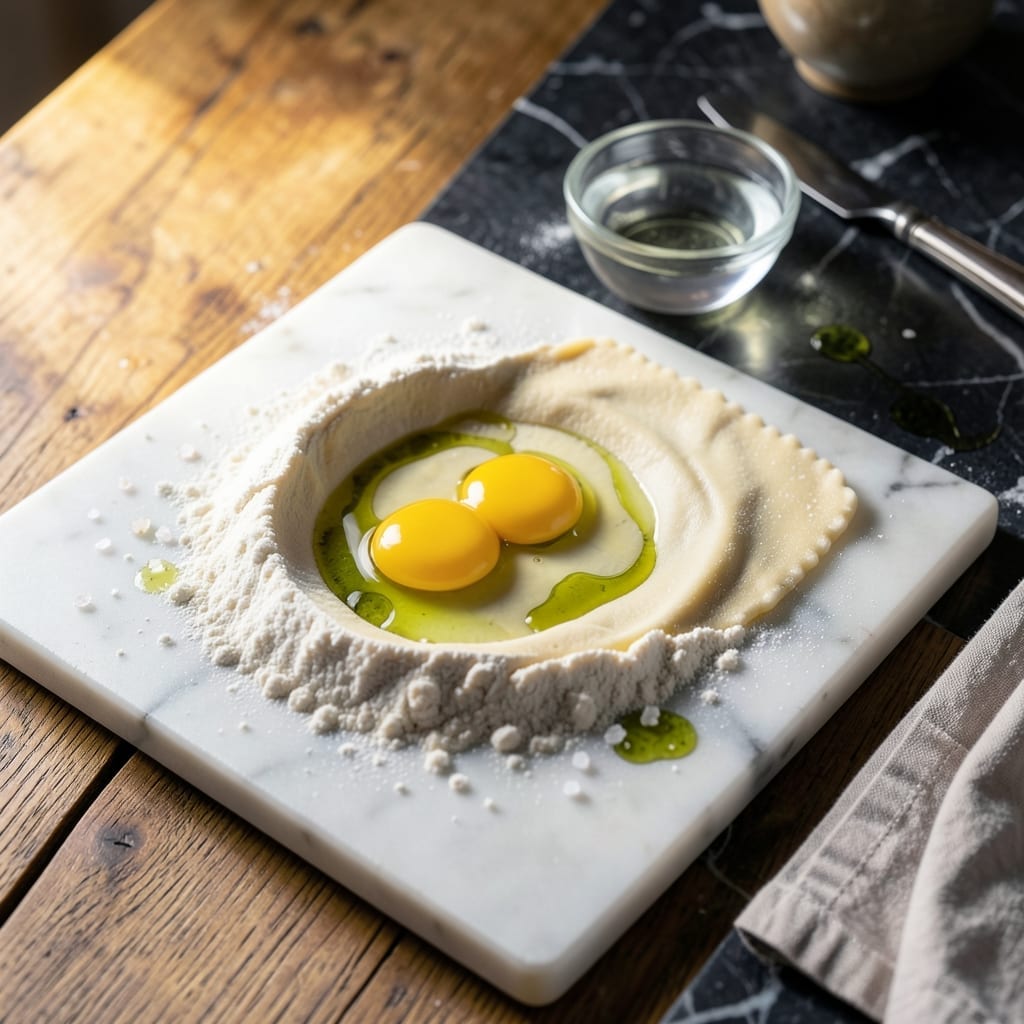
Homemade ravioli dough requires precision and patience, but the reward is a silky, tender pasta that elevates any filling. This recipe uses 00 flour for a delicate texture that’s impossible to replicate with all-purpose.
With a resting period and careful rolling, you’ll create thin, elastic sheets ready for any filling or sauce. The process is straightforward, but attention to detail ensures restaurant-quality results every time.
Ingredients for Ravioli Dough Recipe 00 Flour
Five ingredients yield restaurant-quality pasta dough with unmatched silkiness and elasticity.
| Ingredient | Amount | Notes |
|---|---|---|
| 00 Flour 🌾 | 2 cups | Italian-style, finely ground |
| Large Eggs 🥚 | 2 whole | Room temperature preferred |
| Olive Oil 🫒 | 1 tbsp | Extra-virgin for richness |
| Salt 🧂 | ½ tsp | Fine sea salt recommended |
| Water 💧 | 1 tbsp | As needed for consistency |
[recipe_ingredient_scaler]
The 00 flour is non-negotiable for authentic texture—Antimo Caputo or Bob’s Red Mill are reliable brands. Look for the finest grind, typically labeled as ‘doppio zero’ at Italian markets or well-stocked grocery stores. Room temperature eggs incorporate more evenly, so set them out 30 minutes before starting. This small step makes a noticeable difference in dough uniformity.
No 00 flour? All-purpose flour plus cornstarch (2 tbsp per cup) mimics the texture, though results won’t be identical. For egg-free versions, 1/4 cup water plus 1 tbsp oil per egg works, but the dough loses some elasticity. The olive oil can be swapped for melted butter if you prefer richness, but stick to neutral-tasting oils to avoid overpowering the delicate flavor.
The dough rests best covered with plastic wrap at room temperature for 30 minutes. Use within 24 hours or freeze for up to 1 month—thaw in the fridge overnight before rolling. Fresh dough sheets can also be dusted with flour and stacked between parchment for short-term storage.
Why You’ll Love This Recipe
- 5-Minute Mix: No stand mixer needed—I just dump the 00 flour, eggs, olive oil, salt, and a splash of water on the counter and knead.
- Silky Bite: That ultra-fine 00 flour gives the dough a delicate chew that melts around any filling I choose.
- Freezer Friend: I batch-make sheets, freeze them flat, and pull out only what I need for a quick weeknight ravioli fix.
- Pantry Pal: Eggs, flour, oil, salt—no special trips to the store, and it still tastes like a restaurant dish.
Step-by-Step Instructions for Ravioli Dough with 00 Flour
Master the technique for creating a silky, elastic pasta base that rolls out perfectly every time.
Step 1: Create the Flour Well and Add Wet Ingredients
On a clean work surface, mound the 2 cups 00 Flour and create a well in the center large enough to hold the wet ingredients. The fine grind of 00 flour is essential here—it creates a dough with superior elasticity and a velvety texture.
Crack the 2 whole Large Eggs directly into the well, then add the 1 tbsp Olive Oil and 0.5 tsp Salt. I always use room temperature eggs for this; they incorporate more evenly into the flour, preventing a dough that’s too stiff or prone to cracking during rolling.
Step 2: Gradually Incorporate the Flour
Using a fork, begin whisking the eggs in a circular motion, slowly drawing the flour from the edges of the well into the wet ingredients. Continue this process until the mixture becomes too thick to whisk, then switch to your hands.
At this stage, the dough will look shaggy and dry. Don’t be tempted to add too much water prematurely. The 1 tbsp Water should only be introduced if the mixture refuses to come together after thorough kneading. Press your palms into the dough, pushing and folding it repeatedly to hydrate the flour evenly.
Step 3: Knead to Develop Gluten
Once the dough forms a rough ball, begin kneading in earnest. Use the heel of your hand to push the dough away from you, then fold it back over itself and turn it a quarter turn. Repeat this motion for 8-10 minutes.
The dough should start out slightly tacky but will become smoother and more elastic as you work it. If it feels too dry, dampen your hands with a bit of the 1 tbsp Water and continue kneading. You’ll know it’s ready when it springs back lightly to the touch and has a satin-like finish.
Step 4: Rest the Dough for Optimal Texture
Shape the dough into a ball, wrap it tightly in plastic wrap, and let it rest at room temperature for 30 minutes. This resting period allows the gluten to relax, making the dough far easier to roll out thinly without springing back.
Don’t skip this step—it’s the secret to achieving paper-thin sheets that hold their shape when cut and filled. After resting, the dough should feel supple and roll out effortlessly, whether by hand or with a pasta machine.
Pro Tips For Making Ravioli Dough Recipe 00 Flour
- Knead Longer: I learned this the hard way—under-kneading leaves the dough tough. Give it a good 8-10 minutes until it’s smooth and elastic, almost like Play-Doh.
- Use Room Temp Eggs: Sounds weird, but it works: cold eggs can make the dough seize up. Pull them out 30 minutes before mixing.
- Skip Extra Flour: Resist the urge to dust the counter heavily—too much extra flour makes the dough dry and cracks when rolling.
- Rest the Dough: After mixing, wrap it in plastic and let it sit for at least 30 minutes. I skip this when I’m lazy, but the dough is noticeably easier to roll when I don’t.
Essential Equipment for This Recipe
Pasta Machine
A high-quality pasta machine is non-negotiable for rolling out ravioli dough to the perfect thickness. I swear by the Marcato Atlas 150—it’s durable, clamps to any counter, and gives consistent results. Start at the widest setting and gradually thin the dough over 4-5 passes. 💪
Rolling Pin Alternative
If you prefer hand-rolling, invest in a long, heavy French rolling pin without handles. The weight helps create even pressure. Dust your surface with 00 flour to prevent sticking, and roll from the center outward in all directions.
Ravioli Cutters
For clean, professional edges, fluted ravioli cutters or square molds are worth the investment. I like the Ateco 2-inch square cutter for consistent sizing. Alternatively, a sharp chef’s knife works in a pinch, though it requires a steadier hand.
Bench Scraper
A bench scraper is my secret weapon for dividing dough evenly and cleaning sticky surfaces. The flat edge helps lift delicate sheets without tearing. I use mine to portion the dough before rolling and to scrape up every last bit of flour.
Plastic Wrap
Don’t underestimate the importance of good plastic wrap for resting dough. Press it directly onto the surface to prevent drying. I prefer heavy-duty wrap from Reynolds—it clings better and won’t tear as you stretch it over the dough.
Kitchen Scale
Precision matters with pasta dough, so a digital kitchen scale is essential. Measure your 00 flour in grams (250g for this recipe) for accuracy. I use an OXO Good Grips scale—it’s affordable and easy to clean. ✨
Nutrition Facts
Frequently Asked Questions
Can I substitute all-purpose flour for 00?
You can, but the texture won’t be as delicate. Add 2 tbsp cornstarch per cup to mimic fineness. Expect slightly chewier results.
Why does the dough need to rest?
Resting relaxes gluten strands, making rolling easier and preventing shrinkage. Skip this, and dough springs back like a rubber band.
How thin should I roll the dough?
Aim for 1-2mm thickness—thin enough to see your hand through but not tear. A pasta machine’s second-to-last setting works perfectly.
Can I make this dough in a food processor?
Yes! Pulse 00 flour with eggs until crumbly, then knead by hand for 2 minutes. The processor saves time but don’t overmix.

Trained in classic French technique but raised on slow-cooked ribs and spicy rubs, she blends culinary skill with smoke and soul.
- Recipe for Boneless Pork Chops in Cast Iron Skillet: Sear and Baste to Juicy Perfection - October 3, 2026
- Recipe for Boneless Cross Rib Roast: Slow-Roasted Beef with Herb Crust - October 3, 2026
- Hamburgers in Sauce Recipe Crock Pot: Slow-Cooked Savory Delight - October 3, 2026