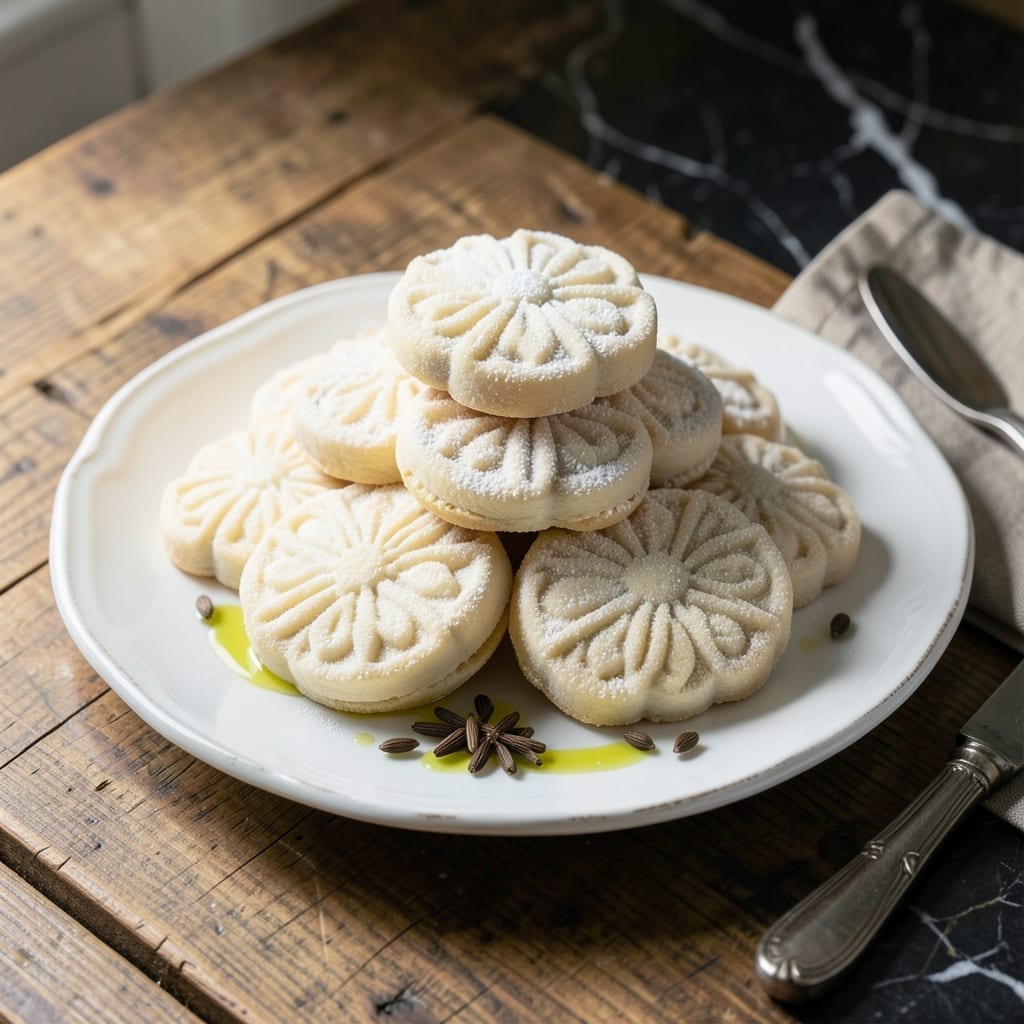
These traditional cookies capture centuries of German baking heritage with their distinctive imprinted designs and subtle anise flavor.
Using a springerle mold creates the characteristic raised patterns, while a slow drying process ensures the perfect texture for this classic treat.
Ingredients for Recipe for German Springerle Cookies
Traditional German baking requires precise ingredients for authentic springerle cookies with their signature anise flavor.
| Ingredient | Amount | Notes |
|---|---|---|
| All-Purpose Flour 🌾 | 4 cups | Sifted for even texture |
| Granulated Sugar 🍚 | 2 cups | Fine grain for smooth dough |
| Unsalted Butter 🧈 | ½ cup | Softened to room temperature |
| Large Eggs 🥚 | 4 whole | Room temperature for best rise |
| Anise Seeds 🌿 | 2 tbsp | Lightly crushed for flavor |
| Anise Extract 💧 | 1 tsp | Pure extract recommended |
| Baking Powder 🧂 | 1 tsp | Ensures proper rise |
| Salt 🧂 | ½ tsp | Fine sea salt preferred |
| Whole Milk 🥛 | ¼ cup | For dough consistency |
| Powdered Sugar 🍚 | ½ cup | For dusting finished cookies |
[recipe_ingredient_scaler]
The flour is foundational here. King Arthur or Gold Medal all-purpose flour yields consistent results. Anise seeds must be fresh—check the expiration date on the package. For the extract, McCormick or Frontier Co-op offer reliable quality. The butter should be European-style for higher fat content, enhancing the cookie’s texture and richness.
No anise seeds? Fennel seeds at equal measure provide a similar licorice note. If avoiding alcohol-based extracts, anise oil at one-fourth the amount works (but use sparingly). For a dairy-free version, coconut oil can replace butter, though the flavor profile will differ slightly. Ensure eggs are fresh—older eggs may not hold the imprint as well.
Store anise seeds and extract in airtight containers away from light. The dough requires overnight drying before baking. Finished cookies keep in an airtight container for up to 2 weeks, though they’re best enjoyed within 5 days for optimal texture and flavor.
Why You’ll Love This Recipe
- One Bowl Wonder: I love that I can mix everything in a single bowl—flour, sugar, butter, eggs, and those fragrant anise seeds—no fancy equipment needed.
- Warm Spiced Aroma: The anise seeds toast slightly as they bake, filling my kitchen with that cozy, old-world scent that makes these cookies irresistible.
- Holiday Tradition: These are my go-to for Christmas cookie swaps, but honestly, I bake them year-round because they’re just that special.
- Budget Friendly: A handful of pantry staples and a few eggs make dozens of cookies—perfect for feeding a crowd without breaking the bank.
Step-by-Step Instructions for German Springerle Cookies
Master the traditional technique for these embossed anise cookies with precise, time-tested methods.
Step 1: Cream Butter and Sugars for Ideal Texture
In a stand mixer fitted with the paddle attachment, beat the 0.5 cup Unsalted Butter with the 2 cups Granulated Sugar on medium speed for 5-7 minutes until the mixture becomes pale and fluffy. This extended creaming incorporates air, which is essential for the cookies’ characteristic lightness.
The butter must be at true room temperature—65-68°F—to properly emulsify with the sugar. If the mixture looks grainy, continue beating until smooth. This base sets the foundation for the dough’s structure and rise.
Step 2: Incorporate Eggs and Anise Flavoring
Add the 4 whole Large Eggs, one at a time, mixing for 1 full minute after each addition to fully emulsify. Scrape the bowl as needed to ensure even mixing. The eggs provide moisture and binding, while their fat contributes to tenderness.
Next, beat in the 1 tsp Anise Extract and the 2 tbsp Anise Seeds, which should be lightly crushed to release their aromatic oils. The dough will be thick and slightly sticky at this stage—this is normal. The anise seeds add texture and a subtle, authentic crunch.
Step 3: Combine Dry Ingredients and Form the Dough
In a separate bowl, whisk together the 4 cups All-Purpose Flour, 1 tsp Baking Powder, and 0.5 tsp Salt to evenly distribute the leavening agent. Gradually add this dry mixture to the wet ingredients on low speed, mixing just until combined.
Pour in the 0.25 cup Whole Milk and mix for an additional 30 seconds until a cohesive, slightly tacky dough forms. Avoid overmixing, as this can develop gluten and result in tough cookies. The dough should pull away from the sides of the bowl but still cling slightly to the paddle.
Step 4: Chill, Roll, and Imprint the Dough
Divide the dough into four equal portions, flatten into discs, and wrap in plastic. Refrigerate for at least 2 hours or overnight. Chilling firms the dough, making it easier to handle and imprint with a springerle mold or rolling pin.
On a lightly floured surface, roll one disc to a ¼-inch thickness. Press the mold firmly into the dough to create sharp, clear impressions. Use a knife to cut around the design, then transfer each cookie to a parchment-lined baking sheet. Space them 1 inch apart to allow for minimal spreading.
Step 5: Dry, Bake, and Dust for Traditional Finish
Let the imprinted cookies dry at room temperature for 2-4 hours or overnight. This drying step is critical—it allows the surface to form a slight skin, which helps the impressions hold their shape during baking. The cookies should feel slightly firm to the touch.
Preheat the oven to 325°F and bake for 12-15 minutes until the edges are just beginning to turn pale golden. Do not overbake; the cookies should remain light in color. Cool completely on a wire rack, then dust generously with 0.5 cup Powdered Sugar before serving.
Pro Tips For Making Recipe For German Springerle Cookies
- Chill the Dough: After mixing, refrigerate the dough for at least 2 hours—this prevents spreading and keeps the embossed designs sharp. I learned this the hard way after my first batch lost all its intricate patterns.
- Toast the Anise: Lightly toast the anise seeds in a dry pan for 30 seconds before adding to the dough. Sounds weird, but it works: the flavor deepens and the aroma fills the kitchen.
- Roll Evenly: Use a rolling pin to get the dough exactly 1/4-inch thick—any thicker and the cookies won’t bake through, any thinner and they’ll be brittle. My grandmother swore by this, and she was right.
- Press Firmly: When pressing the springerle mold into the dough, push down hard and hold for 5 seconds to ensure clean, defined impressions. Skip this and you’ll end up with faint, barely-there designs.
Common Mistakes When Making This Dish
Dough Too Sticky
If your dough feels overly tacky after mixing, resist adding extra flour. Instead, chill it for 2 hours first—this firms the butter and makes it more manageable. I’ve found that King Arthur flour absorbs moisture more consistently than other brands.
Skipping the Drying Step
The 2-4 hour drying period is non-negotiable for preserving the imprinted designs. Without it, the cookies spread and lose their definition. I set mine near a sunny window with a fan for even air circulation. 💡
If short on time, use a dehydrator at 95°F for 1 hour, but watch closely to prevent cracking.
Butter Too Warm
Butter that’s too soft or melted won’t cream properly with sugar. Aim for 65-68°F—it should dent when pressed but not look greasy. I cut mine into ½-inch cubes and let it sit for 30-45 minutes before mixing.
Overmixing the Dough
Once the flour is added, mix just until combined—about 30 seconds. Overworking develops gluten, leading to tough cookies. I stop the mixer as soon as I see no dry streaks remaining.
Incorrect Imprint Pressure
Press the mold firmly and evenly into the ¼-inch thick dough. If the design isn’t sharp, the dough may be too thick or the mold wasn’t pressed hard enough. I roll my dough between parchment sheets for even thickness. ✨
Nutrition Facts
Frequently Asked Questions
Can I make these without a springerle mold?
Yes! Use a rolling pin with textured patterns or press designs with a clean, decorative stamp. The key is pressing firmly into ¼-inch thick dough.
Why does the dough need to dry overnight?
Drying forms a skin that preserves the imprinted designs during baking. Skip this, and your cookies will spread, losing their signature raised patterns.
How do I store the finished cookies?
Keep in an airtight container at room temperature for up to 2 weeks. For best texture, dust with powdered sugar just before serving.
Can I substitute the anise flavor?
Try fennel seeds or almond extract for a different twist. Reduce almond extract to ½ tsp to avoid overpowering the dough.

Trained in classic French technique but raised on slow-cooked ribs and spicy rubs, she blends culinary skill with smoke and soul.
- Recipe for Boneless Pork Chops in Cast Iron Skillet: Sear and Baste to Juicy Perfection - October 3, 2026
- Recipe for Boneless Cross Rib Roast: Slow-Roasted Beef with Herb Crust - October 3, 2026
- Hamburgers in Sauce Recipe Crock Pot: Slow-Cooked Savory Delight - October 3, 2026