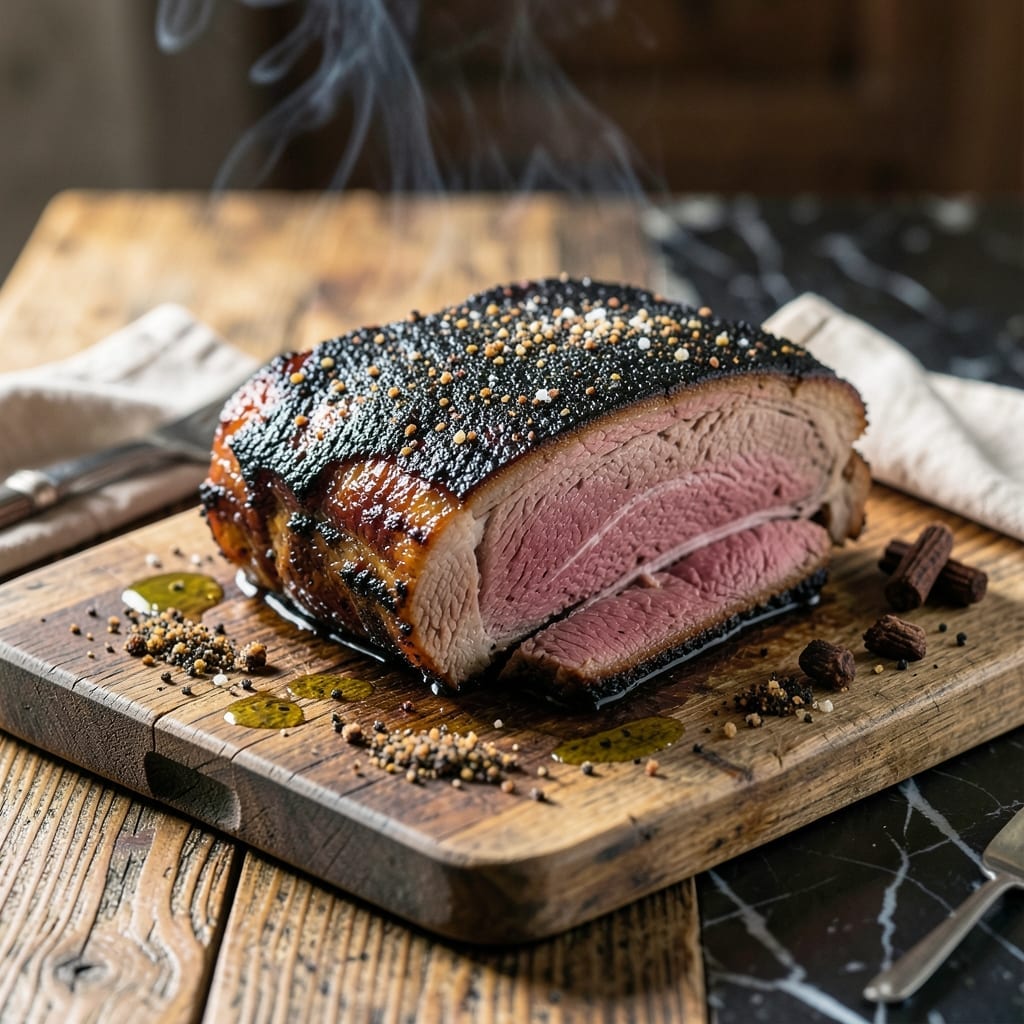
True Texas brisket demands patience and precision. This low and slow method transforms tough meat into tender, smoky perfection.
I’ve spent years refining this technique, blending traditional pitmaster wisdom with professional culinary skill to achieve that coveted bark and juicy interior.
Ingredients for Texas Barbecue Beef Brisket
A few quality ingredients and patience yield authentic Texas barbecue brisket with perfect bark and tender interior.
| Ingredient | Amount | Notes |
|---|---|---|
| Beef Brisket 🥩 | 4 lb | Whole packer cut, untrimmed |
| Kosher Salt 🧂 | ¼ cup | Diamond Crystal preferred for bark |
| Coarse Black Pepper 🌶️ | ¼ cup | Freshly ground for best texture |
| Garlic Powder 🧄 | 2 tbsp | Granulated for even distribution |
| Onion Powder 🧅 | 2 tbsp | Fine grind for rub adhesion |
| Paprika 🌶️ | 2 tbsp | Sweet or smoked variety |
| Mustard Powder 🟡 | 1 tbsp | Enhances bark formation |
| Brown Sugar 🧈 | 2 tbsp | Light or dark for caramelization |
| Cayenne Pepper 🔥 | 1 tsp | Adjust for heat preference |
| Apple Cider Vinegar 🍏 | ½ cup | For spritzing during cook |
| Yellow Mustard 🟡 | ¼ cup | Binder for dry rub |
| Hickory Wood Chunks 🪵 | 4 pieces | Or oak for traditional smoke |
| Beef Tallow 🧈 | ¼ cup | Melted, for moisture during cook |
[recipe_ingredient_scaler]
The brisket itself is non-negotiable—whole packer cut from a trusted butcher or Costco’s prime grade works well. Look for heavy marbling; the fat renders down during the long cook, keeping the meat moist. Diamond Crystal kosher salt is preferred by pitmasters for its coarse texture and clean flavor. Avoid iodized table salt; it can impart a metallic taste to the bark.
No hickory? Oak or pecan wood deliver excellent results with slightly different smoke profiles. Mustard powder can be omitted, but it adds a subtle tang that complements the beef. For a sweeter bark, increase the brown sugar to 3 tablespoons. Worcestershire sauce can be added to the spritz for extra umami, but traditional Texas brisket relies on salt, pepper, and smoke.
Trimmed brisket can be stored in the fridge for 2-3 days before cooking, but fresh is ideal. Leftovers? Wrap tightly in foil and refrigerate for up to 5 days, or freeze for 3 months. The flavor actually improves after a day, making leftovers a prize.
Why You’ll Love This Recipe
- Low-Effort Prep: I just rub the brisket with salt, pepper, garlic and onion powder—no marinade, no fuss.
- That Texas Bark: Honestly, the crust from the coarse black pepper and kosher salt is what makes it ridiculously good.
- Feeds a Crowd: One brisket serves my entire family plus leftovers for sandwiches the next day.
- Budget Stretcher: I get multiple meals out of a single affordable cut, and it’s cheaper than buying pre-smoked.
Step-by-Step Instructions for Texas Barbecue Beef Brisket
Master the art of low and slow smoking with this proven technique for tender, flavorful results.
Step 1: Prepare and Season the Brisket
Begin by trimming the 4 lb Beef Brisket fat cap to ¼ inch thickness, preserving enough to protect the meat during the long cook. This step ensures even smoke penetration while maintaining moisture.
In a bowl, combine the 0.25 cup Kosher Salt, 0.25 cup Coarse Black Pepper, 2 tbsp Garlic Powder, 2 tbsp Onion Powder, 2 tbsp Paprika, 1 tbsp Mustard Powder, 2 tbsp Brown Sugar, and 1 tsp Cayenne Pepper. Apply the rub generously to all sides of the brisket, pressing firmly to adhere. Coat the brisket with 0.25 cup Yellow Mustard as a binder before applying the dry rub for maximum adhesion.
Let the seasoned brisket rest uncovered at room temperature for 1 hour while you prepare the smoker. This allows the rub to penetrate and the meat to cook more evenly.
Step 2: Set Up the Smoker for Low and Slow Cooking
Preheat your smoker to 225-250°F using the 4 pieces Hickory Wood Chunks for authentic smoke flavor. Maintain this temperature range throughout the cook for optimal results. Place a water pan in the smoker to help regulate temperature and add moisture to the cooking environment.
When the smoker reaches temperature and produces thin blue smoke, place the brisket fat-side up on the cooking grate. Position it away from direct heat to prevent burning. Close the lid and maintain the temperature for the duration of the cook.
Step 3: Smoke and Spritz the Brisket
Smoke the brisket undisturbed for 4-6 hours until it develops a dark, flavorful bark. Resist the temptation to open the smoker frequently, as this causes temperature fluctuations and extends the cooking time.
After the initial smoke period, begin spritzing the brisket every 45-60 minutes with a mixture of 0.5 cup Apple Cider Vinegar and water (1:1 ratio). This helps keep the surface moist and enhances bark formation. Continue smoking until the internal temperature reaches 165-170°F.
Step 4: Wrap and Continue Cooking
When the brisket hits 165-170°F, it will stall as moisture evaporates. At this point, wrap the brisket tightly in pink butcher paper, adding 0.25 cup Beef Tallow for moisture and flavor. This “Texas crutch” method helps power through the stall while preserving the bark.
Return the wrapped brisket to the smoker and continue cooking until the internal temperature reaches 200-205°F and a probe slides in like butter. This typically takes another 4-6 hours, but trust the probe test over the thermometer.
Step 5: Rest and Slice the Brisket
Remove the brisket from the smoker and let it rest in the butcher paper for at least 1 hour, preferably 2 hours wrapped in towels in a cooler. This resting period allows the juices to redistribute throughout the meat, ensuring maximum tenderness.
Locate the grain direction and slice the brisket against the grain into ¼-inch thick portions. The flat and point have different grain directions, so adjust your slicing angle accordingly. Serve immediately for the best texture and flavor.
Pro Tips For Making Texas Barbecue Beef Brisket
- Rest Overnight: I learned this the hard way—after seasoning, let the brisket sit uncovered in the fridge for 12 hours so the salt and spices penetrate deep into the meat.
- Low and Slow: Keep your smoker or oven at 225°F and resist the urge to rush it; a full packer brisket can take 12-14 hours to reach that perfect 195-203°F internal temp.
- Skip the Water Pan: Sounds weird, but it works: dry heat in the smoker gives a better bark—just spritz with apple juice every hour to keep it from drying out.
- Slice Against Grain: After resting, slice the brisket against the grain for tender bites—this is non-negotiable, especially with the flat half of the brisket.
Pro Cooking Tips for This Dish
Temperature Control
I can’t stress this enough—maintain 225-250°F consistently in your smoker. I use a ThermoWorks Smoke dual-probe thermometer with one probe in the smoker and another in the brisket. Thin blue smoke is your target; white smoke means your wood isn’t burning cleanly. 🌡️
The Stall Phase
When your brisket hits 165-170°F, it will stall for hours. This is normal—moisture evaporates, cooling the meat. Don’t increase heat. Instead, use the Texas crutch: wrap tightly in pink butcher paper with 0.25 cup Beef Tallow.
Probe Test
Temperature alone doesn’t guarantee doneness. At 200-205°F, probe the thickest part. It should slide in like warm butter. If it resists, keep cooking—this meat won’t lie to you. I learned this the hard way at my first local BBQ competition.
Resting Period
Rest your brisket wrapped in towels in a cooler for at least 1 hour, preferably 2 hours. This lets juices redistribute. Slice too soon, and you’ll lose all that moisture to your cutting board. Patience here separates good brisket from legendary.
Slicing Technique
The flat and point have different grain directions. Slice each section against its grain in ¼-inch thick portions. I use my Dexter-Russell 12-inch slicing knife for clean cuts. This ensures every bite is as tender as the last. 💡
Nutrition Facts
Frequently Asked Questions
What’s the ideal smoker temperature?
Maintain a consistent 225-250°F throughout the cook. This low and slow approach ensures tender results. Use a reliable thermometer to monitor.
How long does it take to smoke?
Plan for 10-12 hours total, including 4-6 hours unwrapped and another 4-6 hours wrapped. The stall phase can add time, so patience is key.
Can I use foil instead of butcher paper?
Foil works but may soften the bark. Pink butcher paper preserves texture while speeding up the cook. Both methods keep moisture in.
How do I know when it’s done?
Check for an internal temp of 200-205°F and probe tenderness. The probe should slide in like butter. Trust the feel over the thermometer.

Trained in classic French technique but raised on slow-cooked ribs and spicy rubs, she blends culinary skill with smoke and soul.
- Recipe for Boneless Pork Chops in Cast Iron Skillet: Sear and Baste to Juicy Perfection - October 3, 2026
- Recipe for Boneless Cross Rib Roast: Slow-Roasted Beef with Herb Crust - October 3, 2026
- Hamburgers in Sauce Recipe Crock Pot: Slow-Cooked Savory Delight - October 3, 2026