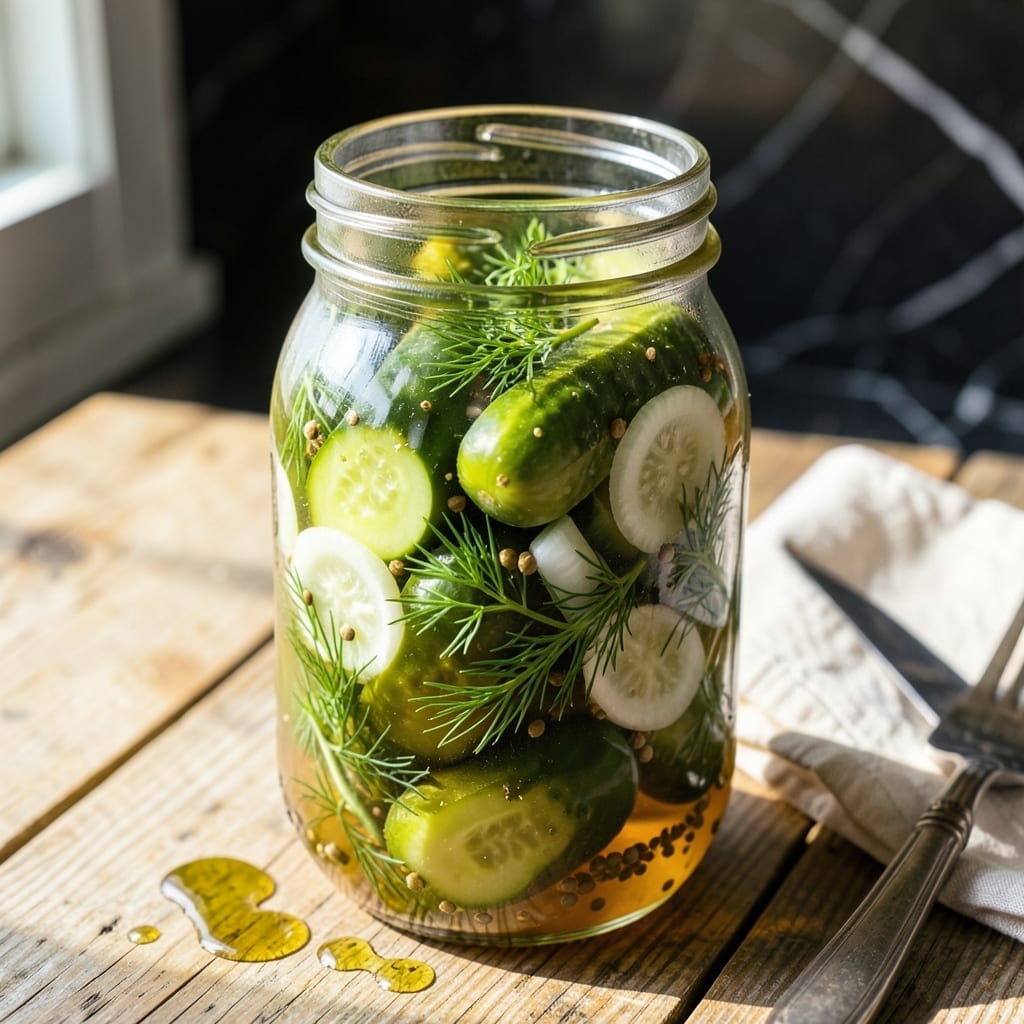
This recipe transforms fresh cucumbers into crisp, tangy-sweet pickles with authentic Amish flavor. The secret lies in the perfect balance of sugar and dill.
With simple ingredients and a short fermentation, you’ll achieve that signature crunch and bright flavor that makes these pickles irresistible.
Ingredients for Amish Sweet Dill Pickle
Fresh cucumbers and bold spices create this crunchy, tangy-sweet classic with authentic Amish character.
| Ingredient | Amount | Notes |
|---|---|---|
| Fresh Cucumbers 🥒 | 2 lb | Small Kirby or pickling variety preferred |
| White Vinegar 💧 | 3 cups | 5% acidity for preservation |
| Water 💧 | 3 cups | Filtered for best clarity |
| Granulated Sugar 🍚 | ¾ cup | Balances the tangy brine |
| Pickling Salt 🧂 | 2 tbsp | Non-iodized for clear brine |
| Fresh Dill 🌿 | ½ cup | Stems and flower heads included |
| Garlic Cloves 🧄 | 8 cloves | Peeled and smashed |
| Mustard Seeds 🌱 | 1 tbsp | Yellow or brown varieties |
| Dill Seeds 🌿 | 1 tbsp | Adds depth to dill flavor |
| Black Peppercorns 🌶️ | 1 tsp | Whole for slow flavor release |
| Red Pepper Flakes 🌶️ | ½ tsp | Adjust for heat preference |
| Bay Leaves 🍃 | 4 pieces | Dried, for aromatic depth |
| Grape Leaves 🍇 | 4 pieces | Optional for added crunch |
[recipe_ingredient_scaler]
The cucumbers are non-negotiable here. Kirby cucumbers are the gold standard for pickling—they stay crisp and hold their shape. Find them at farmers markets in summer or specialty produce sections year-round. The vinegar must be 5% acidity; anything lower risks unsafe fermentation. Ball or Heinz brands are reliable. Pickling salt is essential—iodized salt turns brine cloudy.
No fresh dill? Dried dill seed at half the amount works, but fresh delivers that bright, grassy note. Swap grape leaves for oak or horseradish leaves if you’re foraging. The sugar can be reduced slightly, but don’t skip it—it’s what makes these “sweet” dill pickles. For a clearer brine, use filtered water. Morton’s pickling salt is a safe bet if your store carries it.
These pickles taste best after 48 hours but are safe to eat after 24. Store in the fridge for up to 2 months—the flavor deepens over time. Use a clean jar each time you grab a spear to prevent contamination. The brine? Save it for salad dressing or a Bloody Mary mixer.
Why You’ll Love This Recipe
- Minimal Chopping Required: I just slice the cucumbers and toss everything in a pot—no fancy prep work here.
- Crave-Worthy Balance: The sugar and dill hit that perfect sweet-tangy note that keeps me reaching back in the jar.
- Jars Full of Options: Honestly, these pickles disappear fast at summer picnics but also brighten up a simple sandwich any day.
- Pantry Staple Savings: Pickling salt and vinegar are cheap, and a big batch of cucumbers costs pennies compared to store-bought.
Step-by-Step Instructions for Amish Sweet Dill Pickles
This traditional method ensures crisp, flavorful pickles with the perfect balance of sweet and tang.
Step 1: Prepare the Cucumbers
Begin by thoroughly washing the 2 lb Fresh Cucumbers. I prefer Kirby or pickling varieties for their thick walls and small seed cavities. Trim off and discard the blossom end of each cucumber—this is crucial as it contains enzymes that can soften pickles over time.
Slice the cucumbers into spears or leave them whole if they’re small. For uniform pickles, aim for similar sizes so they absorb the brine evenly. If using the optional 4 pieces Grape Leaves, place one at the bottom of each jar—this adds tannins that help maintain crispness.
Step 2: Sterilize Jars and Prepare Brine
While preparing the cucumbers, sterilize your canning jars and lids in boiling water for 10 minutes. This step prevents contamination and ensures proper preservation. Keep the jars hot until ready to fill.
In a large pot, combine the 3 cups White Vinegar, 3 cups Water, 0.75 cup Granulated Sugar, and 2 tbsp Pickling Salt. Bring to a boil over high heat, stirring until the sugar and salt dissolve completely. The brine should be clear with no visible granules.
Step 3: Layer Aromatics and Cucumbers
Divide the 0.5 cup Fresh Dill, 8 cloves Garlic Cloves, 1 tbsp Mustard Seeds, 1 tbsp Dill Seeds, 1 tsp Black Peppercorns, 0.5 tsp Red Pepper Flakes, and 4 pieces Bay Leaves evenly among your prepared jars. These aromatics will infuse the pickles with complex flavors during the brining process.
Pack the cucumbers tightly into the jars, leaving about ½ inch of headspace at the top. The cucumbers should be snug but not crushed—this ensures they stay submerged in the brine. If using grape leaves, tuck one against the side of each jar.
Step 4: Fill with Brine and Process
Carefully ladle the hot brine into each jar, completely covering the cucumbers and aromatics. Tap the jars gently on the counter to remove air bubbles. Wipe the rims with a clean, damp cloth to ensure a proper seal.
Seal with lids and process in a boiling water bath for 10 minutes. For altitudes above 1,000 feet, add 5 minutes to processing time. After processing, let the jars cool undisturbed for 12-24 hours. You should hear the satisfying “pop” of lids sealing as they cool.
Step 5: Store and Wait for Perfect Flavor
Once cooled, check the seals by pressing down on the lids—they should not flex or pop. Store the sealed jars in a cool, dark place for at least 48 hours before opening to allow flavors to develop fully.
For best results, wait 2-3 weeks before eating. The pickles will continue to develop more complex flavors over time. Refrigerate after opening and consume within 1 month for optimal texture and taste. The brine itself can be reused for a second batch if desired.
Pro Tips For Making Amish Sweet Dill Pickle
- Soak the Cucumbers: I learned this the hard way—soak fresh cucumbers in ice water for 1-2 hours before pickling to keep them crisp. Skip this and you’ll end up with limp pickles, no matter how perfect the brine.
- Use Pickling Salt: Regular table salt has additives that can cloud your brine. Stick with pickling salt—about 2 tablespoons per quart of liquid—for a clear, clean flavor.
- Heat the Brine: Bring your vinegar, water, sugar, and salt to a boil first, then pour it hot over the cucumbers. This ensures the sugar and salt dissolve fully and the flavors meld faster.
- Pack Tight, Not Too Tight: Cramming too many cucumbers into the jar can prevent the brine from circulating. Leave about 1/2 inch of headspace at the top to guarantee even flavor distribution.
Flavor Customization for This Recipe
Extra Spicy Kick
For heat lovers, increase the red pepper flakes to 1 tsp or add 2 sliced jalapeños per jar. The capsaicin will infuse beautifully without overpowering the sweet-dill balance. I often do this for our local BBQ competitions. 🌶️
Herb Infusions
Add 1 tbsp fresh tarragon or 5 sprigs fresh thyme to each jar for an herbal twist. These complement the dill while adding complexity. I forage wild thyme along my coastal rides for a unique touch.
Sweeter Brine
For a dessert-like pickle, increase sugar to 1 cup and add 1 cinnamon stick per jar. This creates a sweet-spiced profile perfect with charcuterie boards. The cinnamon pairs surprisingly well with the dill.
Umami Boost
Add 1 tsp soy sauce or 1 dried shiitake mushroom to the brine for depth. This Japanese-inspired variation adds savory notes while maintaining the pickle’s crunch. I learned this trick during my French technique training.
Citrus Zing
Include 2 strips lemon peel or 1 tbsp coriander seeds per jar for bright citrus notes. The acidity enhances the tang while adding a refreshing twist. Perfect for summer picnics.
Garlic Variations
For intense garlic flavor, use 12 cloves instead of 8. Or try black garlic for a molasses-like depth. The fermented notes complement the pickle’s own fermentation beautifully. 💡
Nutrition Facts
Frequently Asked Questions
What’s the best cucumber type for crunch?
Use Kirby or pickling cucumbers for the crispest results. Their thick walls and small seeds hold up perfectly during brining.
How long do these pickles need to ferment?
Wait at least 48 hours for minimum flavor, but 2-3 weeks yields the best taste. The longer they sit, the more complex the flavor becomes.
Can I reuse the brine from a finished jar?
Yes, but only for a second batch. The acidity weakens with reuse, so avoid extending beyond that.
Why did my pickles turn out soft?
Soft pickles often result from not trimming the blossom end or using overripe cucumbers. Always remove 1/4 inch from the blossom end before brining.

Trained in classic French technique but raised on slow-cooked ribs and spicy rubs, she blends culinary skill with smoke and soul.
- Recipe for Boneless Pork Chops in Cast Iron Skillet: Sear and Baste to Juicy Perfection - October 3, 2026
- Recipe for Boneless Cross Rib Roast: Slow-Roasted Beef with Herb Crust - October 3, 2026
- Hamburgers in Sauce Recipe Crock Pot: Slow-Cooked Savory Delight - October 3, 2026