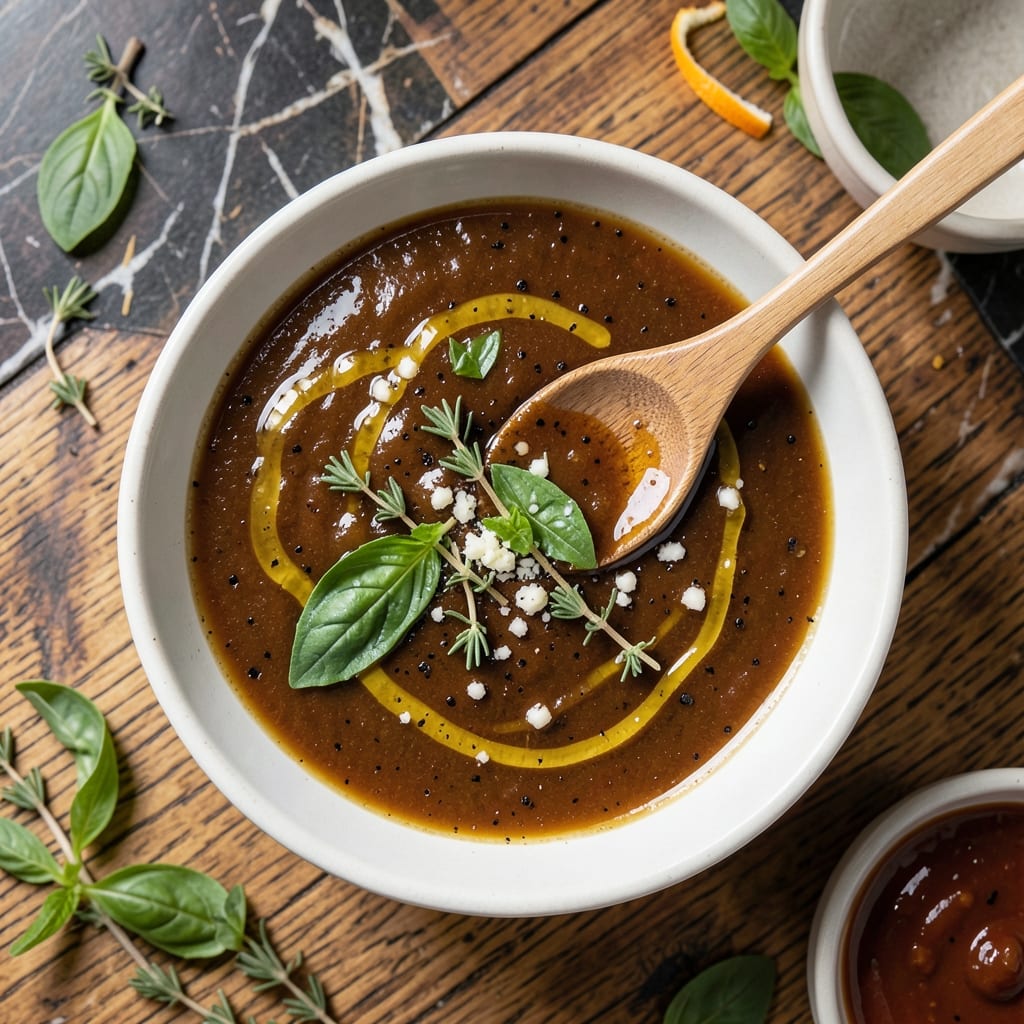
This dressing transforms simple salads into restaurant-quality dishes with its perfect balance of tangy and sweet flavors. I developed this recipe after years of testing ratios to achieve that ideal emulsion.
The key is using high-quality balsamic vinegar and slowly whisking in the oil to create a silky, stable dressing. Fresh herbs add depth that store-bought versions simply can’t match.
What you’ll create is a versatile dressing that works on everything from delicate greens to hearty grain bowls. It keeps beautifully in the fridge for up to 2 weeks.
David declared this his new favorite after the first taste test. Here’s how to make it at home.
Ingredients for Balsamic Vinegar Salad Dressing
Nine ingredients. Ten minutes. Restaurant-quality dressing at home.
| Ingredient | Amount | Notes |
|---|---|---|
| Balsamic Vinegar 🍷 | ½ cup | High-quality aged variety |
| Extra-Virgin Olive Oil 🫒 | ¾ cup | Cold-pressed for best flavor |
| Dijon Mustard 🟡 | 1 tbsp | Smooth, not grainy |
| Maple Syrup 🍁 | 1 tbsp | Or agave nectar |
| Fresh Basil Leaves 🌿 | ¼ cup | Finely chopped |
| Fresh Thyme Leaves 🍃 | 1 tsp | Stems removed |
| Garlic Cloves 🧄 | 1 clove | Minced or pressed |
| Sea Salt 🧂 | ½ tsp | Fine grain preferred |
| Black Pepper 🌶️ | ¼ tsp | Freshly ground |
[recipe_ingredient_scaler]
The balsamic vinegar is the soul here. Splurge on aged balsamic from Traditore or Colavita—the difference is night and day. Whole Foods and Trader Joe’s carry decent options too (just avoid the cheap stuff in plastic bottles). The olive oil needs to be extra-virgin, cold-pressed, and preferably in a dark glass bottle. Look for harvest dates, not just expiration.
No maple syrup? Agave or date syrup works just as well. Fresh herbs are ideal but dried at one-third the amount gets the job done. Out of Dijon? Yellow mustard plus a pinch of turmeric mimics the tang. For a nutty twist, swap 1 tbsp tahini for an equal amount of olive oil. The garlic can be powdered in a pinch (use 1/4 tsp).
This keeps beautifully in a sealed jar for up to 2 weeks. The flavors deepen after a day, so make it ahead if you can. Shake before each use—separation is natural (and a good sign).
Why You’ll Love This Recipe
- Five-Minute Whisk: I toss everything in a jar, shake, and it’s ready—no blender, no fuss.
- Sweet-Tangy Balance: The maple syrup mellows the balsamic’s bite while Dijon adds just the right kick.
- Dressing for Days: It keeps in the fridge for a week, so I drizzle it over greens, roasted veggies, even grilled chicken.
- Pantry Staples Only: Honestly, I always have these ingredients on hand, so it’s my go-to when I’m out of fresh herbs.
Step-by-Step Instructions for Balsamic Vinegar Salad Dressing
This foolproof emulsion comes together in minutes with just a whisk and bowl.
Step 1: Mince Aromatics and Chop Herbs
Start by finely mincing the 1 clove Garlic Cloves until it becomes a paste-like consistency. I use the flat side of my knife to press it against the cutting board for extra smoothness. This ensures the garlic distributes evenly throughout the dressing without overpowering any single bite.
Next, finely chop the 0.25 cup Fresh Basil Leaves and remove any stems from the 1 tsp Fresh Thyme Leaves. The basil should be in small, confetti-like pieces—this prevents large leaf chunks from settling at the bottom of your dressing jar.
Step 2: Whisk Wet Ingredients for Emulsion Base
In a medium bowl, combine the 1 tbsp Dijon Mustard and 1 tbsp Maple Syrup. Whisk them together for 30 seconds until smooth and fully integrated. The mustard acts as your emulsifier, binding the oil and vinegar into a creamy, cohesive dressing.
Add the 0.5 cup Balsamic Vinegar and whisk again for 20 seconds. You’ll notice the mixture thicken slightly as the mustard works its magic. The vinegar’s tangy sharpness will mellow as it combines with the sweet maple syrup.
Step 3: Slowly Incorporate the Oil
Here’s the key to a perfect emulsion: drizzle in the 0.75 cup Extra-Virgin Olive Oil very slowly—about 1 tablespoon at a time—while whisking constantly. I like to use my non-dominant hand for the drizzle and my dominant hand for whisking to maintain control.
As you add the oil, you’ll see the dressing transform from a thin liquid into a thick, creamy mixture that coats the back of a spoon. If it starts to separate, don’t panic—just whisk vigorously for 10-15 seconds to bring it back together. The slower you add the oil, the more stable your emulsion will be.
Step 4: Season and Finish with Herbs
Add the minced garlic, chopped basil, thyme leaves, 0.5 tsp Sea Salt, and 0.25 tsp Black Pepper to the bowl. Whisk everything together for 20-30 seconds until the herbs are evenly distributed throughout the dressing.
The fresh herbs add a bright, aromatic quality that balances the richness of the oil and the acidity of the vinegar. Taste and adjust seasoning if needed—remember that the flavors will develop slightly as the dressing sits.
For the best flavor, let the dressing rest for 10 minutes before using. This allows the garlic to mellow and the herbs to infuse the oil. Store in an airtight jar in the refrigerator for up to 5 days.
Pro Tips For Making Balsamic Vinegar Salad Dressing
- Whisk Vigorous: I learned this the hard way—drizzling oil too fast while whisking creates a broken, separated dressing. Pour the oil in a thin stream while whisking hard to emulsify it properly.
- Use Aged Balsamic: After burning through cheap vinegar, I finally figured out that a good aged balsamic (the thicker, syrupy kind) adds depth you just can’t get from the basic stuff.
- Skip the Blender: Sounds weird, but it works: a jar with a tight lid shakes this dressing into perfection faster than any blender, and cleanup is just a quick rinse.
- Tear the Basil: My grandmother swore by this, and she was right: tearing fresh basil leaves instead of chopping prevents bruising and keeps that bright, fresh flavor intact.
Regional Styles of This Dish
Italian Classic
In Tuscany, they use aged balsamic vinegar from Modena and local frantoio olive oil for a richer, more complex flavor. I add 1 tsp dried oregano to capture that authentic Italian herb profile. The ratio stays 3:2 oil to vinegar for perfect balance.
Southern Style
Back in Nana Mae’s Atlanta diner, we’d sweeten this with 1 tbsp sorghum syrup instead of maple for a true Southern touch. A pinch of cayenne pepper adds that subtle heat my grandmother loved. It pairs beautifully with fried green tomatoes. 🌶️
French Variation
The French approach uses Dijon mustard as the emulsifier and adds 1 tsp shallots for delicate onion flavor. I like to include 1 tsp tarragon for that classic French herbal note. The texture remains smooth and elegant.
Austin Twist
Here in Texas, we sometimes swap 1 tbsp honey for maple syrup and add 1 tsp smoked paprika for a Southwestern flair. David insists this version tastes best on grilled peach salads. The smoky depth complements the vinegar’s tang perfectly.
Greek Inspired
For a Mediterranean touch, I add 1 tsp dried oregano and ½ tsp dried mint to the base recipe. This works wonderfully with feta-topped salads. The herbs create a bright, aromatic profile that transports you to Santorini.
Californian Light
In Asheville, we’d use white balsamic vinegar for a lighter color and milder flavor. I reduce the oil to ½ cup for a tangier, less rich dressing. Perfect for delicate butter lettuce and fresh berries. 💛
Nutrition Facts
Frequently Asked Questions
Can I make this dressing ahead of time?
The flavors actually improve after 24 hours in the fridge. Store in an airtight container for up to 2 weeks. Shake well before each use as separation is natural.
What if my dressing separates?
This is completely normal. Just whisk vigorously for 10-15 seconds or shake in a jar until smooth. The mustard helps stabilize the emulsion, but some separation is expected.
Can I use dried herbs instead of fresh?
Yes, but use 1/3 the amount since dried herbs are more concentrated. Add them during Step 2 with the wet ingredients to rehydrate. Fresh herbs give the best flavor though.
How can I make this dressing sweeter?
Add an extra 1/2 tablespoon of maple syrup or honey. Start small—you can always add more to taste. Balance is key to keep that perfect tangy-sweet profile.

Trained in classic French technique but raised on slow-cooked ribs and spicy rubs, she blends culinary skill with smoke and soul.
- Recipe for Boneless Pork Chops in Cast Iron Skillet: Sear and Baste to Juicy Perfection - October 3, 2026
- Recipe for Boneless Cross Rib Roast: Slow-Roasted Beef with Herb Crust - October 3, 2026
- Hamburgers in Sauce Recipe Crock Pot: Slow-Cooked Savory Delight - October 3, 2026