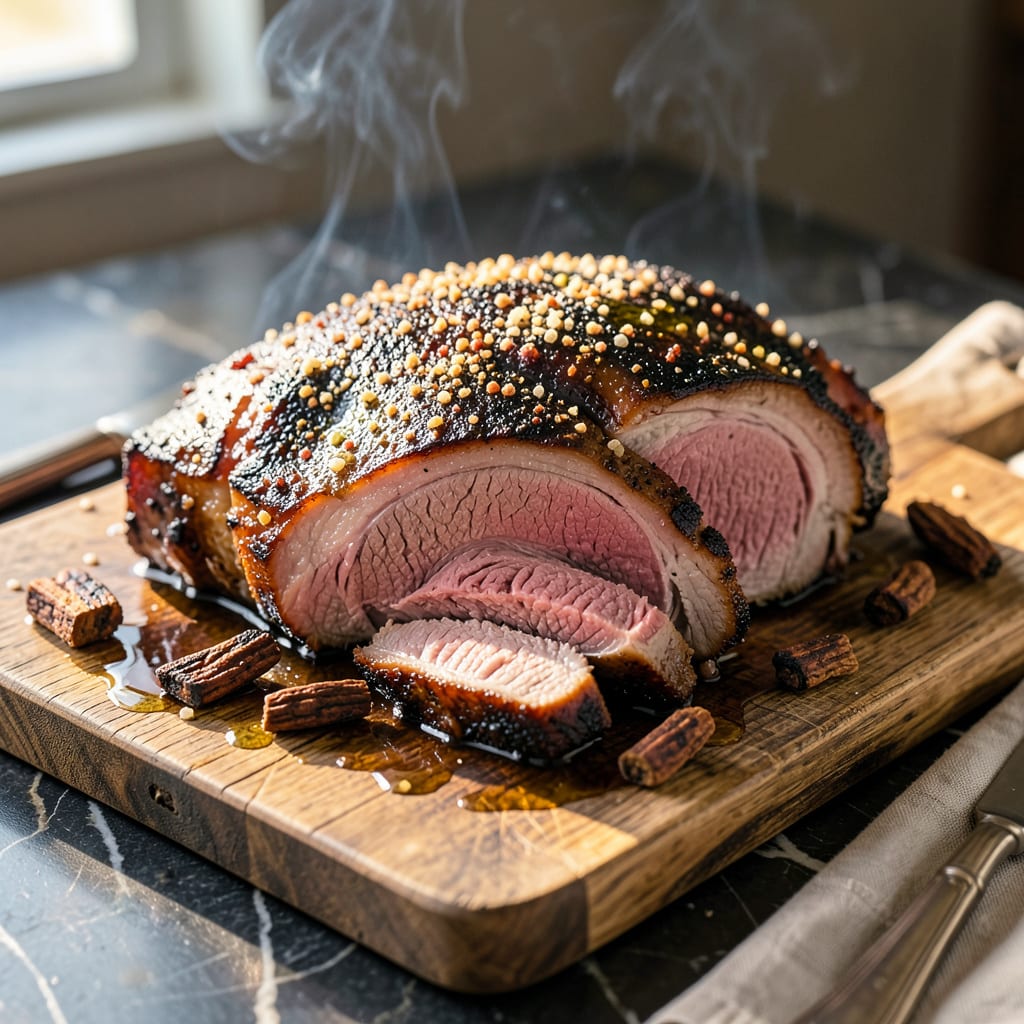
There’s nothing like the deep, smoky aroma of a perfectly smoked brisket coming off the pit. This method honors traditional pitmaster techniques with a low-and-slow approach that transforms tough beef into tender perfection.
I’ve spent years refining this process, from selecting the right cut to mastering the smoke and rest. The result is a smoky masterpiece with a bark so good, it’ll make you weep.
Ingredients for Bbq Pitmasters Beef Brisket
Nothing fancy here—just good beef, a solid rub, and patience. A lot of patience.
| Ingredient | Amount | Notes |
|---|---|---|
| Beef Brisket 🥩 | 8 lb | Full packer cut preferred |
| Coarse Kosher Salt 🧂 | ½ cup | Diamond Crystal brand recommended |
| Coarse Black Pepper 🌶️ | ½ cup | Freshly ground preferred |
| Garlic Powder 🧄 | 2 tbsp | Not garlic salt |
| Onion Powder 🧅 | 2 tbsp | Fresh ground preferred |
| Paprika 🌶️ | 2 tbsp | Sweet or smoked variety |
| Brown Sugar 🍚 | ½ cup | Light or dark works |
| Yellow Mustard 🟡 | ½ cup | For binder in rub |
| Hickory Wood Chunks 🪵 | 4 lb | Or oak for milder smoke |
| Apple Cider Vinegar 🍏 | ½ cup | For spritzing during cook |
| Beef Tallow 🧈 | ¼ cup | For bark enhancement |
| Worcestershire Sauce 💧 | ¼ cup | For injection or spritz |
[recipe_ingredient_scaler]
The brisket cut is non-negotiable here. Full packer (both flat and point muscles) gives you that perfect texture contrast—USDA Prime grade if you can swing it, Choice if that’s what’s available. I get mine from Costco or a local butcher who understands brisket (ask for the cryovaced ones, not the pre-trimmed). Look for good marbling—fat equals flavor. The point end should have a nice thick fat cap.
No hickory? Oak or pecan wood work great—just avoid softwoods like pine. Short on time? Pre-mixed brisket rubs from Killer Hogs or Meat Church are solid shortcuts. Brown sugar can be swapped for turbinado in a pinch. If you can’t find beef tallow, bacon grease adds a similar richness. The mustard in the rub is mostly for binding—Dijon works too if that’s what you’ve got.
Brisket needs to rest—at least 1 hour, 2 is better (the juice redistributes, trust me). Leftovers? Vacuum seal and freeze for up to 3 months. That bark will soften when wrapped, but it’s worth it for the tenderness. Slice against the grain when serving—quarter-turn between flat and point since the grain runs different ways.
Why You’ll Love This Recipe
- Set It and Forget: I rub the brisket with salt, pepper, garlic and onion powder the night before, then let the smoker do all the work while I sip my coffee.
- Crust Worth Bragging: That dark bark from the coarse salt and pepper mix? It snaps like a perfect potato chip over meat so tender it falls apart.
- Feeds My Crowd: One brisket makes enough pulled beef for tacos Tuesday, sandwiches Wednesday, and chili by weekend.
- Leftovers Beat Takeout: Honestly, the sliced brisket reheats better than any restaurant leftovers I’ve ever brought home.
Step-by-Step Instructions for Low-and-Slow Smoky Beef Brisket
Here’s the proven method I use for competition-level brisket every single time.
Step 1: Trim and Apply the Rub
Start by trimming the fat cap on the 8 lb Beef Brisket down to about ¼ inch thickness. I use a sharp boning knife for precision, leaving enough fat to protect the meat during the long cook. This step ensures even cooking and better smoke penetration.
In a bowl, combine the 0.5 cup Coarse Kosher Salt, 0.5 cup Coarse Black Pepper, 2 tbsp Garlic Powder, 2 tbsp Onion Powder, 2 tbsp Paprika, and 0.5 cup Brown Sugar. Rub the 0.5 cup Yellow Mustard all over the brisket as a binder, then apply the spice mix generously, pressing it into the meat. Let it rest for 1 hour at room temperature.
Step 2: Set Up the Smoker
Load your smoker with the 4 lb Hickory Wood Chunks and preheat to 225-250°F. I prefer hickory for its bold, robust smoke flavor, but oak works if you want something milder. Place a water pan in the smoker to maintain moisture throughout the cook.
Once the smoker reaches temperature and you see thin blue smoke (not thick white smoke), you’re ready to add the brisket. Position it fat-side up so the rendering fat bastes the meat as it cooks. Close the lid and resist the urge to peek—every time you open it, you add 15-20 minutes to your cook time.
Step 3: Smoke and spritz
Smoke the brisket undisturbed for 6-8 hours until the internal temperature hits 165-170°F. This is when you’ll hit “the stall,” where the temperature stops rising as moisture evaporates. Don’t panic—this is normal.
Every 1-2 hours, spritz the brisket with a mix of 0.5 cup Apple Cider Vinegar and 0.5 cup water (equal parts) to keep the surface moist and build a beautiful bark. For extra bark enhancement, brush with 0.25 cup Beef Tallow during the last few spritzes.
Step 4: Wrap and Finish
At the stall, wrap the brisket tightly in pink butcher paper (not foil—paper breathes better and preserves the bark). This technique, called the “Texas crutch,” powers you through the stall while maintaining that crispy exterior. Return it to the smoker and continue cooking.
Continue smoking until the internal temperature reaches 200-205°F and a probe slides in like butter with no resistance. This usually takes another 4-6 hours. Trust the probe test over the thermometer—tenderness matters more than temperature.
Step 5: Rest and Slice
Transfer the brisket to a cutting board and tent loosely with foil. Let it rest for at least 1 hour (I prefer 2 hours wrapped in towels in a cooler). This resting period allows the juices to redistribute throughout the meat, ensuring every slice is moist and flavorful.
Unwrap the brisket and locate the grain direction. Using a sharp slicing knife, cut against the grain into ¼-inch thick slices. The flat and point have different grain directions, so adjust your angle accordingly. Serve immediately while still warm.
Pro Tips For Making Bbq Pitmasters Beef Brisket
- Rest Overnight: After rubbing with salt, pepper, garlic and onion powder, let the brisket sit uncovered in the fridge for at least 12 hours—this dries the surface for a better bark.
- Low and Slow: Cook at 225°F until the internal temp hits 195-203°F; I learned this the hard way after pulling it too early and getting chewy meat.
- Skip the Trim: Leave that fat cap on—it renders down during the long cook and keeps the brisket moist. Sounds weird, but it works.
- Wrap at 165°F: When the internal temp reaches 165°F, wrap it tight in butcher paper to power through the stall without drying out.
Pro Cooking Tips for bbq pitmasters beef brisket
Temperature Control
Maintaining 225-250°F in your smoker is non-negotiable for perfect brisket. I swear by my ThermoWorks Smoke dual-probe thermometer—one probe for the smoker, one for the meat. Thin blue smoke means you’re in the sweet spot; thick white smoke means you need to adjust your airflow. 🌡️
The Stall Strategy
When your brisket hits 165-170°F (usually after 6-8 hours), you’ve hit the stall. This is where most beginners panic. Don’t. Just spritz with apple cider vinegar and water every 1-2 hours and ride it out.
Texas Crutch Method
At the stall, wrap your brisket in pink butcher paper—not foil. This preserves the bark while powering through the stall. I learned this trick at a local BBQ competition and it changed my brisket game forever. The paper breathes better than foil.
Probe Test
Forget the thermometer—trust the probe test. When your probe slides into the brisket like butter with no resistance, it’s done. Usually happens around 200-205°F. This is how I know my brisket is ready, every single time.
Resting Period
Let your brisket rest for at least 1 hour, but 2 hours is better. I wrap mine in towels and place it in a cooler. This resting period lets the juices redistribute, ensuring every slice is moist and flavorful. 💪
Slicing Technique
The flat and point have different grain directions. Slice against the grain in ¼-inch thick slices. I use a 12-inch slicing knife for clean cuts.
Nutrition Facts

Trained in classic French technique but raised on slow-cooked ribs and spicy rubs, she blends culinary skill with smoke and soul.
- Recipe for Boneless Pork Chops in Cast Iron Skillet: Sear and Baste to Juicy Perfection - October 3, 2026
- Recipe for Boneless Cross Rib Roast: Slow-Roasted Beef with Herb Crust - October 3, 2026
- Hamburgers in Sauce Recipe Crock Pot: Slow-Cooked Savory Delight - October 3, 2026