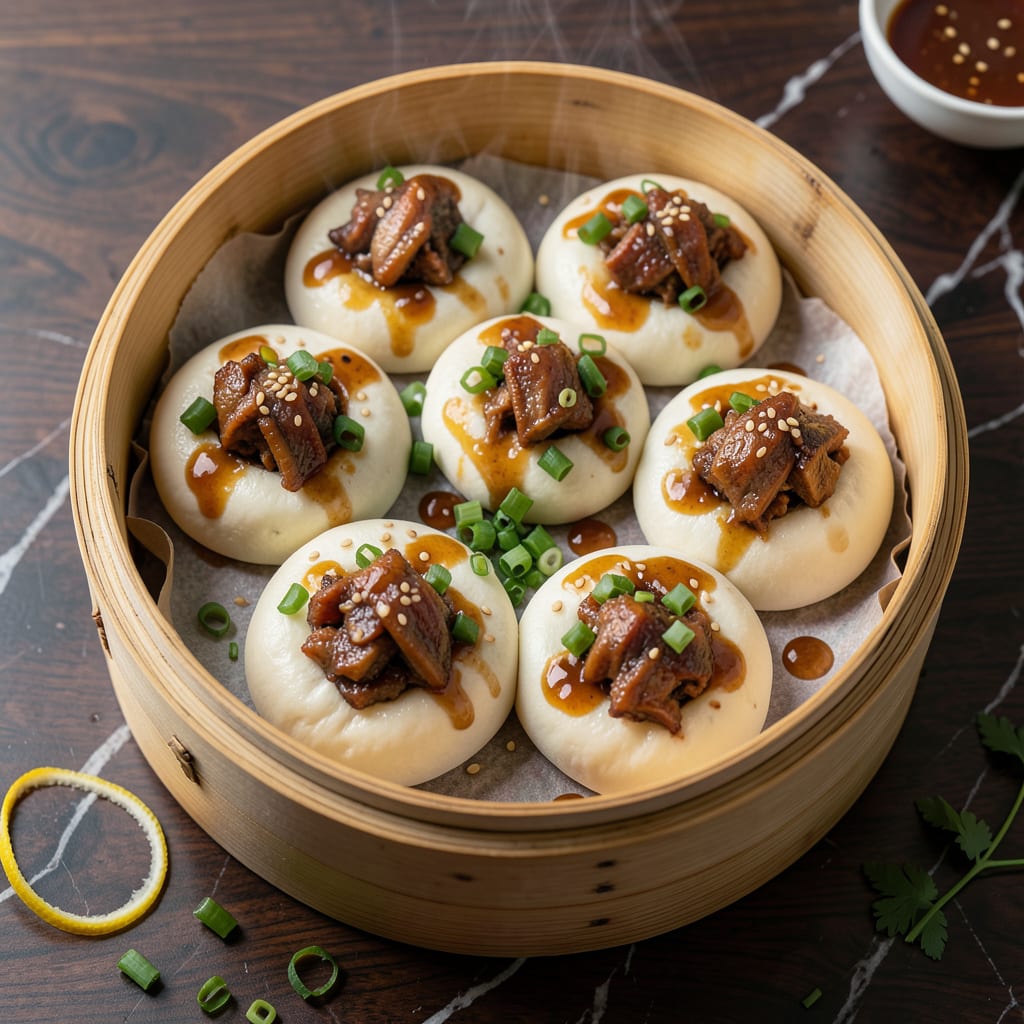
These steamed buns deliver a perfect balance of pillowy dough and rich, sticky pork filling. My pitmaster roots taught me the value of slow-cooked meats, and this recipe brings that expertise to your kitchen.
With simple ingredients and precise technique, you’ll achieve tender buns and a filling that’s both sweet and savory. The result is a dish that tastes as good as it looks.
Ingredients for Bbq Pork Bao Bun
Nothing exotic here—just good stuff for pillowy buns and sticky pork filling.
| Ingredient | Amount | Notes |
|---|---|---|
| All-Purpose Flour 🌾 | 4 cups | Plus extra for dusting |
| Granulated Sugar 🍚 | ¼ cup | For dough sweetness |
| Active Dry Yeast 🍞 | 2 ¼ tsp | One packet plus extra |
| Warm Water 💧 | 1 ¼ cups | About 110°F |
| Vegetable Oil 🫒 | 3 tbsp | Divided for dough and filling |
| Pork Shoulder 🍖 | 1 lb | Boneless, diced small |
| Hoisin Sauce 🍯 | ½ cup | For sticky sweetness |
| Soy Sauce 🫒 | 3 tbsp | Low-sodium preferred |
| Brown Sugar 🍚 | ¼ cup | Packed for filling |
| Fresh Ginger 🌿 | 1 tbsp | Minced finely |
| Garlic Cloves 🧄 | 4 cloves | Minced for filling |
| Rice Vinegar 🍋 | 1 tbsp | For tangy balance |
| Green Onions 🧅 | 3 whole | Thinly sliced for garnish |
| Sesame Oil 🫒 | 1 tsp | For aroma in filling |
| Salt 🧂 | 1 tsp | Divided for dough and filling |
[recipe_ingredient_scaler]
The pork is the foundation here. Pork shoulder (or pork butt) gives you that melt-in-your-mouth texture—avoid lean cuts like tenderloin. Costco has great prices on big pieces, or ask your butcher to cube it for you. For the hoisin, Koon Chun is the gold standard (find it at Asian markets or the international aisle), but any brand works in a pinch.
No pork shoulder? Pork belly or country-style ribs (cut into small pieces) are great swaps. Out of hoisin? Mix 2 tbsp soy sauce + 1 tbsp molasses + 1 tsp five-spice powder. Fresh ginger and garlic are ideal, but jarred minced saves time (just use a little less). The green onions can be swapped for chives if that’s what’s growing in your garden.
Dough keeps in the fridge 2 days (let it warm up before shaping). Cooked filling freezes for 3 months—perfect for making extra. Steamed buns are best fresh, but leftovers reheat nicely in a steamer for about 5 minutes.
Why You’ll Love This Recipe
- One Bowl Wonder: I mix the dough right in my stand mixer—flour, sugar, yeast, water, oil—no extra bowls to wash.
- Party Ready: I’ve served these at potlucks and weeknight dinners alike—equally at home with tea or beer.
- Budget Stretch: A bag of flour and a little yeast make a dozen buns. I’ll be real: it’s cheaper than takeout and just as satisfying.
Step-by-Step Instructions for BBQ Pork Bao Buns
This is my go-to method for those fluffy buns with sticky-sweet pork filling.
Step 1: Make and Proof the Dough
In a large bowl, whisk together the 4 cups All-Purpose Flour, 0.25 cup Granulated Sugar, and 2.25 tsp Active Dry Yeast. I always use a fork to break up any lumps in the flour for a smooth mixture.
Create a well in the center and pour in the 1.25 cups Warm Water and 2 tbsp Vegetable Oil (reserving 1 tbsp Vegetable Oil for later). Stir everything together until a shaggy dough forms. You’ll know it’s ready when it pulls away from the sides of the bowl.
Turn the dough onto a lightly floured surface and knead for 8-10 minutes until smooth and elastic. The dough should spring back slowly when pressed with a finger. Place it in a greased bowl, cover with a damp towel, and let it rise in a warm spot for 1-2 hours until doubled in size.
Step 2: Prepare the BBQ Pork Filling
While the dough rises, heat a large skillet over medium-high heat. Add the remaining 1 tbsp Vegetable Oil, then add the 1 lb Pork Shoulder, diced small. Cook for 5-6 minutes until the pork is browned on all sides and no longer pink.
Stir in the 1 tbsp Fresh Ginger, minced, and 4 cloves Garlic Cloves, minced, and cook for 1 minute until fragrant. Add the 0.5 cup Hoisin Sauce, 3 tbsp Soy Sauce, 0.25 cup Brown Sugar, 1 tbsp Rice Vinegar, 1 tsp Sesame Oil, and ½ tsp Salt. Simmer for 10-12 minutes until the pork is tender and the sauce thickens to a glossy consistency.
Step 3: Shape the Buns
Once the dough has doubled, punch it down and divide it into 12 equal pieces. Roll each piece into a 3-inch circle on a lightly floured surface, keeping the rest covered with a towel to prevent drying out.
Place 1-2 tbsp of the cooled pork filling in the center of each dough circle. Gather the edges up around the filling, pleating as you go, and twist the top to seal. Pinch the pleats firmly to ensure they stay closed during steaming. Place each bun on a small square of parchment paper to prevent sticking.
Step 4: Steam the Buns
Arrange the buns in a bamboo steamer lined with parchment paper, leaving 1 inch of space between them to expand. Bring 2 inches of water to a boil in a large pot, then place the steamer on top. Cover and steam over medium-high heat for 12-15 minutes until the buns are puffed and slightly translucent.
Turn off the heat and let the buns sit covered for 2 minutes to finish setting. They should feel light and spongy when pressed gently. Garnish with the 3 whole Green Onions, thinly sliced, before serving warm. The filling should be sticky and the dough should pull apart easily with a soft, pillowy texture.
Pro Tips For Making Bbq Pork Bao Bun
- Test Your Yeast: I learned this the hard way—always bloom your active dry yeast in 100°F warm water with a pinch of sugar first. If it doesn’t foam within 5 minutes, your bao buns won’t rise.
- Knead Thoroughly: Don’t rush the kneading—8-10 minutes by hand or 5-6 in a mixer until the dough is smooth and elastic. Skipping this leaves your buns dense instead of fluffy.
- Use Room-Temp Ingredients: Cold water or oil can shock the yeast. Let all your liquids sit out for 20 minutes first—it makes a real difference in getting a consistent rise.
- Steam with Space: Overcrowding the steamer tray causes buns to stick together. Leave at least an inch between each bao so they expand properly and don’t tear when pulling apart.
Essential Equipment for This Recipe
Steamer Setup
You’ll need a bamboo steamer—I use a 12-inch two-tiered one from Eden. It fits perfectly over my 5-quart Dutch oven, which is heavy enough to maintain steady heat. Line each tier with parchment paper to prevent sticking. 🔥
Mixing Bowls
A large stainless steel mixing bowl is ideal for the dough. I prefer Cuisinox—it’s lightweight yet durable. The smooth surface makes kneading easier, and the size accommodates the dough’s rise. A damp towel works perfectly for covering during proofing.
Precision Tools
For accurate measurements, I rely on my OXO Good Grips measuring cups and spoons. The pork filling’s balance of sweet and savory depends on precise ratios, so don’t skimp here. A digital kitchen scale helps ensure your 12 dough portions are equal.
Skillet Choice
A 12-inch cast iron skillet is my go-to for cooking the pork. It retains heat evenly, ensuring the meat browns properly. If you don’t have cast iron, a heavy stainless steel skillet works too—just avoid nonstick for high-heat searing.
Kneading Surface
Roll out the dough on a large wooden cutting board dusted with flour. Wood provides the right resistance for kneading and shaping. Keep a dough scraper nearby to lift and turn the dough without stretching it too thin.
Cooling Rack
Let your steamed buns rest on a wire cooling rack for 2 minutes before serving. This prevents the bottoms from getting soggy. I use a stainless steel rack—it’s sturdy and easy to clean. 💡
Nutrition Facts

Trained in classic French technique but raised on slow-cooked ribs and spicy rubs, she blends culinary skill with smoke and soul.
- Recipe for Boneless Pork Chops in Cast Iron Skillet: Sear and Baste to Juicy Perfection - October 3, 2026
- Recipe for Boneless Cross Rib Roast: Slow-Roasted Beef with Herb Crust - October 3, 2026
- Hamburgers in Sauce Recipe Crock Pot: Slow-Cooked Savory Delight - October 3, 2026