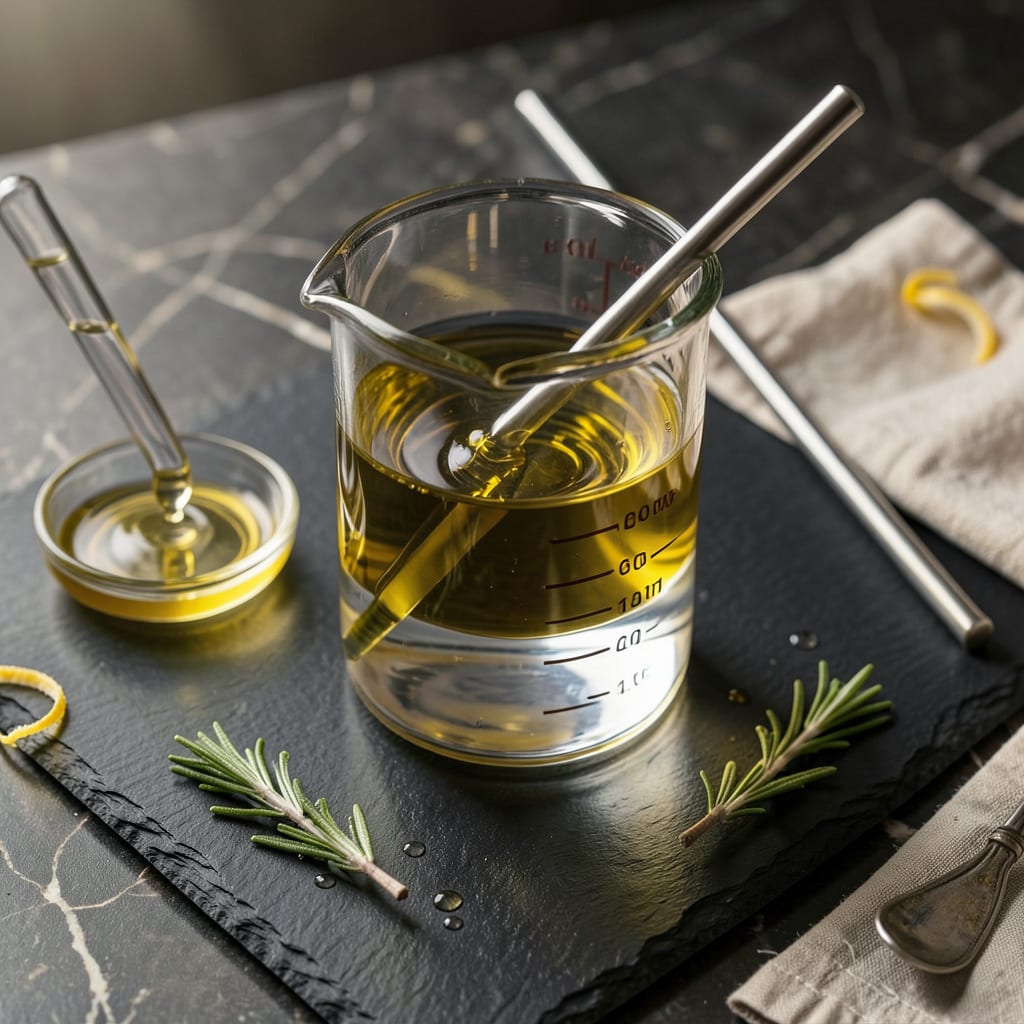
Oil and water cannot mix naturally because they have different molecular structures—water is polar and oil is nonpolar. This causes them to separate into distinct layers, no matter how much you stir or shake them.
This fundamental principle explains why you’ll always see that classic separation in your salad dressing bottle. 🔥 The water molecules cling tightly to each other through hydrogen bonds, while oil molecules—being hydrophobic—repel water entirely. It’s like watching two dance partners who refuse to hold hands, no matter how much you push them together. This molecular mismatch is why we need emulsifiers in cooking to temporarily bridge the gap between these stubborn liquids.
💡 In This Article
- Why Oil and Water Repel Each Other at a Molecular Level
- How to Temporarily Combine Oil and Water in Cooking
Why Oil and Water Repel Each Other at a Molecular Level
Let’s dive into the microscopic world where water molecules behave like tiny magnets. Each water molecule has a positively charged hydrogen end and a negatively charged oxygen end, creating what scientists call polarity. These molecules form tight networks through hydrogen bonds, constantly attracting and repelling each other in a delicate dance.
Oil molecules, on the other hand, are completely nonpolar—they have no charged ends to interact with water’s magnetic pull.
When you try to mix them, water molecules immediately cluster together, leaving oil molecules completely isolated. This separation happens because oil is hydrophobic (water-fearing), while water is hydrophilic (water-loving). The difference in molecular structure creates an invisible barrier that prevents true mixing.
Think of it like trying to blend sand with marbles—they’ll always settle into separate layers no matter how much you shake the container. 🔥
The energy required to break water’s hydrogen bonds and force oil molecules to interact would be enormous—far beyond what simple stirring can achieve. This is why you’ll always see that telltale separation in your salad dressing bottle after it sits for just a few minutes.
The water molecules quickly reform their hydrogen-bonded networks, pushing all oil molecules to the surface where they can’t interfere with water’s preferred molecular arrangements.
Temperature plays an interesting role here too. Heating the mixture increases molecular movement, which might temporarily create smaller oil droplets suspended in water. But as soon as the temperature drops, those oil molecules coalesce back into larger droplets. This is why warm vinaigrettes might appear more uniform but always separate when cooled.
The fundamental molecular incompatibility remains unchanged by temperature fluctuations.
What’s fascinating is how this molecular behavior manifests in our daily lives. That rainbow sheen you see on puddles after rain? That’s oil (from cars or other sources) floating on water’s surface because the two simply cannot mix.
Even in industrial processes, engineers must use specialized equipment like high-shear mixers or chemical emulsifiers to temporarily combine oil and water for products like cosmetics or processed foods. ✨
The separation isn’t just visual—it’s a fundamental property of these liquids. Water’s density (about 1 g/mL) combined with its polar nature creates a molecular environment that’s completely inhospitable to nonpolar oil molecules (typically around 0.9 g/mL).
This density difference is why oil always floats to the top when given the chance, forming that distinct layer we’re all familiar with from our kitchen experiments.
Understanding this molecular dance helps explain why certain cooking techniques work while others fail. It’s the reason why simply whisking oil and vinegar creates only a temporary mixture, while adding an emulsifier like mustard can create a stable vinaigrette that lasts for hours.
The science is inescapable—these liquids will always find their way back to their preferred molecular communities unless we intervene with some clever chemistry. 💫

Trained in classic French technique but raised on slow-cooked ribs and spicy rubs, she blends culinary skill with smoke and soul.
- Recipe for Boneless Pork Chops in Cast Iron Skillet: Sear and Baste to Juicy Perfection - October 3, 2026
- Recipe for Boneless Cross Rib Roast: Slow-Roasted Beef with Herb Crust - October 3, 2026
- Hamburgers in Sauce Recipe Crock Pot: Slow-Cooked Savory Delight - October 3, 2026