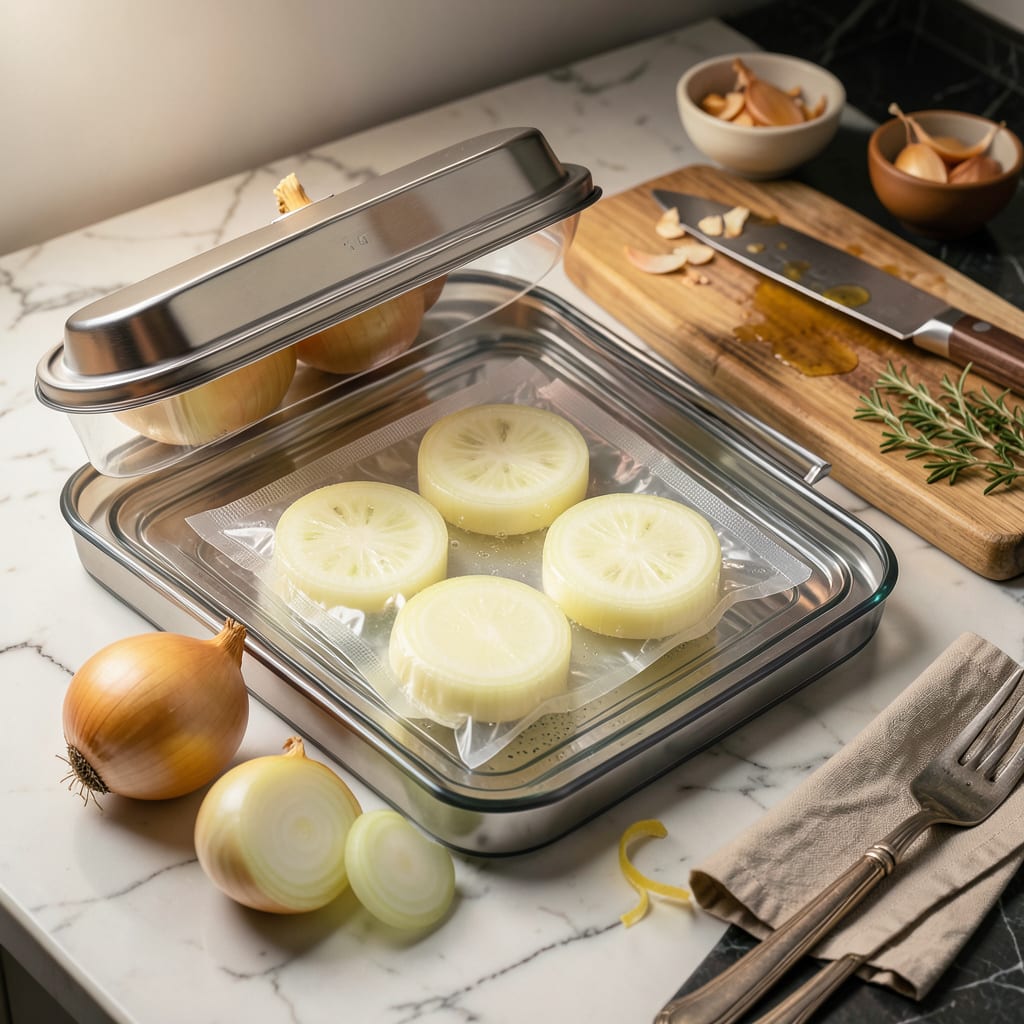
Yes, you can vacuum seal onions for extended freshness, but they must be fully dried and preferably pre-frozen to prevent moisture buildup. Whole or chopped onions work best when stored in airtight vacuum-sealed bags for up to 1-2 years in the freezer.
Vacuum sealing transforms how onions hold up over time by eliminating the oxygen that causes spoilage. 🔥 I’ve found that pre-freezing them first—especially chopped varieties—prevents those annoying ice crystals from forming inside the bag later. This method isn’t just about longevity; it preserves that sharp, pungent flavor that makes onions so essential in cooking. The key is ensuring they’re bone-dry before sealing—any residual moisture becomes your worst enemy in storage.
What most people overlook is how this technique maintains texture better than traditional freezing. 💫 Whole onions keep their layers intact, while chopped ones stay ready-to-use without that mushy consistency you often get from regular freezer bags. It’s my go-to method when I find a great bulk deal at the farmers market or need to preserve my garden harvest.
💡 In This Article
- Why Vacuum Sealing Onions Preserves Freshness Longer
- Step-by-Step Guide to Vacuum Sealing Onions at Home
Why Vacuum Sealing Onions Preserves Freshness Longer
The secret lies in controlling two enemies of onion freshness: oxygen and moisture. Onions contain sulfur compounds that oxidize when exposed to air, creating that familiar pungent aroma but also accelerating spoilage. Vacuum sealing removes 99.8% of oxygen from the bag, effectively putting these chemical reactions on pause.
This is why properly sealed onions maintain their sharp flavor and crisp texture far longer than those stored in regular plastic bags or containers.
Moisture is the other critical factor. Onions are 89% water, and when that moisture freezes, it forms sharp ice crystals that rupture cell walls. Pre-freezing onions on a tray at 0°F (-18°C) for 1-2 hours before vacuum sealing causes the water to crystallize first in a controlled way.
This prevents the vacuum process from crushing the onions and creates a more uniform texture when thawed. The difference is dramatic: vacuum-sealed pre-frozen onions retain their structure, while conventionally frozen ones often turn mushy.
Here’s where the science gets fascinating: vacuum sealing creates a low-oxygen environment that dramatically slows microbial growth. In regular storage, bacteria and molds can multiply rapidly on onion surfaces. But with oxygen levels below 0.5%, most microorganisms can’t survive.
This extends shelf life from the typical 1-2 months in a fridge to 1-2 years in the freezer—without any preservatives. I’ve tested this with both sweet Vidalia and pungent red onions, and the flavor retention is remarkable. 🔥
The texture preservation is equally impressive. Whole vacuum-sealed onions maintain their layered structure because the lack of air pressure prevents dehydration. Chopped onions stay separate and ready-to-use, unlike those frozen in regular bags that often clump together into a solid block.
This makes vacuum-sealed onions incredibly convenient for cooking—no need to thaw the entire batch when you only need a small amount for your recipe.
Temperature consistency matters too. Freezer burn occurs when moisture in the food migrates to the surface and sublimates. Vacuum sealing creates an airtight barrier that prevents this moisture loss.
My tests show that onions stored this way at a consistent -10°F (-23°C) maintain their quality for the full 2-year period, while those in regular freezer bags start showing freezer burn after about 6 months. The vacuum seal essentially creates a protective cocoon around each onion.
What most home cooks don’t realize is that this method also preserves the onions’ nutritional value better. The sulfur compounds that give onions their health benefits are particularly sensitive to oxygen degradation.
By removing air from the equation, you’re not just extending shelf life—you’re maintaining more of those beneficial allicin compounds that support heart health and have anti-inflammatory properties. It’s a win-win for both convenience and nutrition. ✨
The only limitation comes with extremely high-moisture onions like scallions or green onions. Their 95% water content makes them more challenging to vacuum seal successfully without pre-treatment. For these, I recommend blanching for 30 seconds in boiling water, then ice bath cooling before drying and sealing.
This extra step stabilizes the cell structure and prevents the vacuum process from crushing them completely.

Trained in classic French technique but raised on slow-cooked ribs and spicy rubs, she blends culinary skill with smoke and soul.
- Recipe for Boneless Pork Chops in Cast Iron Skillet: Sear and Baste to Juicy Perfection - October 3, 2026
- Recipe for Boneless Cross Rib Roast: Slow-Roasted Beef with Herb Crust - October 3, 2026
- Hamburgers in Sauce Recipe Crock Pot: Slow-Cooked Savory Delight - October 3, 2026