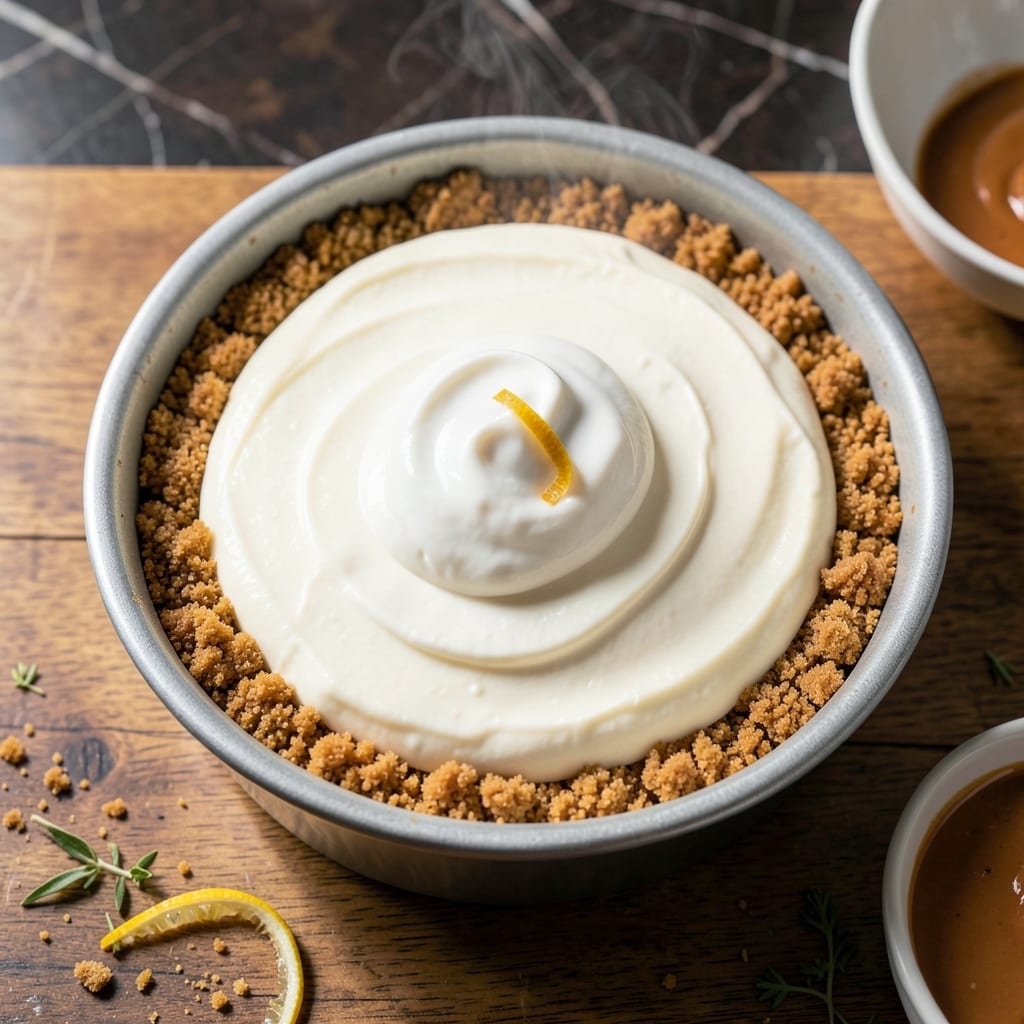
There’s a reason this cheesecake has achieved legendary status in the dessert world. My version captures that signature velvety texture and clean, creamy flavor that made the original famous.
This recipe relies on a few key techniques: room-temperature ingredients, a gentle water bath, and precise baking times. The result is a classic cheesecake with no cracks, no sinking, and that perfect dense-yet-smooth consistency.
What you’ll get is a dessert that stands tall, slices beautifully, and delivers that familiar rich taste in every forkful. The sour cream topping adds the final authentic touch.
Serve it plain or with your favorite fruit compote. This is the cheesecake that set the standard.
Ingredients for Cheesecake Factory Original Cheesecake
A few quality ingredients create this iconic, velvety dessert everyone loves.
| Ingredient | Amount | Notes |
|---|---|---|
| Graham Cracker Crumbs 🍪 | 1 ½ cups | Fine crumbs, not coarse |
| Granulated Sugar 🧂 | ¼ cup | For crust sweetness |
| Unsalted Butter 🧈 | ½ cup | Melted for crust binding |
| Cream Cheese 🧀 | 4 lb | Full-fat, room temperature |
| Granulated Sugar 🧂 | 1 ½ cups | For filling sweetness |
| Sour Cream 🥛 | 1 ½ cups | Full-fat, room temperature |
| Large Eggs 🥚 | 5 whole | Room temperature, separated |
| Vanilla Extract 🌿 | 2 tsp | Pure extract, not imitation |
| All-Purpose Flour 🌾 | ¼ cup | For structure in filling |
| Salt 🧂 | ½ tsp | Fine sea salt preferred |
| Lemon Juice 🍋 | 1 tbsp | Freshly squeezed for brightness |
| Heavy Cream 🥛 | ½ cup | For topping, optional |
[recipe_ingredient_scaler]
The cream cheese is non-negotiable—Philadelphia full-fat blocks are what the Factory uses. Don’t even think about the tub version (too much air). Room temperature is key here, so pull it out 2 hours before baking. For the graham crumbs, I crush whole crackers in a food processor—store-bought crumbs from Keebler or Honey Maid work too, but check the label for added sugar.
No graham crackers? Digestive biscuits or vanilla wafers make a fine substitute—just adjust sugar to taste. The sour cream must be full-fat (light versions can curdle). If you’re worried about cracks, add an extra egg yolk for insurance. Vanilla beans are fancy, but pure extract from Nielsen-Massey gives that deep, authentic flavor without the hassle.
This keeps beautifully—5 days in the fridge (covered tightly) or 2 months frozen. Slice it cold with a hot knife for clean pieces, and bring individual slices to room temperature for serving. Always use a water bath to prevent that dreaded center crack.
Why You’ll Love This Recipe
- No-Fuss Base: I just mix graham cracker crumbs, sugar, and melted butter—press it in and it’s done. No rolling, no chilling, no stress.
- That Cream Cheese Magic: The tangy cream cheese with just the right sugar hits that restaurant-quality sweetness I crave.
- Crowd Pleaser: This is my go-to for birthdays, potlucks, or just because Tuesday needs a win.
- Leftovers? Ha.: Honestly, it disappears fast—but if some lingers, it tastes even better the next day.
Step-by-Step Instructions for Classic Cheesecake
Master the technique behind this timeless dessert with these precise, foolproof steps.
Step 1: Press the Graham Cracker Crust
Combine the 1.5 cups Graham Cracker Crumbs, 0.25 cup Granulated Sugar, and 0.5 cup Unsalted Butter in a bowl until the mixture resembles wet sand. Press it firmly into the bottom of a 9-inch springform pan using the bottom of a glass to create an even layer.
I always press about ½ inch up the sides of the pan to create a slight edge. Chill the crust in the refrigerator for 15 minutes while you preheat the oven to 325°F—this prevents the butter from melting out during baking.
Step 2: Beat the Cream Cheese Filling
In a stand mixer with the paddle attachment, beat the 4 lb Cream Cheese on medium speed until completely smooth, scraping the bowl down frequently. This step is crucial—lumps in the cream cheese will result in a grainy texture in your finished cheesecake.
Gradually add the 1.5 cups Granulated Sugar and mix until fully incorporated. Then add the 1.5 cups Sour Cream, 2 tsp Vanilla Extract, 0.25 cup All-Purpose Flour, 0.5 tsp Salt, and 1 tbsp Lemon Juice. Mix just until combined—overmixing incorporates too much air, which can cause cracks.
Step 3: Incorporate Eggs Gently
Add the 5 whole Large Eggs one at a time, mixing on low speed just until each egg is incorporated. I crack each egg into a separate bowl first to ensure no shell fragments make it into the batter.
Mixing the eggs on low prevents over-aeration, which is the primary cause of cheesecake cracks. The batter should be smooth, thick, and slightly glossy. Pour it over the chilled crust and smooth the top with a spatula.
Step 4: Bake in a Water Bath
Place the springform pan inside a larger roasting pan and carefully pour hot water into the roasting pan until it comes about ½ inch up the sides of the springform. This water bath regulates the oven temperature, ensuring even baking and preventing cracks.
Bake at 325°F for 1 hour to 1 hour 15 minutes until the edges are set but the center still has a slight wobble. Turn off the oven, crack the door open 1 inch, and let the cheesecake cool inside for 1 hour—this gradual cooling prevents sudden temperature changes that cause cracks.
Step 5: Chill and Serve
After the hour in the oven, transfer the cheesecake to the refrigerator and chill uncovered for at least 4 hours (overnight is ideal). This extended chill time allows the cheesecake to set completely and develop its signature creamy texture.
Before serving, you can top it with sweetened 0.5 cup Heavy Cream if desired. Run a knife around the edge of the pan before releasing the springform. Slice with a hot, clean knife for perfect portions every time.
Pro Tips For Making Cheesecake Factory Original Cheesecake
- Room Temp Cream Cheese: Take your cream cheese out 1-2 hours before starting—cold blocks leave lumps no matter how hard you beat them. I learned this the hard way after my first three cheesecakes looked like cottage cheese.
- Press Crust Hard: Pack those graham cracker crumbs into the pan like you mean it, using a glass to really compress them. A loose crust falls apart when you slice, and nobody wants that.
- Skip the Overmixing: Once your batter is smooth, stop mixing—overworking it adds air that can cause cracks later. Sounds weird, but it works: just fold in the last bits gently with a spatula.
- Water Bath Always: Wrap your springform pan in foil and bake it in a water bath. After burning three batches, I finally figured out this is the only way to get that creamy, even texture without the dreaded top cracks.
Storing and Reheating This cheesecake factory original cheesecake
Refrigerator Storage
Let your cheesecake cool completely at room temperature for about 2 hours before transferring to the fridge. Store it in an airtight container or tightly wrapped with plastic wrap. It’ll stay fresh for up to 5 days. 💡
Freezing for Later
For longer storage, freeze the entire cheesecake or individual slices. Wrap tightly in plastic wrap, then aluminum foil, or use a freezer bag. It keeps beautifully for up to 2 months. Thaw overnight in the fridge before serving.
Reheating Slices
If you prefer your slice slightly warm, microwave individual portions on 50% power for 15-20 seconds. Avoid overheating, as it can make the texture grainy. A quick warm-up enhances the creamy richness. 🔥
Avoiding Texture Issues
Never reheat the entire cheesecake—it’ll lose its signature smoothness. If storing without a topping, add fresh whipped cream or fruit compote just before serving to keep it looking and tasting its best.
Serving Temperature
For the best experience, serve this dessert chilled or at room temperature. The flavors are most vibrant when it’s not ice-cold. I always pull slices out 10 minutes before serving to take the edge off the chill.
Nutrition Facts
Frequently Asked Questions
Why use a water bath when baking?
The water bath creates a gentle, even heat that prevents cracks and ensures a silky texture. Without it, the edges may cook too quickly while the center stays underdone.
Can I use low-fat cream cheese?
No, full-fat cream cheese is essential for the authentic rich flavor and dense texture. Low-fat versions have more water content, which can make your cheesecake less stable and grainy.
How do I prevent the top from cracking?
Avoid overmixing the batter, use room-temperature ingredients, and let it cool gradually in the oven with the door cracked. These steps minimize the risk of unsightly cracks.
Can I make this without a springform pan?
Yes, but it’s tricky. A 9-inch cake pan works if lined with parchment paper, but releasing the cheesecake without a springform is more challenging.

Trained in classic French technique but raised on slow-cooked ribs and spicy rubs, she blends culinary skill with smoke and soul.
- Recipe for Boneless Pork Chops in Cast Iron Skillet: Sear and Baste to Juicy Perfection - October 3, 2026
- Recipe for Boneless Cross Rib Roast: Slow-Roasted Beef with Herb Crust - October 3, 2026
- Hamburgers in Sauce Recipe Crock Pot: Slow-Cooked Savory Delight - October 3, 2026