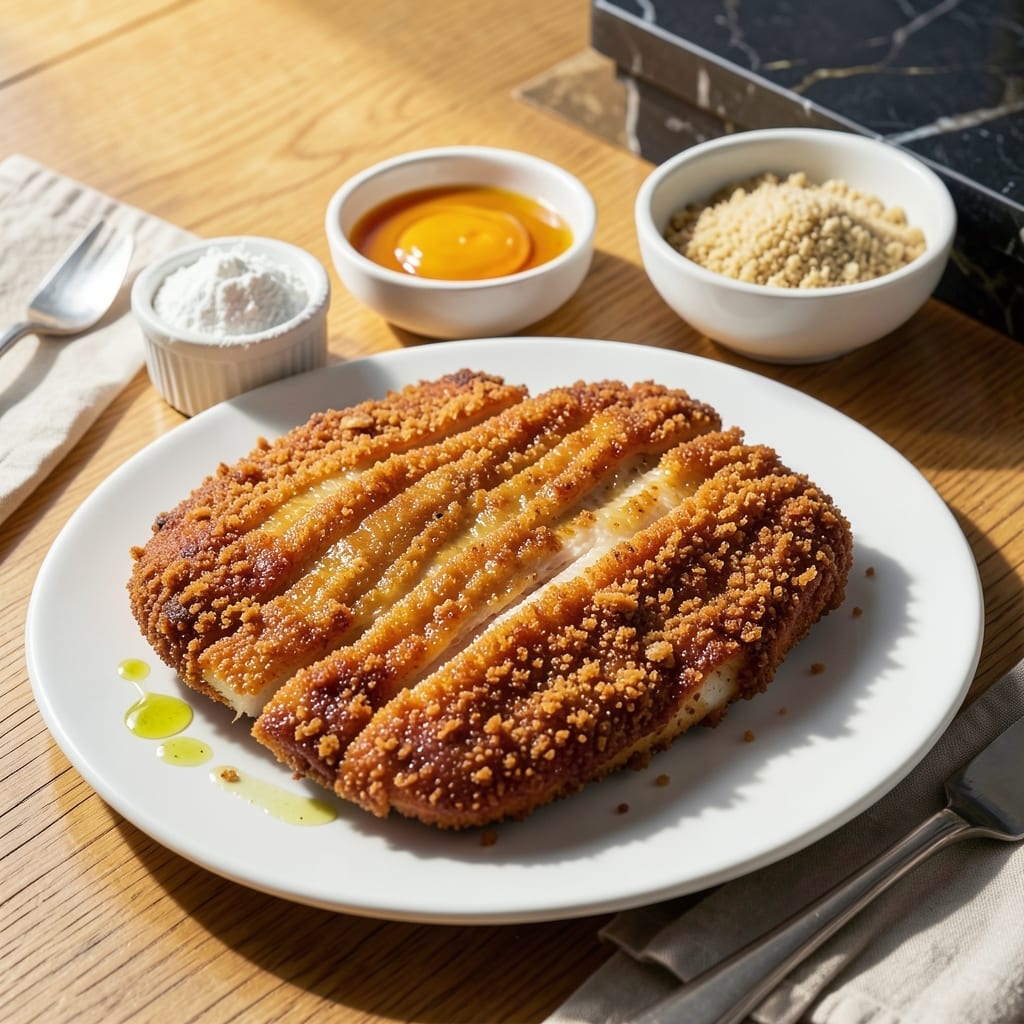
This breading method delivers a crispy golden coating that clings perfectly to each cutlet. I developed this technique through years of testing different flour-to-egg ratios and drying times.
The secret lies in a three-step process: flour for structure, egg wash for adhesion, and breadcrumbs for texture. Each layer builds upon the last to create an unbreakable bond with the chicken.
You’ll achieve restaurant-quality results with a shatteringly crispy exterior and juicy meat inside. The coating stays put from pan to plate without a single crumb left behind.
Perfect for weeknight dinners or impressive meals. This method works for chicken, pork, or even vegetable cutlets.
Ingredients for Chicken Cutlet Breading
Eleven ingredients deliver that shatteringly crispy golden coating that adheres perfectly to each cutlet.
| Ingredient | Amount | Notes |
|---|---|---|
| Boneless Skinless Chicken Breasts 🍗 | 1 ½ lb | Pounded to 1/4-inch thickness |
| All-Purpose Flour 🌾 | 1 cup | For initial dredging layer |
| Kosher Salt 🧂 | 1 tbsp | Diamond Crystal preferred for consistency |
| Freshly Ground Black Pepper 🌶️ | 1 tsp | Coarse grind for texture |
| Large Eggs 🥚 | 2 whole | Beaten for adhesion layer |
| Whole Milk 🥛 | 2 tbsp | Added to egg wash for richness |
| Panko Breadcrumbs 🍞 | 2 cups | Japanese-style for maximum crunch |
| Grated Parmesan Cheese 🧀 | ½ cup | Freshly grated from wedge |
| Garlic Powder 🧄 | 1 tsp | Added to breadcrumb mixture |
| Onion Powder 🧅 | 1 tsp | Balances breading flavor profile |
| Dried Oregano 🌿 | ½ tsp | Mediterranean variety preferred |
| Vegetable Oil 🫒 | 1 cup | High smoke point for frying |
[recipe_ingredient_scaler]
The breading foundation requires quality ingredients. Panko breadcrumbs from the Asian aisle at Whole Foods deliver superior crunch. Diamond Crystal kosher salt provides consistent seasoning without overpowering. For the chicken, boneless skinless breasts pounded to uniform thickness ensure even cooking. The Parmesan should be freshly grated from a wedge—pre-grated contains anti-caking agents that affect texture.
No panko? Fresh breadcrumbs from a crusty loaf work acceptably. Substitute buttermilk for the milk in the egg wash for extra tang. For gluten-free versions, rice flour and gluten-free panko maintain structure. The garlic and onion powders can be replaced with fresh minced at one-third the quantity. Avoid pre-seasoned breadcrumbs—they contain salt that throws off the balance.
The breaded cutlets hold in the refrigerator for 24 hours before cooking. Store raw chicken separately from dry ingredients. Cooked cutlets keep in an airtight container for 3-4 days. Freeze uncooked breaded cutlets on a tray first to prevent sticking, then transfer to bags for up to 1 month.
Why You’ll Love This Recipe
- 20-Minute Magic: I can coat and cook these while the pasta water boils. Honestly, it’s faster than ordering takeout.
- Crisp & Juicy: The egg wash and flour combo locks in moisture while giving that golden crunch every bite needs.
- Weeknight Hero: Between us, this is my Tuesday night lifesaver—equally good in sandwiches, salads, or solo.
- Budget Stretcher: A pound of chicken breasts turns into four generous portions. I’ll be real: leftovers vanish before lunch the next day.
Step-by-Step Instructions for Chicken Cutlet Breading
Follow this professional technique to achieve a flawless, crispy coating that adheres perfectly to each cutlet.
Step 1: Prepare and Season the Chicken
Begin by pounding the 1.5 lb Boneless Skinless Chicken Breasts to an even ¼-inch thickness using a meat mallet. This ensures uniform cooking and prevents thicker portions from drying out before the breading browns.
Season both sides of each cutlet with 1 tbsp Kosher Salt and 1 tsp Freshly Ground Black Pepper. I always use Diamond Crystal kosher salt for its consistent texture and even distribution. Let the seasoned chicken rest at room temperature for 10 minutes to allow the salt to penetrate slightly, enhancing flavor and moisture retention.
Step 2: Create the Breading Stations
Set up three shallow dishes for the breading process. In the first, place the 1 cup All-Purpose Flour. In the second, whisk together the 2 whole Large Eggs and 2 tbsp Whole Milk until the mixture is smooth and pale yellow—the milk adds richness and helps the egg adhere better to the chicken.
In the third dish, combine the 2 cups Panko Breadcrumbs, 0.5 cup Grated Parmesan Cheese, 1 tsp Garlic Powder, 1 tsp Onion Powder, and 0.5 tsp Dried Oregano. Stir thoroughly to distribute the seasonings evenly. The Panko’s coarse texture guarantees maximum crunch, while the Parmesan adds a savory depth to the crust.
Step 3: Bread the Chicken with Precision
Working with one cutlet at a time, dredge it in the flour, pressing gently to ensure full coverage. Shake off any excess—too much flour creates a gummy layer that prevents proper adhesion. Immediately dip the floured cutlet into the egg mixture, allowing any excess to drip off for 5 seconds.
Transfer the cutlet to the breadcrumb mixture. Press the breadcrumbs firmly into the chicken, turning it over and pressing again to ensure a thick, even coating. I like to lift the cutlet slightly and sprinkle additional breadcrumbs on top, then press down once more. Place the breaded cutlet on a wire rack set over a baking sheet and let it rest for 10 minutes—this drying period is crucial for creating a crispy texture.
Step 4: Fry to Golden Perfection
Heat the 1 cup Vegetable Oil in a large, heavy-bottomed skillet over medium-high heat until it reaches 350-375°F. To test the temperature, drop in a pinch of breadcrumbs—if it sizzles immediately and turns golden within 30 seconds, the oil is ready.
Carefully place 2-3 breaded cutlets in the hot oil, ensuring they are not touching. Fry for 3-4 minutes per side until the coating is deep golden brown and crisp. Avoid moving the cutlets too soon; they should release easily from the pan when properly browned. Transfer the fried cutlets to a paper towel-lined plate to drain excess oil. The internal temperature of the chicken should reach 165°F.
Pro Tips For Making Chicken Cutlet Breading
- Pound the Breasts: Use a rolling pin or meat mallet to pound the chicken to an even 1/4-inch thickness. I learned this the hard way—uneven pieces cook unevenly, leaving you with dry edges and raw centers.
- Season Every Layer: Salt and pepper the flour and the eggs, not just the chicken. My grandmother swore by this, and she was right: it builds flavor in every bite, not just the surface.
- Skip the Crowding: Fry in batches with at least an inch between each cutlet, or the temp drops and you’ll end up with soggy, oily breading. After ruining three batches, I finally figured out patience is non-negotiable here.
- Rest Before Frying: Let the breaded cutlets sit for 5-10 minutes before hitting the pan. Sounds weird, but it works—the coating adheres better and stays put where it belongs.
Regional Styles of This Dish
Italian Milanese Style
In Milan, they use fine dry breadcrumbs instead of Panko, creating a delicate, golden crust. I add lemon zest to the breading for brightness. The cutlets are pan-fried in butter and olive oil for extra richness. 🌟
Southern Fried Chicken
Down South, buttermilk replaces the egg wash for extra tang and tenderness. I use self-rising flour with paprika and cayenne for heat. The breading is thicker, creating a craggy, ultra-crispy exterior that’s impossible to resist.
Japanese Tonkatsu
For this version, I use Panko only in the breading for maximum crunch. The egg wash is seasoned with 1 tsp soy sauce and 1 tsp mirin. Fry in vegetable oil at 340°F until deep golden brown. Serve with tonkatsu sauce.
French Cordon Bleu
This elegant version wraps the cutlet around ham and Gruyère cheese before breading. I use Dijon mustard in the egg wash for depth. The result is a crispy exterior with a gooey, savory center that’s pure comfort food.
Austrian Wiener Schnitzel
Traditionally made with veal, but chicken works beautifully. I pound the cutlets paper-thin and use fine breadcrumbs for an ultra-delicate crust. Fry in clarified butter for a rich, nutty flavor. Squeeze lemon wedges over the top before serving.
Nutrition Facts
Frequently Asked Questions
Why does my breading fall off when frying?
This usually happens if the chicken is too wet or the breading didn’t rest. Pat the cutlets dry before breading and let them rest for 10 minutes after coating.
Can I bake instead of frying?
Yes! Bake at 400°F for 15-20 minutes, flipping halfway. Spray with oil first for extra crispiness. The texture won’t be identical but still delicious.
How do I keep cutlets warm while frying batches?
Place finished cutlets on a wire rack in a 200°F oven. This keeps them crispy without overcooking. Avoid stacking them.
Can I use regular breadcrumbs instead of panko?
Yes, but the texture will be less crispy. For best results, pulse regular breadcrumbs in a food processor to make them coarser. Add 1/4 cup extra for better coverage.

Trained in classic French technique but raised on slow-cooked ribs and spicy rubs, she blends culinary skill with smoke and soul.
- Recipe for Curried Tofu: Aromatic Spices With Crispy Edges - October 3, 2026
- Recipe for Dumplings in Crock Pot: Fluffy Pillows with Minimal Effort - October 3, 2026
- Recipe For Diced Pork In Slow Cooker: Melt-In-Your-Mouth Tenderness All Day - October 3, 2026