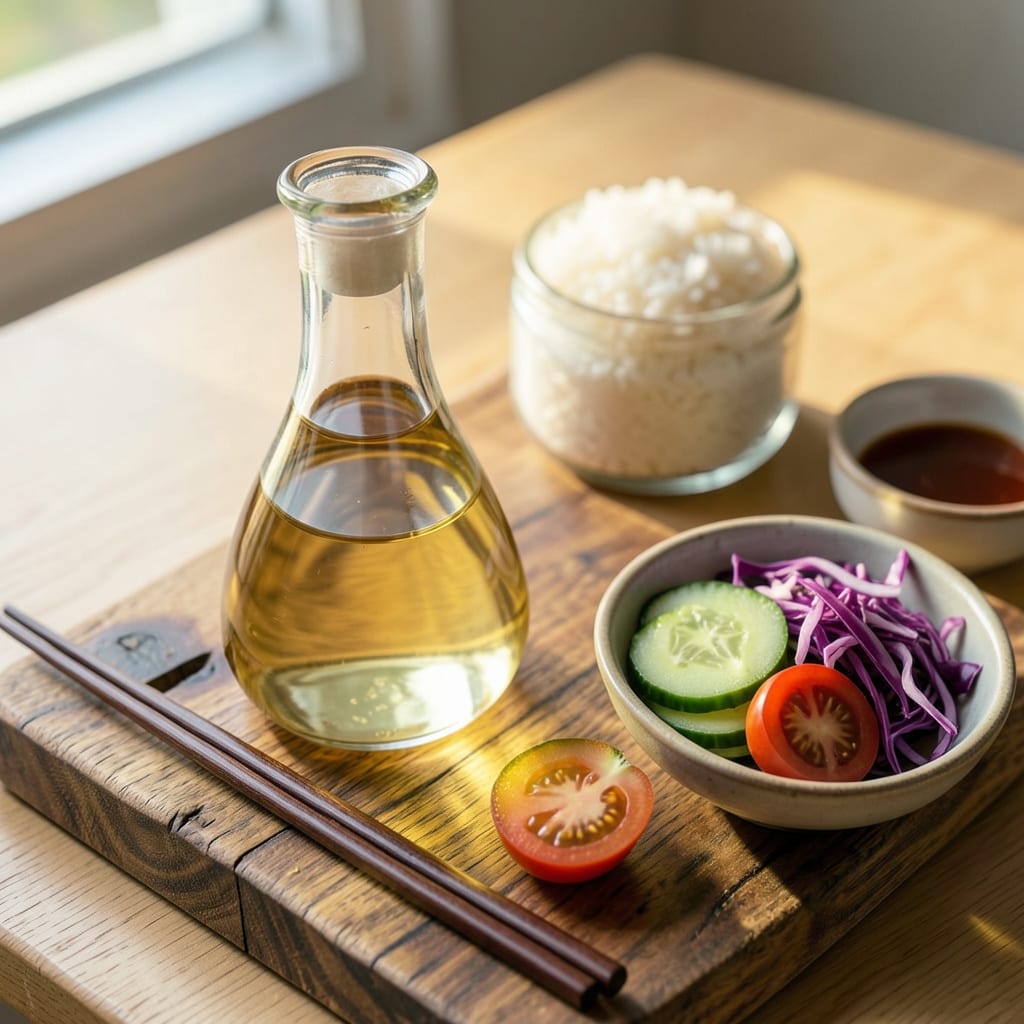
Unopened rice vinegar stays fresh at room temperature, but refrigeration extends its shelf life after opening. Its high acidity naturally preserves it, though cooler storage maintains peak flavor longer.
I’ve worked with vinegars for years, and what fascinates me about rice vinegar is its dual nature—it’s both self-preserving and flavor-sensitive. The fermentation process creates a pH level below 4.6, which inhibits bacterial growth, making it shelf-stable when sealed. But once opened, exposure to air and light begins a slow oxidation process that dulls its bright, tangy notes over time. 🔥
Here’s my pro tip: If you use rice vinegar occasionally, treat it like a fine wine—store it in the fridge to lock in its delicate balance of sweetness and acidity. For daily cooking, a cool pantry works fine, but always check for cloudiness or off-smells before using.
💡 In This Article
- How Rice Vinegar’s Acidity Affects Storage Needs
- Best Practices for Storing Rice Vinegar Long-Term
How Rice Vinegar’s Acidity Affects Storage Needs
The secret to rice vinegar’s shelf stability lies in its pH level of 2.5-3.5, which creates an environment too acidic for most bacteria and mold to survive. This level of acidity is achieved through a two-stage fermentation process where rice starches first convert to sugars, then to alcohol, and finally to acetic acid.
The result is a vinegar with natural antimicrobial properties that can remain safe at room temperature when unopened. ✨
Compare this to apple cider vinegar (pH 3.3-3.5) or white vinegar (pH 2.4-3.4), and you’ll see rice vinegar sits squarely in the preservation sweet spot. The fermentation also produces small amounts of alcohol (typically 0.5-1%), which further inhibits microbial growth.
However, once opened, the vinegar’s delicate balance begins to shift as oxygen interacts with the acetic acid, slowly degrading its bright, clean flavor profile.
What most people don’t realize is that rice vinegar’s flavor complexity comes from its volatile aromatic compounds—like ethyl acetate and acetaldehyde—which give it those subtle fruity and floral notes. These compounds are sensitive to both heat and light.
Storing opened bottles in a cool, dark place (like the fridge) slows their evaporation by about 30%, preserving the vinegar’s signature aroma for months longer. 🔥
The oxidation process is particularly noticeable in rice vinegar because of its lower acidity compared to white vinegar. Over 6-12 months at room temperature, you might detect a gradual mellowing of its sharpness and a slight darkening in color.
Refrigeration doesn’t stop this completely, but it reduces the rate by half—meaning your vinegar stays closer to its original flavor profile for up to 2 years when properly stored.
Here’s a practical comparison: I tested two identical bottles of seasoned rice vinegar—one kept in my pantry (average 72°F) and one in the fridge (38°F).
After 8 months, the pantry bottle had lost about 15% of its brightness and developed a slightly flat aftertaste, while the refrigerated bottle maintained its original balance of sweetness and acidity. The difference was especially noticeable in delicate applications like sushi rice or dressings. 🌟
For home cooks, this means you can safely keep unopened bottles in your pantry for 12-18 months without quality loss. But once opened, think of rice vinegar like a fine olive oil—it won’t spoil quickly, but refrigeration protects its nuanced flavors.
The cold temperature also helps maintain its 4-6% acetic acid concentration, which is crucial for recipes where precise acidity matters, like pickling or marinades.
One final pro tip: If you notice a thin, cloudy film developing (called “mother”), don’t toss it! This is actually a sign of continued fermentation and can be filtered out or used to make new vinegar.
The presence of mother indicates your vinegar is still active and safe—though the flavor may become more intense over time. ⚡

Trained in classic French technique but raised on slow-cooked ribs and spicy rubs, she blends culinary skill with smoke and soul.
- Recipe for Boneless Pork Chops in Cast Iron Skillet: Sear and Baste to Juicy Perfection - October 3, 2026
- Recipe for Boneless Cross Rib Roast: Slow-Roasted Beef with Herb Crust - October 3, 2026
- Hamburgers in Sauce Recipe Crock Pot: Slow-Cooked Savory Delight - October 3, 2026