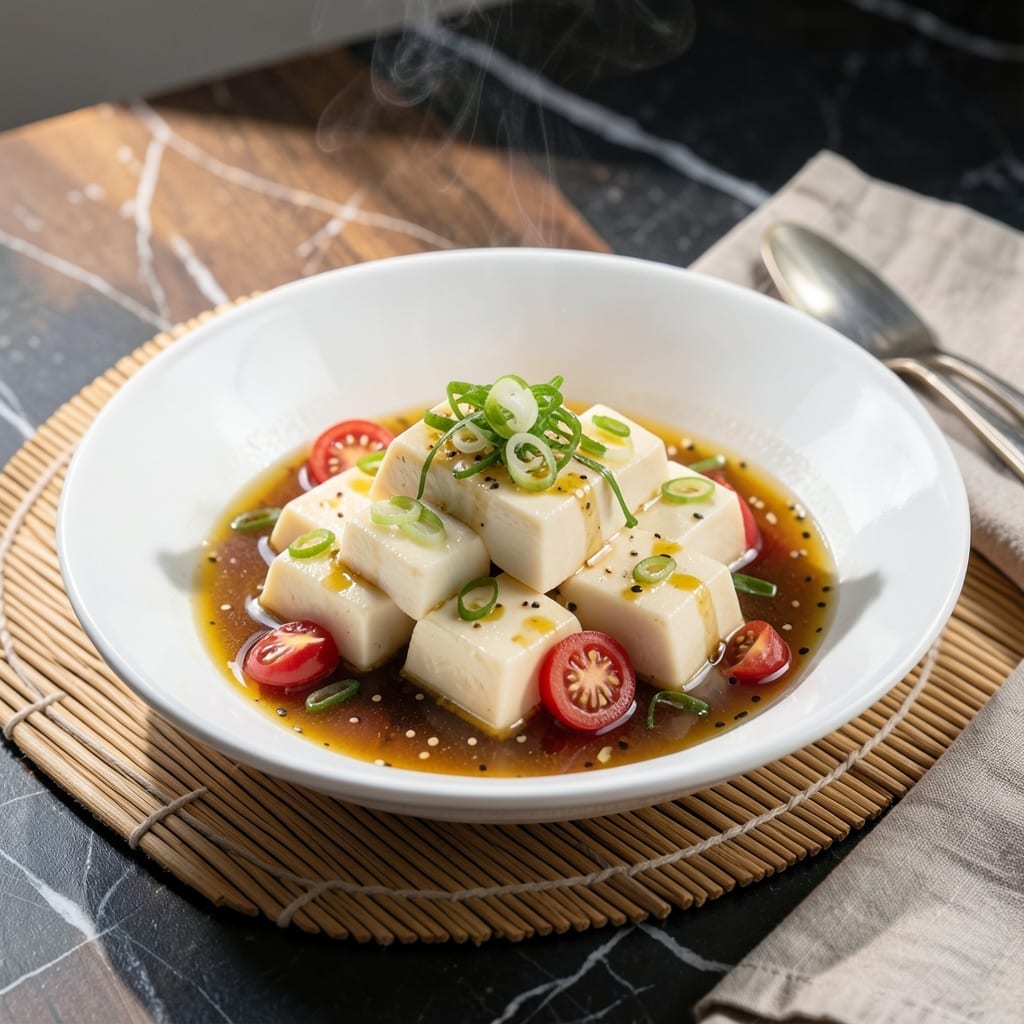
This dish transforms simple ingredients into a silky, custard-like texture that defines authentic Chinese egg tofu. The technique requires precision with heat control and gentle folding to maintain that delicate consistency.
What sets this version apart is the wok-fried depth, achieved through careful layering of flavors. The process creates a dish that’s light yet deeply satisfying, with each bite offering a contrast between the soft tofu and the savory sauce.
You’ll achieve professional results by mastering the timing and temperature control. The key is maintaining a steady hand while cooking to preserve the tofu’s signature smoothness.
This vegetarian creation proves that plant-based dishes can deliver complex flavors and textures. The final product is as beautiful to look at as it is to eat.
Ingredients for Egg Tofu Recipe Chinese
Transform everyday eggs and tofu into a silky, restaurant-worthy dish with these ingredients.
| Ingredient | Amount | Notes |
|---|---|---|
| Large Eggs 🥚 | 6 whole | Room temperature preferred |
| Silken Tofu 🧈 | 14 oz | Soft or extra-soft variety |
| Vegetable Stock 🥣 | 2 cups | Low-sodium preferred |
| Soy Sauce 🫒 | 2 tbsp | Light soy sauce recommended |
| Shaoxing Wine 🍶 | 1 tbsp | Dry sherry substitute works |
| Sesame Oil 🫒 | 1 tsp | Toasted variety for depth |
| Garlic Cloves 🧄 | 3 cloves | Minced finely |
| Fresh Ginger 🌿 | 1 tbsp | Grated or minced |
| Green Onions 🧅 | 3 whole | Thinly sliced for garnish |
| Cornstarch 🌾 | 1 tbsp | For thickening sauce |
| Neutral Oil 🫒 | ¼ cup | For wok-frying (peanut or vegetable) |
| White Pepper 🧂 | ¼ tsp | Ground, for authentic flavor |
| Salt 🧂 | ½ tsp | Adjust to taste |
| Sugar 🧈 | ½ tsp | Balances savory flavors |
[recipe_ingredient_scaler]
Silken tofu quality is non-negotiable here. Mori-Nu or Nasoya brands consistently deliver the smooth texture required. Find them in the refrigerated section at Whole Foods or most Asian markets—avoid the shelf-stable versions, which lack the necessary delicacy. Room-temperature eggs blend more uniformly into the custard base, so pull them from the fridge 30 minutes early (worth the extra minute).
No Shaoxing wine? Dry sherry at equal volume works nearly as well. For a non-alcoholic option, rice vinegar with a pinch of sugar mimics the tang. The vegetable stock can be swapped for mushroom stock for deeper umami. If using regular tofu instead of silken, blend it thoroughly to achieve a smooth consistency (the texture won’t be identical but it’s passable in a pinch).
The custard base sets as it cools, so serve immediately for that signature wobble. Leftovers keep in the fridge for up to 2 days, though the texture firms slightly. Reheat gently in a steamer or microwave at 50% power to preserve the silky finish.
Why You’ll Love This Recipe
- One Bowl Wonder: I just whisk eggs with silken tofu, pour in the stock, and let it steam—no chopping, no fuss.
- Umami Bomb: The soy sauce and Shaoxing wine create this deep, savory richness that coats every silky bite.
- Weeknight Hero: Honestly, it’s my go-to when I need dinner ready before the kids finish homework.
- Budget Stretcher: A block of tofu and a few eggs feed four of us, and leftovers taste even better the next day.
Step-by-Step Instructions for Egg Tofu
Master the technique for achieving that signature silky texture with rich wok-fried flavor in every bite.
Step 1: Create the Custard Base
In a blender, combine the 6 whole Large Eggs with the 14 oz Silken Tofu, 2 cups Vegetable Stock, 2 tbsp Soy Sauce, 1 tbsp Shaoxing Wine, 0.5 tsp Salt, and 0.5 tsp Sugar. Blend until completely smooth with no visible lumps—this should take 2-3 minutes on high speed.
The mixture will be thin and pourable, like heavy cream. This consistency is crucial for achieving the signature custard-like texture. Strain through a fine-mesh sieve into a large bowl to remove any remaining solids, ensuring the smoothest possible base for your dish.
Step 2: Thicken the Mixture
Place the strained mixture in a saucepan over medium heat. In a small bowl, whisk the 1 tbsp Cornstarch with 2 tbsp of cold water to create a slurry. Slowly pour this into the saucepan while whisking constantly to prevent lumps from forming.
Cook the mixture for 5-7 minutes, stirring continuously with a wooden spoon, until it thickens enough to coat the back of the spoon. You’ll notice it transform from a thin liquid to a velvety custard. Be patient—this step ensures the proper texture before the final cooking stage.
Step 3: Prepare the Aromatics
While the custard base thickens, finely mince the 3 cloves Garlic Cloves and grate the 1 tbsp Fresh Ginger. Thinly slice the 3 whole Green Onions, keeping the white and green parts separate. These aromatics will build the flavor foundation for the finished dish.
Heat the 0.25 cup Neutral Oil in a wok over medium-high heat until it shimmers. Add the minced garlic and grated ginger, stirring constantly for 30-45 seconds until fragrant but not browned. The oil should become infused with their aroma without taking on color.
Step 4: Steam the Custard
Pour the thickened custard mixture into a heatproof dish that fits inside your steamer. Cover with a lid or foil and steam over boiling water for 15-20 minutes until the custard is set but still slightly jiggly in the center, like a soft tofu.
Check for doneness by inserting a toothpick—it should come out clean. The texture should be silky and smooth, not rubbery or firm. Carefully remove from the steamer and let it cool slightly while you finish the aromatics.
Step 5: Finish and Serve
Pour the hot garlic-ginger oil over the steamed custard. Drizzle with the 1 tsp Sesame Oil and sprinkle with 0.25 tsp White Pepper. Garnish with the sliced green onions, using both white and green parts for color and freshness.
Serve warm in bowls, ensuring each portion gets a share of the fragrant oil on top. The contrast between the silky custard and the aromatic oil creates the authentic texture and depth this dish is known for.
Pro Tips For Making Egg Tofu Recipe Chinese
- Beat Eggs Gently: I learned this the hard way—overmixing the eggs creates a dense, rubbery texture in your tofu. Whisk just until the yolks and whites are combined, about 15-20 strokes.
- Drain Silken Tofu Well: Press the silken tofu between paper towels for 10 minutes to remove excess water, or your egg mixture will turn out watery. Sounds tedious, but it actually changes the outcome.
- Skip Boiling Stock: Use warm or room temperature vegetable stock when blending with the eggs and tofu. Hot stock can cook the eggs prematurely, leaving you with lumps instead of a smooth custard.
- Add Wine Early: Mix the Shaoxing wine into the egg-tofu blend before steaming—it mellows the alcohol flavor and distributes evenly. I was skeptical until I tried it, but the depth of flavor is noticeable.
Common Mistakes When Making Perfect Results
Over-blending the Base
Blending the egg and tofu mixture for too long can incorporate too much air, creating bubbles that disrupt the silky texture. I blend for 2-3 minutes max on high, then let it rest for 1 minute to allow any bubbles to settle before straining. 💡
Skipping the Straining
Even with a high-speed blender, tiny bits of tofu or egg can remain. Always strain through a fine-mesh sieve—this extra step ensures the smoothest possible custard. I use a Chinois strainer for best results.
Pressing the mixture through with a spatula helps extract every bit of liquid, leaving only the solids behind.
High Heat Steaming
Boiling water too vigorously can cause the custard to cook unevenly or develop a rubbery texture. Maintain a gentle simmer in your steamer, and check water levels frequently. I add 1 inch of water initially and top up with hot water as needed.
Overcooking the Custard
The custard should be set but still slightly jiggly in the center when done. Over-steaming turns it dense and firm—think soft tofu, not firm. I check at 15 minutes and remove it as soon as a toothpick comes out clean.
Rushing the Aromatics
Burnt garlic or ginger will impart bitter flavors that ruin the dish. Cook them over medium-high heat for only 30-45 seconds until fragrant but not browned. David can always tell when I’ve rushed this step—he’s my official taste-tester for a reason!
Improper Oil Temperature
Pouring the garlic-ginger oil over the custard while it’s not hot enough results in a dull, flat flavor. The oil should be shimmering and fragrant when you drizzle it. I let it sit for 10 seconds off the heat to cool slightly before pouring. 🔥
Nutrition Facts
Frequently Asked Questions
What kind of tofu works best?
Use silken tofu (soft or extra-soft) for the smoothest texture. Mori-Nu or Nasoya brands work well. Avoid firm tofu—it won’t blend into a silky custard.
Can I make this without a steamer?
Yes! Use a bamboo steamer insert in a pot or a metal colander over boiling water. Cover tightly with foil to trap steam.
How do I fix a lumpy custard base?
Strain through a fine-mesh sieve to remove lumps. For stubborn bits, blend again briefly or press through with a spatula.
Can I prepare this ahead of time?
Best served fresh, but leftovers keep for 2 days refrigerated. Reheat gently in a steamer or microwave at 50% power.

Trained in classic French technique but raised on slow-cooked ribs and spicy rubs, she blends culinary skill with smoke and soul.
- Recipe for Boneless Pork Chops in Cast Iron Skillet: Sear and Baste to Juicy Perfection - October 3, 2026
- Recipe for Boneless Cross Rib Roast: Slow-Roasted Beef with Herb Crust - October 3, 2026
- Hamburgers in Sauce Recipe Crock Pot: Slow-Cooked Savory Delight - October 3, 2026