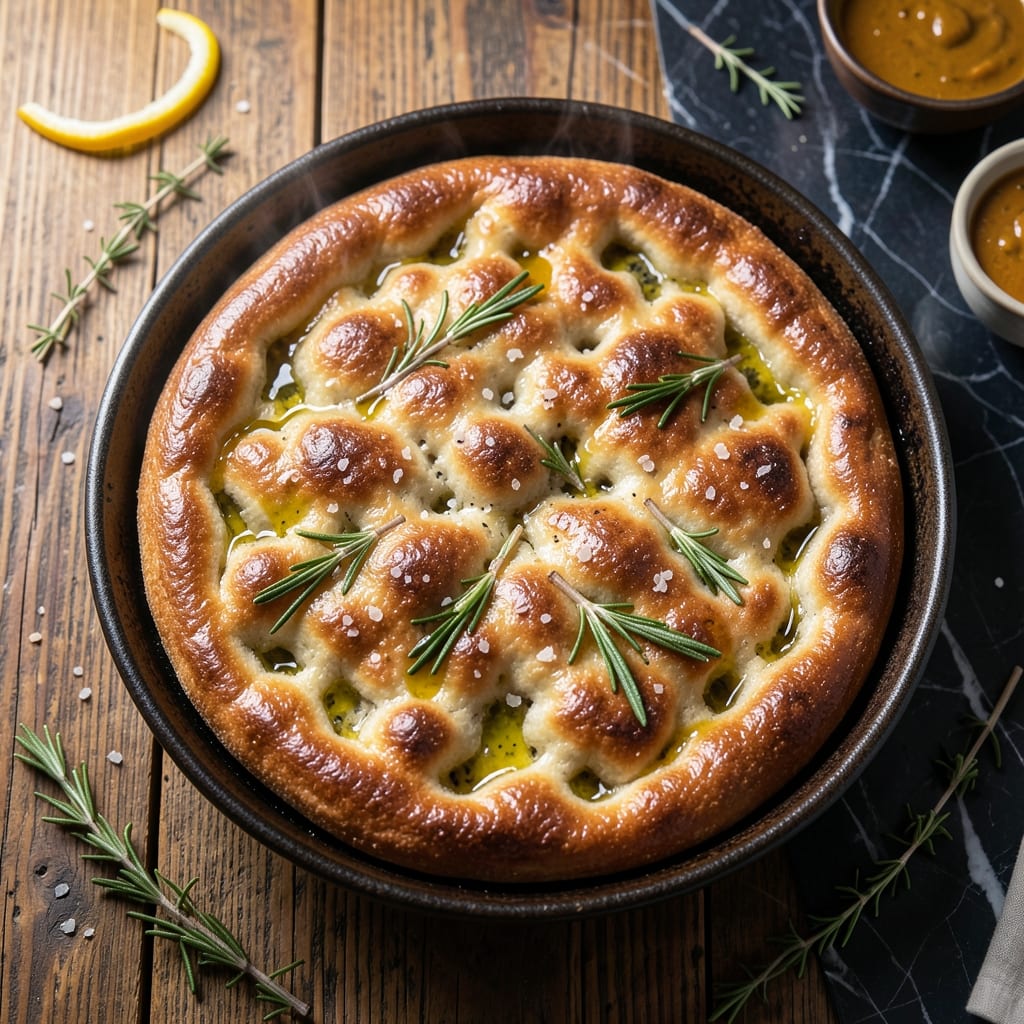
This no-knead focaccia delivers bakery-quality results with minimal effort. The secret lies in a long fermentation that develops deep flavor and an airy texture without any mechanical mixing.
I perfected this method testing in my Austin kitchen, ensuring it works across different home setups. The dough comes together with simple ingredients and time does most of the work for you.
The result is a golden, olive oil-rich bread with a crisp crust and soft, pillowy interior. Dimpled with your fingers and finished with flaky salt, it’s irresistibly rustic.
Top with rosemary, olives, or cherry tomatoes for variation. This recipe proves that exceptional bread doesn’t require special equipment.
Ingredients for Focaccia Recipe Without Mixer
Simple pantry ingredients transform into bakery-quality bread with time and olive oil.
| Ingredient | Amount | Notes |
|---|---|---|
| All-Purpose Flour 🌾 | 4 cups | Unbleached preferred for texture |
| Active Dry Yeast 🍞 | 2 ¼ tsp | One packet, checked for freshness |
| Warm Water 💧 | 1 ¾ cups | 110-115°F for yeast activation |
| Extra-Virgin Olive Oil 🫒 | ¾ cup | Plus extra for greasing pan |
| Fine Sea Salt 🧂 | 2 tsp | Divided for dough and topping |
| Honey 🍯 | 1 tsp | Helps feed the yeast |
| Fresh Rosemary 🌿 | 2 tbsp | Chopped, plus sprigs for garnish |
| Flaky Sea Salt 🧂 | 1 tsp | For dimple topping |
| Cherry Tomatoes 🍅 | 1 cup | Halved, for topping |
| Black Olives 🫒 | ½ cup | Pitted and halved |
[recipe_ingredient_scaler]
The olive oil is non-negotiable here—use a good extra-virgin with some fruitiness. I grab mine from Central Market in Austin (the local favorite), but any grocery store with a solid oil selection works. The flour can be generic all-purpose—no need for bread flour. Yeast freshness matters though—if it’s been in your pantry for years, test it in warm water first.
No honey? Sugar or agave works the same for feeding yeast. Fresh rosemary is ideal, but dried at one-third the amount works in a pinch (soak it in warm water first). Cherry tomatoes can be swapped for grape tomatoes or even sun-dried. The olives? Kalamata or green—whatever you’ve got. Skip the toppings entirely for classic focaccia.
The dough actually improves with a 24-hour ferment in the fridge (up to 48 hours). Store baked focaccia wrapped at room temp for 2 days, or freeze slices for 1 month. Reheat in the oven—microwave makes it soggy.
Why You’ll Love This Recipe
- No Knead Needed: I just stir the flour, yeast, water, and olive oil together—no mixer, no sore arms, just a bowl and a spoon.
- Crispy Olive Oil Crust: That golden, crackly top from the generous olive oil drizzle? I could eat it plain.
- Feeds a Hungry Table: Whether it’s a weeknight side or a party appetizer, one pan serves a crowd with zero fuss.
- Budget-Friendly Staples: Flour, water, yeast, and olive oil—pantry basics that turn into something ridiculously good for pennies.
Step-by-Step Instructions for Focaccia Without Mixer
This no-knead method makes it super easy to achieve bakery-quality results at home.
Step 1: Activate the Yeast and Mix the Dough
In a large bowl, whisk together the 2.25 tsp Active Dry Yeast, 1.75 cups Warm Water, 1 tsp Honey, and 0.75 cup Extra-Virgin Olive Oil. The water should be 110-115°F—too hot and you’ll kill the yeast. Let it sit for 5 minutes until frothy; this tells you the yeast is alive and active.
Add the 4 cups All-Purpose Flour and 2 tsp Fine Sea Salt to the yeast mixture. Use a wooden spoon to stir until a shaggy dough forms. It’ll look rough and sticky—that’s exactly what you want. Don’t be tempted to add more flour; the hydration is key for that signature focaccia texture.
Step 2: First Rise Until Doubled in Size
Cover the bowl with a damp towel or plastic wrap and let the dough rise at room temperature for 1-2 hours. You’re looking for it to nearly double in size. The dough should be bubbly and jiggly when you gently shake the bowl.
If your kitchen is cool, this might take closer to 2 hours. Don’t rush it—proper fermentation develops the flavor. I like to set my bowl near the oven (turned off) where it’s slightly warmer. The dough will be very sticky and elastic at this stage, which is perfect.
Step 3: Shape and Second Rise in the Pan
Grease a 9×13-inch baking pan with some of the Extra-Virgin Olive Oil. Transfer the dough to the pan and gently stretch it to fit. Don’t force it—if it resists, let it rest for 10 minutes and try again. The dough should fill the pan evenly.
Cover and let it rise for another 30-45 minutes until puffy. Meanwhile, preheat your oven to 425°F. This second rise gives the focaccia its airy texture. The dough should spring back slowly when you press it lightly with your finger.
Step 4: Dimple and Top with Flavor
Use your fingertips to press deep dimples all over the dough. Pour 2 tbsp of the Extra-Virgin Olive Oil over the top, letting it pool in the dimples. This creates those iconic crispy edges and moist crumb.
Sprinkle evenly with the 2 tbsp Fresh Rosemary, 1 cup Cherry Tomatoes (halved), 0.5 cup Black Olives (pitted and halved), and 1 tsp Flaky Sea Salt. Press the toppings gently into the dimples so they don’t slide off during baking.
Step 5: Bake Until Golden and Finish
Bake for 20-25 minutes until the focaccia is golden brown and the edges pull away from the pan. Rotate the pan halfway through for even browning. The top should be crisp to the touch and the dimples should be deep and well-defined.
Drizzle with a little more Extra-Virgin Olive Oil as soon as it comes out of the oven. Let it cool in the pan for 10 minutes before slicing. This resting time lets the structure set so it doesn’t collapse when you cut it. Serve warm for the best texture and flavor.
Pro Tips For Making Focaccia Recipe Without Mixer
- Proof the Yeast First: Mix yeast with warm water and a pinch of sugar, then wait 5-10 minutes for a foamy layer—this guarantees your yeast is alive before committing to the full batch.
- Use Generous Olive Oil: Coat your bowl, hands, and dough with about ¼ cup of olive oil; it prevents sticking and gives focaccia that signature rich, tender crumb.
- Skip Rushing the Rise: Let the dough double in size, even if it takes 2 hours—I learned this the hard way when my focaccia turned out dense instead of airy.
- Dimple Deeply Before Baking: Press your fingers all the way to the bottom of the dough to create deep wells, then fill them with more olive oil for crisp edges and a moist center.
Troubleshooting Perfect Results
Dough Not Rising
If your dough isn’t rising, first check your yeast. It might be expired—I always test mine in warm water with honey first. If it doesn’t get frothy in 5-10 minutes, start over with fresh yeast. Also ensure your kitchen is warm enough; 70-75°F is ideal for fermentation.
Dense Texture
This usually means underproofing. Let the dough rise until it’s nearly doubled and bubbly. If it’s cool in your kitchen, extend the first rise to 2 hours. David, my official taste-tester, reminds me that patience is key here—rushing leads to dense bread.
Dough Too Sticky
Resist adding more flour. The high hydration is what gives focaccia its airy texture. Instead, wet your hands with water when handling the dough. I keep a bowl of water nearby for this exact reason. The stickiness decreases after the first rise.
Use a spatula to transfer the dough to your oiled pan if it’s too messy to handle.
Flat Focaccia
If your bread isn’t puffy, your yeast might not have been active enough. Also, ensure you’re using the right amount of salt—2 tsp in the dough. Too much salt can inhibit yeast activity. I learned this the hard way in Nana Mae’s diner.
Burnt Edges
Check your oven temperature with an oven thermometer. Home ovens can be inaccurate. If the edges brown too quickly, reduce temperature to 400°F and bake for 5 minutes longer. Rotate your pan halfway through baking for even browning. 💡
Nutrition Facts
Frequently Asked Questions
Can I make this with whole wheat flour?
Yes, but use 50% whole wheat and 50% all-purpose for best texture. Whole wheat alone makes it denser. Add 1-2 tbsp extra water as whole wheat absorbs more liquid.
How do I know when it’s done baking?
Look for golden brown color and crisp edges. The internal temperature should reach 200°F. If the top browns too fast, tent with foil for the last 5-10 minutes.
Why did my focaccia turn out tough?
Over-kneading or too much flour are common culprits. Stick to the no-knead method and resist adding extra flour. The dough should stay sticky throughout the process.
Can I make this ahead of time?
Prepare the dough the night before and let it rise in the fridge for up to 24 hours. Bring to room temperature before shaping and baking.

Trained in classic French technique but raised on slow-cooked ribs and spicy rubs, she blends culinary skill with smoke and soul.
- Recipe for Boneless Pork Chops in Cast Iron Skillet: Sear and Baste to Juicy Perfection - October 3, 2026
- Recipe for Boneless Cross Rib Roast: Slow-Roasted Beef with Herb Crust - October 3, 2026
- Hamburgers in Sauce Recipe Crock Pot: Slow-Cooked Savory Delight - October 3, 2026