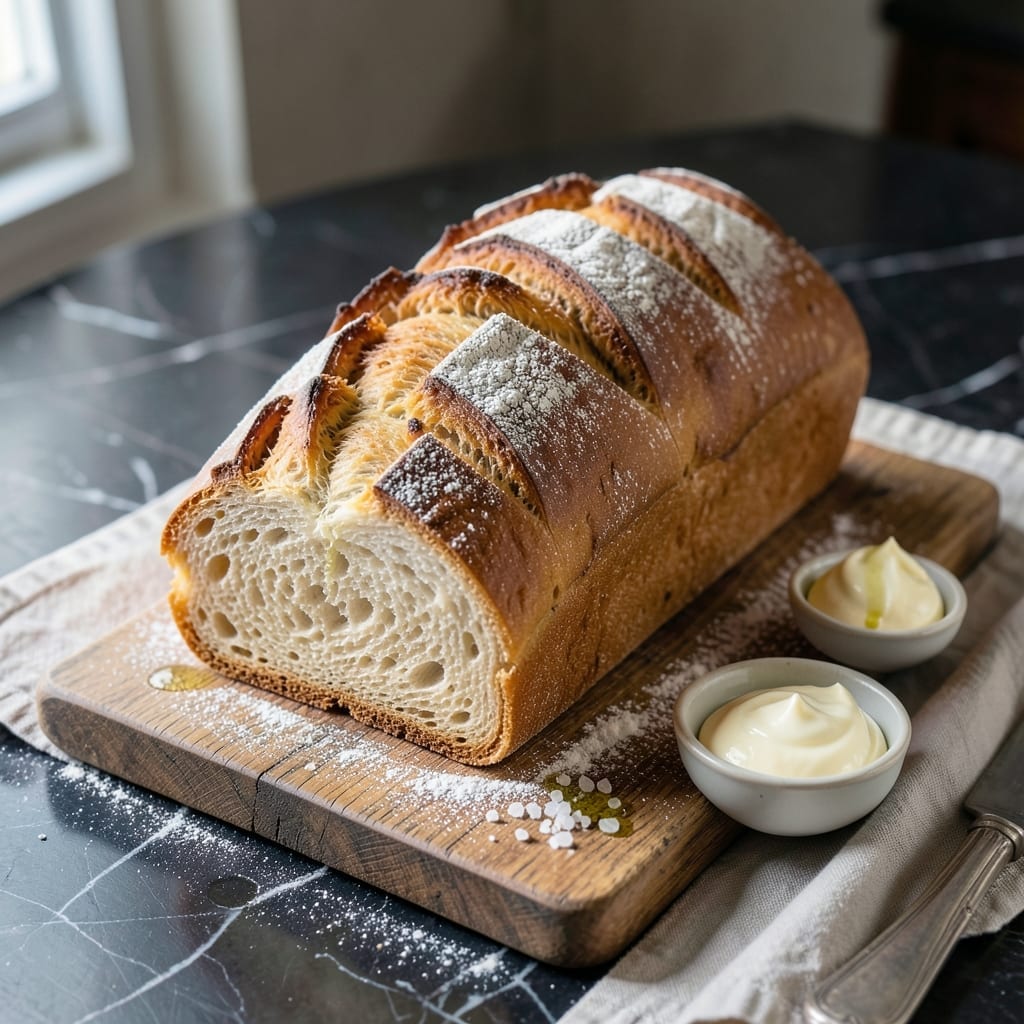
There’s nothing like the aroma of fresh-baked French bread filling your kitchen. This hands-free method delivers a golden crust and airy crumb with minimal effort.
Your bread machine handles the mixing and kneading while you focus on the shaping. The result is an artisan-style loaf that rivals any bakery.
Ingredients for French Bread Recipe Bread Machine
Nine simple ingredients transform into bakery-quality French bread with your bread machine doing the heavy lifting.
| Ingredient | Amount | Notes |
|---|---|---|
| Bread Flour 🌾 | 3 ½ cups | High-protein for structure |
| Active Dry Yeast 🍞 | 2 ¼ tsp | Instant yeast works too |
| Kosher Salt 🧂 | 1 ½ tsp | Diamond Crystal preferred |
| Granulated Sugar 🍚 | 1 tbsp | Feeds the yeast activity |
| Water 💧 | 1 ¼ cups | Warm, about 110°F |
| Unsalted Butter 🧈 | 2 tbsp | Softened for dough |
| Vital Wheat Gluten 🌾 | 1 tbsp | Optional for extra chew |
| Cornmeal 🌽 | 2 tbsp | For dusting baking sheet |
| Large Egg 🥚 | 1 whole | For egg wash finish |
| Lemon Juice 🍋 | 1 tsp | Enhances yeast development |
[recipe_ingredient_scaler]
The flour is non-negotiable here. King Arthur Bread Flour is my go-to—high protein content means better gluten development and that classic chewy texture. Gold Medal works too. Don’t even think about all-purpose; it just won’t give you that open crumb. Yeast should be fresh (check the expiration date—old yeast is the #1 reason bread fails to rise). I buy mine in bulk from Costco and store it in the freezer.
No bread flour? All-purpose plus vital wheat gluten (1 tbsp per cup) gets you close. Out of kosher salt? Table salt at half the amount, but measure carefully—it’s saltier. No egg for the wash? Milk or water works, just won’t be as shiny. The sugar isn’t just for sweetness—it’s yeast food, so don’t skip it (honey or maple syrup in a pinch). Butter can be swapped for olive oil if you’re avoiding dairy.
This dough rises fast—use it within 2 hours of mixing. Baked loaves stay fresh for 2-3 days wrapped in foil at room temp, or freeze for up to 3 months. Slice before freezing for easy toast-ready portions.
Why You’ll Love This Recipe
- Set and Forget: Honestly, I just toss the flour, yeast, salt, sugar, and water in the machine and let it do the work—no kneading, no fuss.
- Crust Perfection: That golden, crispy crust with a soft, airy center? The bread machine nails it every time with just those five ingredients.
- Sandwich Savior: I slice it fresh for lunch or freeze halves for later—it’s my go-to for soups, dips, or even garlic bread.
Step-by-Step Instructions for French Bread Bread Machine
Here’s the method that delivers bakery-quality results with minimal effort on your part.
Step 1: Prepare the Bread Machine Pan and Ingredients
Begin by adding the 1.25 cups Water to your bread machine pan first. The liquid should be warm, about 110°F—any hotter and you’ll risk killing the yeast before it can activate. I use a kitchen thermometer to be precise, as water temperature is crucial for consistent results.
Next, add the 2 tbsp Unsalted Butter cut into small pieces so it distributes evenly. Then sprinkle the 1 tbsp Granulated Sugar, 1.5 tsp Kosher Salt, and 1 tbsp Vital Wheat Gluten over the water. The vital wheat gluten gives this loaf that extra chew characteristic of artisan French bread.
Step 2: Add Flour and Yeast to the Machine
Now add the 3.5 cups Bread Flour on top of the liquid ingredients. Use a spoon to level the flour without packing it down. The high protein content in bread flour creates the perfect structure for this loaf.
Make a small well in the center of the flour and add the 2.25 tsp Active Dry Yeast. It’s important to keep the yeast separate from the liquid until the machine starts mixing. This prevents premature activation and ensures your bread rises properly during the cycle.
Step 3: Select and Start the Bread Machine Cycle
Place the pan into your bread machine and select the French bread or basic white bread setting. I recommend using the 1.5-pound loaf size and medium crust color settings for this recipe. The entire cycle will take approximately 3-4 hours, depending on your machine.
About 10 minutes into the cycle, check that the dough has formed a smooth ball. If it appears too wet, add additional bread flour 1 tablespoon at a time. If too dry, add warm water 1 teaspoon at a time. The dough should be slightly tacky but not sticky.
Step 4: Prepare for Baking and Apply Egg Wash
When the machine beeps at the end of the kneading cycle (usually after about 1 hour), sprinkle the 2 tbsp Cornmeal on a baking sheet. This adds texture and prevents sticking.
If your machine has a bake-only function, transfer the dough to the prepared baking sheet. Otherwise, let the machine complete its cycle. For a golden finish, whisk the 1 whole Large Egg with 1 tsp Lemon Juice and brush over the dough just before the final rise begins.
Step 5: Bake and Cool for Perfect Texture
Allow the bread to bake completely in the machine or in your oven at 375°F for 25-30 minutes until deep golden brown. The loaf should sound hollow when tapped on the bottom and reach an internal temperature of 190-200°F.
Transfer to a wire rack and let cool for at least 1 hour before slicing. This cooling period is essential as it allows the crumb structure to set properly. The result should be a crisp crust with a light, airy interior and that characteristic French bread flavor.
Pro Tips For Making French Bread Recipe Bread Machine
- Warm Your Water: Use water at 110°F—any hotter kills the yeast, any cooler slows the rise. I learned this the hard way after a few dense loaves.
- Measure Flour Right: Spoon flour into your measuring cup and level it off—scooping directly packs it down and makes bread too dense.
- Skip the Overproof: Let the dough rise until it just doubles in the machine, about 1 hour. Resist the urge to let it go longer or it’ll collapse when baked.
- Brush With Water: Before baking, lightly brush the top with water for that classic French bread crust. Sounds simple, but it actually changes the outcome.
Make-Ahead Tips for This Dish
Same-Day Prep
Mix your dough in the bread machine first thing in the morning. After the kneading cycle, let it rise in the machine for 1 hour, then shape and transfer to a baking sheet. Cover with a damp towel and refrigerate for up to 8 hours before baking. 💡
Overnight Dough
Prepare the dough in your bread machine at night, but stop it after the kneading cycle. Place the dough in a greased bowl, cover tightly, and refrigerate overnight. In the morning, shape your loaf and let it rise at room temperature for 1-2 hours before baking.
Dough Balls for Later
After kneading, divide the dough into 4 equal portions (about 6 oz each). Shape into balls, place on a floured tray, cover with plastic wrap, and refrigerate for up to 24 hours. Bake individual rolls when needed.
Freezing Unbaked Dough
Shape your loaf after the bread machine’s kneading cycle, then wrap tightly in plastic wrap and freeze for up to 1 month. Thaw overnight in the fridge, then let rise at room temperature for 2 hours before baking.
Baked Loaf Storage
Cool your French bread completely, then wrap in aluminum foil. Store at room temperature for up to 3 days. For longer storage, freeze the whole loaf in a freezer bag for up to 3 months. 📅
Reheating Tips
For best results, preheat your oven to 350°F and warm the bread wrapped in foil for 10-15 minutes. For a crispy crust, unwrap and bake for an additional 5 minutes.
Nutrition Facts
Frequently Asked Questions
Can I use all-purpose flour instead?
Not recommended. Bread flour’s high protein is key for structure. If you must, add 1 tbsp vital wheat gluten per cup of all-purpose flour.
Why does the dough need to cool before slicing?
Letting it rest for 1 hour allows the crumb to set. Cutting too soon makes bread gummy. Patience pays off with perfect texture!
How do I know when it’s fully baked?
Check for deep golden brown color and a hollow sound when tapped. Internal temp should be 190-200°F.
Can I make this without an egg wash?
Yes, but the crust won’t be as shiny. Use milk or water for a simpler finish. The flavor remains the same.

Trained in classic French technique but raised on slow-cooked ribs and spicy rubs, she blends culinary skill with smoke and soul.
- Sanjeev Kapoor Egg Biryani Recipe: Fragrant Spiced Rice With Boiled Eggs - October 3, 2026
- Recipe for French Pork Spread Gorton: Savory Gallic Flavors in a Spreadable Delight - October 3, 2026
- Recipe for Pan Fried: Golden Crust with Savory Depth - October 3, 2026