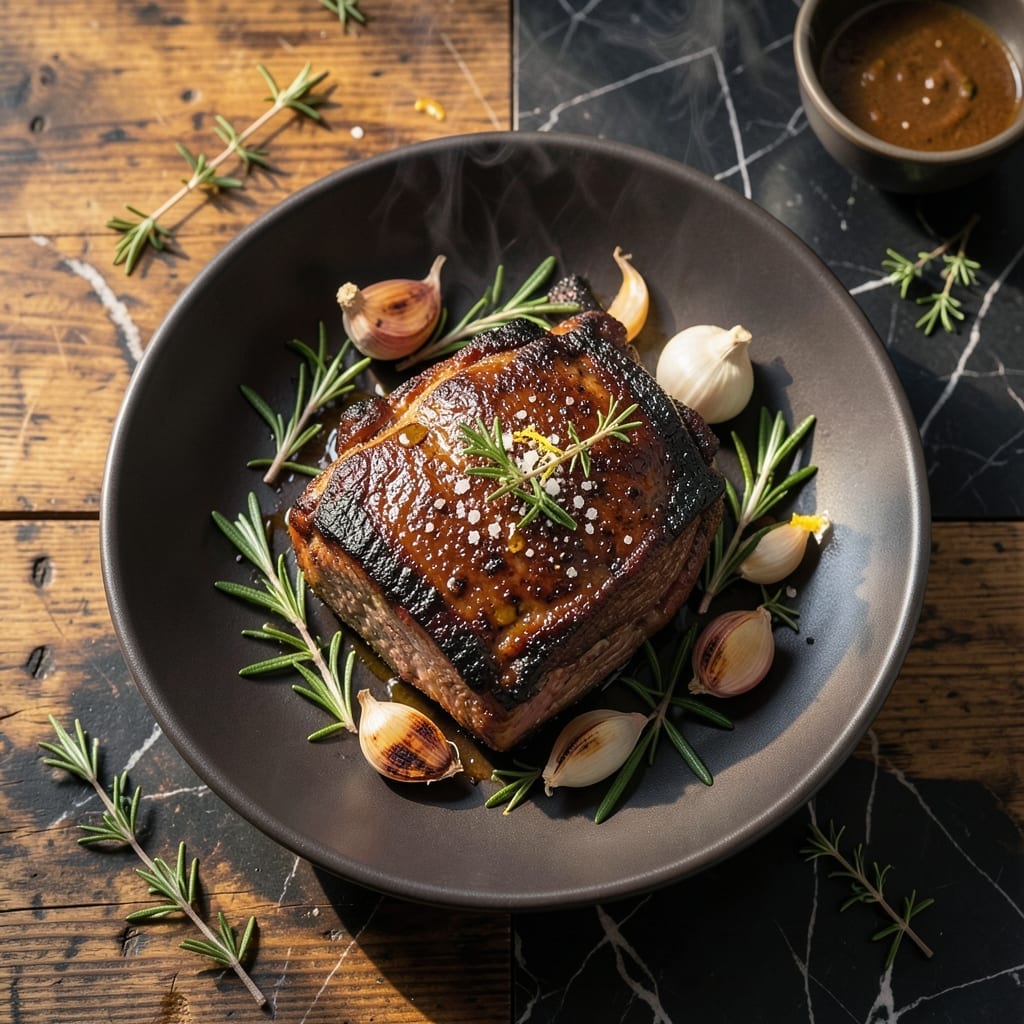
This pellet-smoked beef roast delivers tender results with a fragrant herb crust that locks in juices. My years of pitmaster experience show that low and slow cooking transforms tough cuts into melt-in-your-mouth perfection.
The Green Mountain Grill provides consistent temperature control for even smoking. A simple herb rub enhances the natural beef flavors without overpowering them.
Ingredients for Green Mountain Grill Beef Roast
A well-marbled roast and fresh herbs create that melt-in-your-mouth perfection you crave.
| Ingredient | Amount | Notes |
|---|---|---|
| Beef Chuck Roast 🥩 | 3 lb | Well-marbled, boneless preferred |
| Coarse Kosher Salt 🧂 | 1 ½ tbsp | Diamond Crystal brand recommended |
| Freshly Ground Black Pepper 🌶️ | 1 tbsp | Coarse grind for texture |
| Garlic Cloves 🧄 | 6 cloves | Peeled and minced |
| Fresh Rosemary 🌿 | 2 tbsp | Chopped, stems discarded |
| Fresh Thyme 🍃 | 2 tbsp | Chopped, stems discarded |
| Olive Oil 🫒 | ¼ cup | Extra-virgin for herb rub |
| Yellow Onion 🧅 | 1 whole | Large, quartered |
| Carrots 🥕 | 3 whole | Cut into chunks |
| Celery Stalks 🌱 | 3 pieces | Cut into chunks |
| Beef Broth 💧 | 2 cups | Low-sodium preferred |
| Red Wine 🍷 | 1 cup | Dry variety like Cabernet |
| Apple Cider Vinegar 🍏 | 2 tbsp | For brightness in mop sauce |
| Brown Sugar 🍚 | 2 tbsp | Light or dark |
[recipe_ingredient_scaler]
The beef is everything here. Chuck roast with good marbling (look for those white fat streaks) is ideal—Costco or Whole Foods usually have great options. The herb crust needs fresh rosemary and thyme (the good stuff, not the pre-dried kind). I grab mine from Trader Joe’s when I’m in a pinch. For the olive oil, go with a high-quality extra-virgin—it makes a difference in the rub.
No red wine? Substitute beef broth with a splash of balsamic vinegar. Fresh out of rosemary? Dried at one-third the amount works, but fresh is worth the effort. The apple cider vinegar can be swapped for white vinegar in a pinch—just use a touch less. Brown sugar? Maple syrup or honey (though honey’s not vegan) can stand in, but the sugar adds a nice caramelization.
Store the raw roast in the fridge for up to 3 days before smoking. Leftovers keep for 4-5 days in the fridge or freeze for 3 months. Always slice against the grain for serving—makes every bite tender.
Why You’ll Love This Recipe
- Set It and Forget: I just rub the chuck roast with salt, pepper, garlic, and rosemary, then let the Green Mountain grill do the work.
- Herb-Kissed Perfection: The rosemary and garlic form this insane crust that makes every bite ridicously good.
- Sunday Dinner, Tuesday Leftovers: We feast on it fresh, then I shred the leftovers for sandwiches all week.
- Budget Feast: One affordable chuck roast feeds my whole family—with enough for seconds.
Instructions
Here’s the method. Straightforward, tested, works every time.
Step 1: Create the Herb Rub and Prep the Roast
In a small bowl, combine the 1.5 tbsp Coarse Kosher Salt, 1 tbsp Freshly Ground Black Pepper, 6 cloves Garlic Cloves, 2 tbsp Fresh Rosemary, and 2 tbsp Fresh Thyme with the 0.25 cup Olive Oil. The mixture should form a thick, fragrant paste that clings to the meat.
Pat the 3 lb Beef Chuck Roast completely dry with paper towels—this ensures the rub adheres properly and creates a beautiful crust. I like to score the surface lightly with a knife to help the flavors penetrate deeper. Rub the herb paste all over the roast, pressing it in firmly so it forms an even coating. Let it sit at room temperature for 30 minutes while you prep the smoker.
Step 2: Set Up the Green Mountain Grill for Indirect Smoking
Preheat your Green Mountain Grill to 225°F using your preferred wood pellets—I recommend hickory or oak for a robust flavor that complements the beef. Fill the hopper with enough pellets for a long cook (this will take 6-8 hours).
Once the grill reaches temperature, place a disposable aluminum pan on the lower grate and add the 1 whole Yellow Onion, 3 whole Carrots, and 3 pieces Celery Stalks to the pan. These vegetables will add moisture and depth to the cooking environment. Fill the pan with 2 cups Beef Broth, 1 cup Red Wine, 2 tbsp Apple Cider Vinegar, and 2 tbsp Brown Sugar to create a mop sauce that will baste the roast.
Step 3: Smoke the Roast to Perfection
Place the roast directly on the upper grate, fat-side up. Insert a meat probe into the thickest part of the roast, avoiding any large fat pockets. Close the lid and let it smoke undisturbed for 4 hours.
After 4 hours, start basting the roast with the mop sauce every 45-60 minutes. This keeps the surface moist and adds layers of flavor. You’ll know it’s ready when the internal temperature reaches 200-205°F and the probe slides in like butter with no resistance. The bark should be dark and crusty, and the roast should have a rich, smoky aroma.
Step 4: Rest and Serve
Remove the roast from the grill and transfer it to a cutting board. Tent it loosely with foil and let it rest for 20-30 minutes. This resting period is crucial—it allows the juices to redistribute, ensuring every slice is tender and moist.
Slice the roast against the grain into thick pieces. The meat should pull apart easily with a fork but still hold its shape. Serve with the strained mop sauce from the pan, which will have reduced into a rich, flavorful au jus. The result is a melt-in-your-mouth roast with a perfect herb crust and deep smoky flavor.
Pro Tips For Making Green Mountain Grill Beef Roast
- Dry the Roast: Pat the chuck roast completely dry with paper towels before seasoning—moisture prevents that deep, flavorful crust from forming on the Green Mountain grill.
- Smash the Garlic: Lightly crush the garlic cloves with the flat side of your knife (peel on) before stuffing them into slits in the roast; it releases more aroma without burning.
- Skip Cold Meat: I learned this the hard way—let the roast sit at room temperature for 30-45 minutes before grilling so it cooks evenly and doesn’t seize up.
- Rest Under Foil: After pulling it from the grill, tent the roast loosely with foil and give it a solid 15 minutes to redistribute juices—carving too soon sends them all to the cutting board.
Troubleshooting green mountain grill beef roast
Uneven Cooking
If one side of your roast is cooking faster, rotate it 180 degrees every 2 hours. I learned this the hard way at my first BBQ competition—now it’s second nature. Uneven heat in pellet grills can create hot spots, even on a Green Mountain Grill. 🌡️
Tough Meat
Tough beef usually means it didn’t reach the right internal temp. Don’t pull it until the probe slides in like butter at 200-205°F. If you’re in a hurry, wrap it in pink butcher paper at 165°F to speed up the process.
Weak Bark Formation
For a better bark, leave the roast unwrapped for at least 4 hours. The sugar in your rub needs time to caramelize. I always use light brown sugar for a crispier finish. If it’s too dark, tent with foil for the last hour.
Dry Results
Dry meat often comes from not enough moisture. Baste more frequently with your mop sauce every 45 minutes after the first 4 hours. The beef broth and red wine in the pan help keep the environment humid. 💧
Temperature Stalls
Hitting a stall around 160-170°F is normal. Don’t panic—this is the collagen breaking down. Wrap the roast in foil or butcher paper to push through faster. I add a splash of apple cider vinegar to the wrap for extra tenderness.
Overpowering Smoke
If the smoke flavor is too strong, switch to a milder pellet like cherry or apple instead of hickory. Also, ensure your grill isn’t producing dirty smoke—clean the fire pot if you see thick, white smoke. Fresh pellets make a difference too.
Nutrition Facts
Frequently Asked Questions
What’s the ideal pellet choice for this roast?
Hickory or oak pellets deliver a robust flavor that pairs perfectly with beef. For a milder profile, try cherry or apple wood.
Can I use a different cut of beef?
Brisket or bottom round work well too, but require 8-10 hours at 225°F. Chuck roast is ideal for its marbling and tenderness.
How do I know when it’s done?
The roast is ready when the internal temp hits 200-205°F and the probe slides in like butter. Expect 6-8 hours total cook time.
What if my bark isn’t forming?
Leave it unwrapped for at least 4 hours and baste regularly. Light brown sugar in the rub helps caramelize for a crispier finish.

Trained in classic French technique but raised on slow-cooked ribs and spicy rubs, she blends culinary skill with smoke and soul.
- Recipe for Boneless Pork Chops in Cast Iron Skillet: Sear and Baste to Juicy Perfection - October 3, 2026
- Recipe for Boneless Cross Rib Roast: Slow-Roasted Beef with Herb Crust - October 3, 2026
- Hamburgers in Sauce Recipe Crock Pot: Slow-Cooked Savory Delight - October 3, 2026