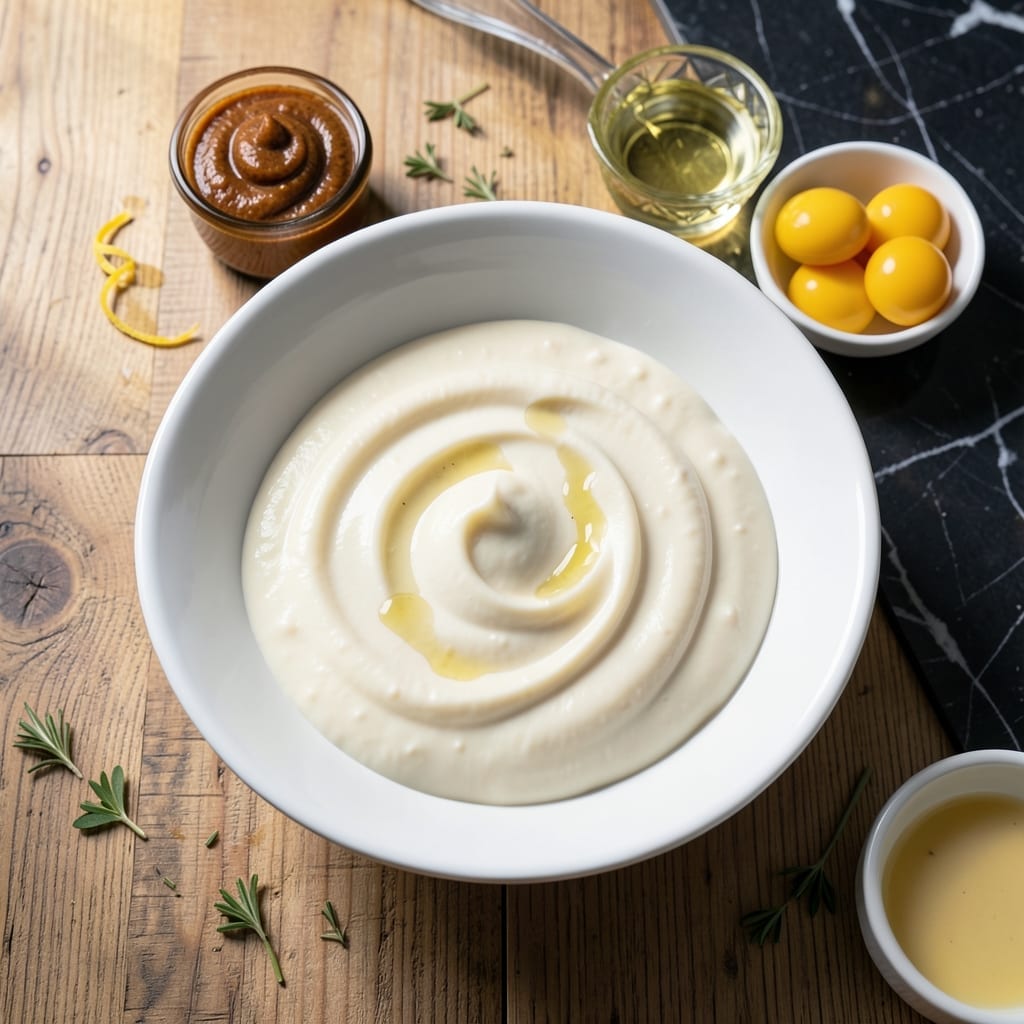
Julia Child’s classic French mayonnaise technique delivers a homemade emulsion that’s rich, creamy, and far superior to store-bought versions.
This classic method requires patience and precision, but the result is a velvety sauce that transforms sandwiches, salads, and dips.
Ingredients for Homemade Mayonnaise Recipe Julia Child
Seven classic ingredients for a velvety emulsion that outshines any store-bought version.
| Ingredient | Amount | Notes |
|---|---|---|
| Large Egg Yolks 🥚 | 2 whole | Room temperature essential |
| Whole Egg 🥚 | 1 whole | Room temperature essential |
| Dijon Mustard 🟡 | 1 tsp | Smooth, not grainy variety |
| White Wine Vinegar 🍷 | 1 tbsp | Or substitute lemon juice |
| Neutral Oil 🫒 | 1 ½ cups | Light olive or avocado oil |
| Kosher Salt 🧂 | ½ tsp | Diamond Crystal preferred |
| Freshly Ground White Pepper 🌶️ | ¼ tsp | Black pepper acceptable alternative |
[recipe_ingredient_scaler]
The oil choice is critical here. Light olive oil or avocado oil yield the cleanest flavor, while neutral vegetable oil works but lacks character. Eggs must be room temperature—cold yolks resist emulsification. Whole Foods or Williams Sonoma carry high-quality Dijon mustard, but Maille is the gold standard for authenticity.
No white wine vinegar? Fresh lemon juice at equal volume provides the needed acidity. Short on eggs? Two whole eggs replace the yolk-plus-egg combo (though texture differs slightly). For a lighter version, replace half the oil with Greek yogurt—add it last, one spoonful at a time. The mustard isn’t just for flavor; it’s your emulsifier.
Mayonnaise keeps 1 week refrigerated in a sealed jar. The emulsion may separate slightly—just whisk to recombine. For longer storage, freeze in ice cube trays for up to 3 months. Thaw overnight in the fridge before using.
Why You’ll Love This Recipe
- One-Bowl Wonder: I love that I just dump everything in one bowl and whisk—no fuss, no extra dishes.
- Tangy Magic: The Dijon and white wine vinegar give it that bright, zippy kick store-bought just can’t match.
- Sandwich Superhero: Honestly, once I started making this, my BLTs and burger nights got a serious upgrade.
- Penny-Pincher’s Friend: A whole egg and a few pantry staples make way more mayo than a jar—and for half the price.
Step-by-Step Instructions for Homemade Mayonnaise
Master this classic French emulsion technique for creamy, rich results every time.
Step 1: Combine the Eggs and Acid Base
In a medium bowl, whisk together the 2 whole Large Egg Yolks and 1 whole Whole Egg until lightly beaten and uniform in color. Room temperature eggs are essential—they emulsify more readily than cold eggs.
Add the 1 tsp Dijon Mustard and 1 tbsp White Wine Vinegar. Whisk vigorously for 30 seconds until the mixture thickens slightly and becomes pale yellow. The mustard acts as an emulsifier, while the vinegar provides the necessary acidity to stabilize the emulsion.
Step 2: Begin the Emulsion with Slow Oil Incorporation
Start adding the 1.5 cups Neutral Oil drop by drop while whisking constantly. This slow introduction is critical—adding oil too quickly will break the emulsion. After about ¼ cup of oil has been incorporated, you’ll notice the mixture begin to thicken and lighten in color.
At this stage, you can switch to adding the oil in a very thin, steady stream while continuing to whisk vigorously. Maintain a consistent pace; the mixture should remain smooth and creamy without any separation. If it begins to look greasy, stop adding oil and whisk until it re-emulsifies.
Step 3: Incorporate Remaining Oil and Season
Once about 1 cup of oil has been added, the mixture will be quite thick. Now you can add the remaining oil slightly faster, but still in a thin stream, whisking continuously. The mayonnaise should become thick enough to hold its shape briefly when the whisk is lifted.
When all the oil is incorporated, whisk in the 0.5 tsp Kosher Salt and 0.25 tsp Freshly Ground White Pepper. Taste and adjust seasoning if needed, though be cautious with additional salt as the flavors will intensify as the mayonnaise rests.
Step 4: Finish and Store Properly
Transfer the mayonnaise to a clean jar or airtight container. The finished product should be pale, creamy, and smooth with a slight sheen. If it appears too thick, whisk in 1 teaspoon of warm water to loosen it slightly.
Store in the refrigerator for up to 1 week. The mayonnaise will thicken slightly as it chills. Always use a clean utensil when removing mayonnaise from the jar to prevent contamination and extend its freshness.
Pro Tips For Making Homemade Mayonnaise Recipe Julia Child
- Start Room Temp: Take your eggs and oil out of the fridge 30 minutes before starting—I learned this the hard way after my mayo broke twice with cold ingredients.
- Drip Then Stream: Add the first 1/4 cup of oil drop by drop, whisking like you mean it, then switch to a thin stream once it starts to thicken.
- Skip the Substitutions: Use Dijon mustard and white wine vinegar exactly as written; I tried swapping in yellow mustard once and the flavor was noticeably flatter.
- Rescue with Water: If it breaks, don’t panic—whisk in 1 teaspoon of hot water at a time until it comes back together, sounds weird but it works every time.
Make-Ahead Tips for This Recipe
🔪 Week Before
Start by gathering all the ingredients for your homemade mayonnaise. Check your pantry for staple items like Dijon mustard, white wine vinegar, and salt. Purchase fresh eggs and ensure they’re at room temperature the day you plan to make the mayo. If you’re using a stand mixer or immersion blender, confirm it’s clean and in working order. This is also a great time to review Julia Child’s technique in her classic cookbook or a trusted online video for inspiration. 💡
⏰ Day Before
Measure out all your dry ingredients—salt, mustard, and vinegar—and store them in small containers or bowls. Separate your egg yolk if using just the yolk (though Julia often used the whole egg). Let the egg sit out overnight to reach room temperature, which is crucial for a smooth emulsion. Prep any tools, like a whisk or blender attachment, and set them aside for easy access the next day.
👨🍳 Day Of
About 30 minutes before starting, double-check that all ingredients are at room temperature. Set up your workspace with the egg, oil, vinegar, and mustard within arm’s reach. If using a whisk, have a stable bowl ready. For best results, avoid distractions—this is a process that rewards focus! Julia Child emphasized slow, steady drizzling of oil, so clear your schedule for at least 10-15 minutes of active prep.
✨ Last-Minute Tasks
Just before mixing, give your egg a quick whisk to break it up. Have a clean jar or container ready to store the finished mayonnaise. If you’re adding flavors like herbs or garlic, prep those now so they’re ready to fold in at the end. And remember: patience is key—rushing the oil addition can break the emulsion. 🎯
Nutrition Facts

Trained in classic French technique but raised on slow-cooked ribs and spicy rubs, she blends culinary skill with smoke and soul.
- Recipe for Boneless Pork Chops in Cast Iron Skillet: Sear and Baste to Juicy Perfection - October 3, 2026
- Recipe for Boneless Cross Rib Roast: Slow-Roasted Beef with Herb Crust - October 3, 2026
- Hamburgers in Sauce Recipe Crock Pot: Slow-Cooked Savory Delight - October 3, 2026