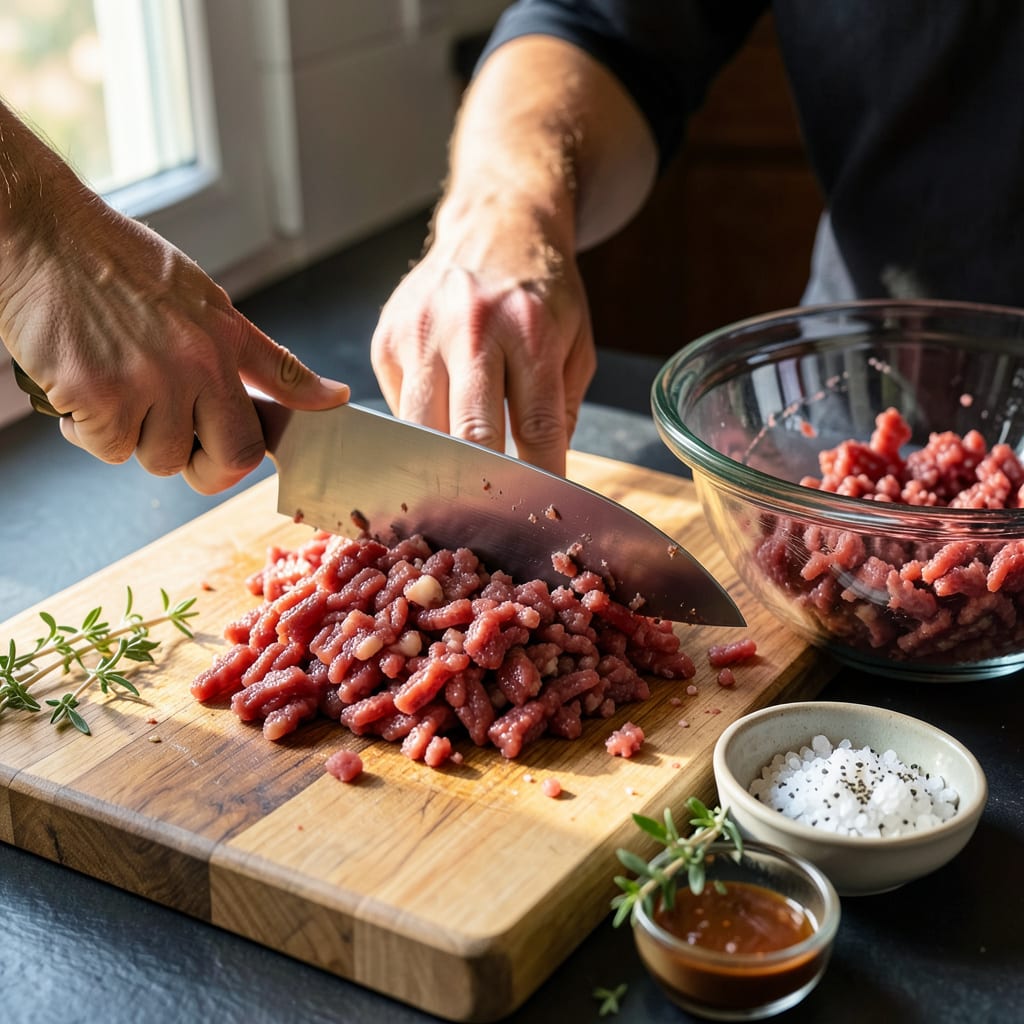
To mince ground beef, use a sharp chef’s knife to finely chop cooked or raw beef on a cutting board with a rocking motion. For even texture, partially freeze the beef first or pulse briefly in a food processor. Avoid overworking to prevent mushiness.
This technique gives you full control over the final texture—something store-bought pre-minced beef can’t match. I’ve found that partially freezing the beef for 20-30 minutes firms it up just enough to create uniform pieces without turning into paste. The rocking motion with your knife isn’t just for show; it creates a consistent rhythm that produces evenly sized bits every time. 🔥
What many home cooks overlook is how the fat content affects the process. Leaner beef (like 90% lean) minces more cleanly, while fattier blends require extra care to avoid smearing. I always keep a bowl of ice water nearby to occasionally dip my knife—this prevents the fat from sticking to the blade and ruining your precision cuts.
💡 In This Article
- Knife Techniques for Mincing Ground Beef Like a Pro
- Tools and Shortcuts for Faster Ground Beef Mincing
Knife Techniques for Mincing Ground Beef Like a Pro
The rocking motion isn’t just culinary jargon—it’s about physics and precision. Start by anchoring your cutting board with a damp towel underneath to prevent slipping. Grip your 8-10 inch chef’s knife with a pinch grip (thumb and index finger on the blade just above the handle) for maximum control.
The key is maintaining contact between the knife tip and board while lifting the handle—this creates that signature rocking action that produces uniform pieces.
For raw beef, I recommend working with 1-pound batches at room temperature (or slightly chilled for firmer texture). Position your non-dominant hand in a claw grip over the beef, using your knuckles as a guide for the knife. The angle matters: keep your knife at about 15-20 degrees to the board for optimal slicing efficiency.
Each rock forward should cut through the beef while the backward motion resets for the next pass—like a metronome for your knife work. 🔥
The tap-chop method (lifting the knife completely between chops) works better for cooked beef or when you need extra-fine mincing. This technique gives you more power per chop but requires perfect hand-eye coordination. I use this method when making taco filling or Bolognese sauce where I want almost powder-like consistency. The tradeoff?
It takes about 30% more time than the rocking motion for the same quantity.
Knife choice dramatically affects your results. A Santoku knife (with its flatter blade) excels at the tap-chop method, while a curved chef’s knife is ideal for rocking. The blade should be razor-sharp—a dull knife requires more force, which compresses the beef and creates uneven pieces.
I test sharpness by seeing if it can slice through a tomato skin with no resistance. Pro tip: sharpen your knife every 2-3 uses when working with meat to maintain precision.
Safety isn’t just about avoiding cuts—it’s about texture control. Always cut away from your body, and never put your hand in the knife’s path. For extra stability, place a second cutting board perpendicular to your first to create a “corner” that keeps the beef from sliding. The ideal cutting surface?
A 1.5-inch thick hardwood board that absorbs impact without dulling your knife. Plastic boards work but require more frequent knife sharpening.
What most home cooks miss is the importance of knife angle adjustments. For coarse mincing (like for chili), keep the angle shallow at about 10 degrees. For fine mincing (like for stuffed peppers), increase to 25-30 degrees for more aggressive cutting.
The angle changes how much of the blade makes contact—more angle equals finer results but requires more effort. ✨
The final pro move? Rotate your cutting board 90 degrees after every few passes. This ensures you’re always cutting across the grain of the beef, not with it. The grain direction affects how the meat breaks apart—cutting across creates shorter fibers for that perfect minced texture.
I learned this trick from butchers who use it to control ground meat texture in commercial operations.

Trained in classic French technique but raised on slow-cooked ribs and spicy rubs, she blends culinary skill with smoke and soul.
- Recipe for Boneless Pork Chops in Cast Iron Skillet: Sear and Baste to Juicy Perfection - October 3, 2026
- Recipe for Boneless Cross Rib Roast: Slow-Roasted Beef with Herb Crust - October 3, 2026
- Hamburgers in Sauce Recipe Crock Pot: Slow-Cooked Savory Delight - October 3, 2026