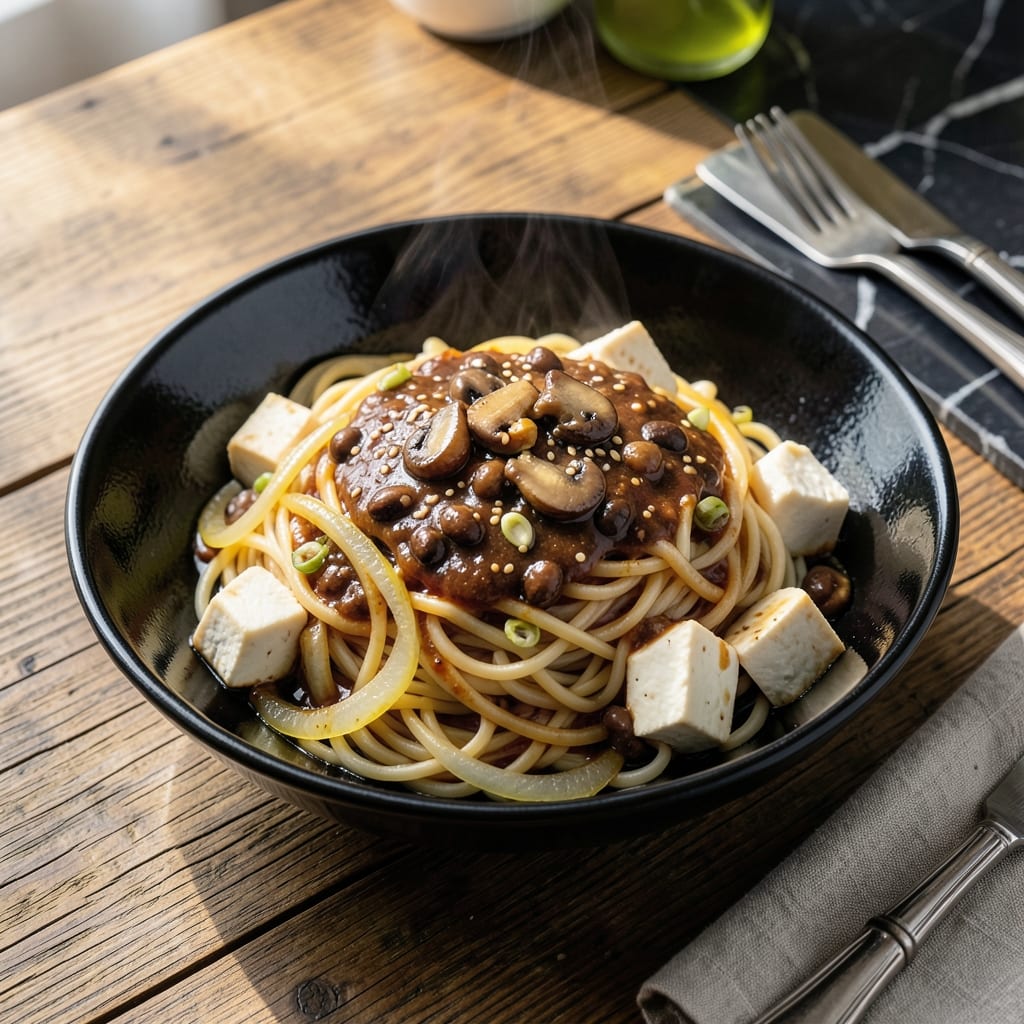
This pork-free jajangmyeon proves that umami-rich Korean black bean noodles don’t require meat to be authentic. I developed this version after realizing how often vegetarian friends missed out on this beloved dish.
The secret lies in using shiitake mushrooms and tofu to create the deep, savory base that traditional jajangmyeon is known for. The mushrooms add meaty texture, while the black bean paste delivers that signature rich, slightly sweet flavor.
What emerges is a bowl of glossy, sauce-coated noodles with the same comforting appeal as the original. The sauce clings perfectly to each strand, and the dish comes together in under 45 minutes.
Serve with cucumber slices for a refreshing contrast. Here’s how to make it at home.
Ingredients for Jajangmyeon Recipe Without Pork
No pork, no problem. These ingredients deliver that signature jajangmyeon depth and richness.
| Ingredient | Amount | Notes |
|---|---|---|
| Dried Shiitake Mushrooms 🍄 | 1 cup | Rehydrated and finely chopped |
| Firm Tofu 🧈 | 14 oz | Pressed and cubed |
| Korean Black Bean Paste 🫘 | ½ cup | Chunjang or jajang sauce |
| Fresh Wheat Noodles 🍜 | 1 lb | Udon or somyeon noodles work |
| Yellow Onion 🧅 | 1 whole | Finely diced |
| Garlic Cloves 🧄 | 4 cloves | Minced for sauce base |
| Fresh Ginger 🌿 | 1 tbsp | Grated for depth |
| Soy Sauce 🫒 | 2 tbsp | Low-sodium preferred |
| Brown Sugar 🍚 | 1 tbsp | Balances savory flavors |
| Sesame Oil 🫒 | 1 tbsp | Toasted for aroma |
| Vegetable Stock 💧 | 1 ½ cups | Low-sodium for control |
| Potato Starch 🥔 | 1 tbsp | For sauce thickening |
| English Cucumber 🥒 | 1 whole | Thinly sliced for garnish |
| Green Onions 🌱 | 3 whole | Thinly sliced for topping |
[recipe_ingredient_scaler]
The shiitake mushrooms are non-negotiable here—they provide that meaty, umami depth that makes this dish sing. Asian markets often carry the best dried shiitakes (look for thick caps with white stems), but Whole Foods or Trader Joe’s have solid options too. The black bean paste is the soul of the sauce; Koon Chun is a reliable brand if you’re not making it from scratch. For tofu, extra-firm holds its shape best, but firm works in a pinch.
No black bean paste? Miso plus hoisin sauce at a 1:1 ratio gets you close—won’t be identical but still delicious. Short on shiitakes? Cremini or oyster mushrooms work, though the flavor won’t be as deep. Fresh noodles are ideal, but dried udon or even spaghetti can stand in (adjust cooking time). If you don’t have potato starch, cornstarch at the same amount thickens just fine.
The sauce thickens as it cools, so don’t panic if it seems thin at first. Keeps in the fridge for 3-4 days—the flavors actually deepen overnight. Freezes beautifully for up to 3 months, though the noodles may soften slightly. Always garnish fresh with cucumber and green onions for that crunch contrast.
Why You’ll Love This Recipe
- One Pot Magic: I throw everything in a single pan—shiitakes, tofu, black bean paste—and let it simmer while the noodles cook. Honestly, cleanup is just one pot and a bowl.
- Umami Bomb: The dried shiitakes and black bean paste create this deep, savory richness that’s way more complex than you’d expect from such a simple dish.
- Meal Prep Hero: I make a double batch on Sunday and it reheats beautifully for lunch all week. Between us, it tastes even better the next day.
- Budget Friendly: Firm tofu and dried mushrooms stretch this dish further than pork ever could, and it still feels indulgent. My wallet thanks me every time.
Step-by-Step Instructions for Jajangmyeon Without Pork
Here’s the method. Simple, flavor-packed, and it works every time.
Step 1: Rehydrate and Prep Mushrooms and Tofu
Cover the 1 cup Dried Shiitake Mushrooms with hot water and let soak for 20 minutes until fully plump. Drain, finely chop, and reserve the soaking liquid. Meanwhile, press the 14 oz Firm Tofu between paper towels for 15 minutes to remove excess moisture, then cube it.
This step is crucial—rehydrated shiitakes deliver that deep umami base, while pressed tofu soaks up the sauce without falling apart. I always save the mushroom soaking liquid; it’s pure flavor waiting to be used.
Step 2: Build the Sauce Base with Aromatics
Heat the 1 tbsp Sesame Oil in a wok or deep skillet over medium heat. Add the 1 whole Yellow Onion (finely diced) and cook for 3-4 minutes until translucent. Stir in the 4 cloves Garlic Cloves (minced) and 1 tbsp Fresh Ginger (grated), cooking for 1 minute until fragrant.
Add the chopped shiitake mushrooms and cook for another 5 minutes until they release their moisture and begin to brown. This builds the foundation of your sauce with layers of savory depth. Don’t rush—browning equals flavor.
Step 3: Combine Sauce Ingredients and Thicken
Stir in the 0.5 cup Korean Black Bean Paste, 2 tbsp Soy Sauce, and 1 tbsp Brown Sugar. Pour in the 1.5 cups Vegetable Stock and 1 cup of reserved mushroom soaking liquid. Bring to a simmer and let cook for 8-10 minutes until slightly reduced.
Mix the 1 tbsp Potato Starch with 2 tbsp cold water to form a slurry, then stir it into the sauce. Cook for another 2-3 minutes until the sauce thickens to a glossy, gravy-like consistency. The sauce should coat the back of a spoon without running off immediately.
Step 4: Add Tofu and Finish
Gently fold in the cubed 14 oz Firm Tofu and simmer for 3-4 minutes until heated through. The tofu should be tender and fully coated in the rich, dark sauce. Taste and adjust seasoning if needed—this sauce should be deeply savory with a touch of sweetness.
Real talk: if the sauce seems too thick, add a splash of water or extra stock. It should be thick enough to cling to the noodles but still pourable. This is your moment to get it just right.
Step 5: Assemble and Garnish
Cook the 1 lb Fresh Wheat Noodles according to package instructions until al dente. Drain and rinse briefly under cold water to stop cooking. Divide the noodles among bowls and ladle the hot tofu and sauce over the top.
Garnish with thinly sliced 1 whole English Cucumber and 3 whole Green Onions. Serve immediately while hot—the contrast of cool cucumber against the warm, hearty noodles is what makes this dish sing.
Pro Tips For Making Jajangmyeon Recipe Without Pork
- Bloom the paste: Cook the black bean paste in oil for 3-4 minutes on medium-low before adding anything else—I learned this the hard way after my first batch tasted raw and bitter.
- Press the tofu: Give firm tofu a good 15-minute press under a heavy pan to remove excess water, or it’ll turn mushy in the sauce instead of soaking up flavor.
- Rehydrate shiitakes properly: Soak dried shiitakes in hot (not boiling) water for at least 30 minutes, and save that soaking liquid—it adds deep umami to the sauce.
- Parboil the noodles: Fresh wheat noodles only need 45-60 seconds in boiling water to soften before finishing in the sauce, otherwise they’ll turn to mush.
Essential Equipment for This Recipe
Wok or Deep Skillet
A carbon steel wok is ideal for this recipe—its high heat retention and wide surface area let you build deep flavor quickly. I use a 14-inch wok from my local Asian market. If you don’t have one, a deep cast iron skillet works well too. 💡
Wooden Spoon
For stirring the sauce, a wooden spoon won’t scratch your cookware and helps scrape up all those delicious browned bits from the bottom. I keep a dedicated bamboo spoon just for my wok cooking—it’s stood the test of time and countless meals.
Fine Mesh Strainer
You’ll need this to strain the mushroom soaking liquid to remove any grit before adding it to your sauce. A small fine mesh strainer works perfectly. I learned the hard way that skipping this step can lead to unwanted texture in your final dish.
Tofu Press
While not strictly essential, a tofu press makes quick work of removing excess moisture. I use a simple EZ Tofu Press—it’s a game-changer. No press? Wrap tofu in a clean kitchen towel, place a heavy pan on top, and let it drain for 15 minutes.
Large Pot for Noodles
For cooking the 1 lb Fresh Wheat Noodles, use a 5-6 quart pot to give them room to expand. I prefer a stainless steel pasta pot with a built-in strainer. Fresh noodles cook quickly, usually in just 2-3 minutes, so keep an eye on them.
Kitchen Scale
A digital kitchen scale helps with precise measurements, especially for the 14 oz Firm Tofu and 1 cup Dried Shiitake Mushrooms. I use a simple OXO scale—it’s accurate and easy to clean. This is one tool that makes cooking more consistent and less stressful. 🥗
Nutrition Facts
Frequently Asked Questions
Can I use fresh mushrooms instead of dried?
Yes, but dried shiitakes pack more umami. Use 2 cups fresh for every 1 cup dried. Sauté until all moisture evaporates for best flavor.
What if my sauce is too thin?
Mix 1 tsp potato starch with 1 tbsp cold water, stir into simmering sauce. Repeat until it coats a spoon.
Can I make this gluten-free?
Swap wheat noodles for 100% buckwheat soba and use tamari instead of soy sauce. Check all labels for hidden gluten.
How do I store leftovers?
Keep noodles and sauce separate in airtight containers for 3-4 days. Reheat sauce with a splash of water to loosen.

Trained in classic French technique but raised on slow-cooked ribs and spicy rubs, she blends culinary skill with smoke and soul.
- Energy Ball Recipe Peanut Butter: No-Bake Protein-Packed Bites - September 24, 2026
- Jerk Chicken Recipe Crock Pot: Slow-Cooked Caribbean Heat - September 24, 2026
- Japanese Curry Recipe Kenji: Chef-Tested Rich and Velvety Sauce - September 24, 2026