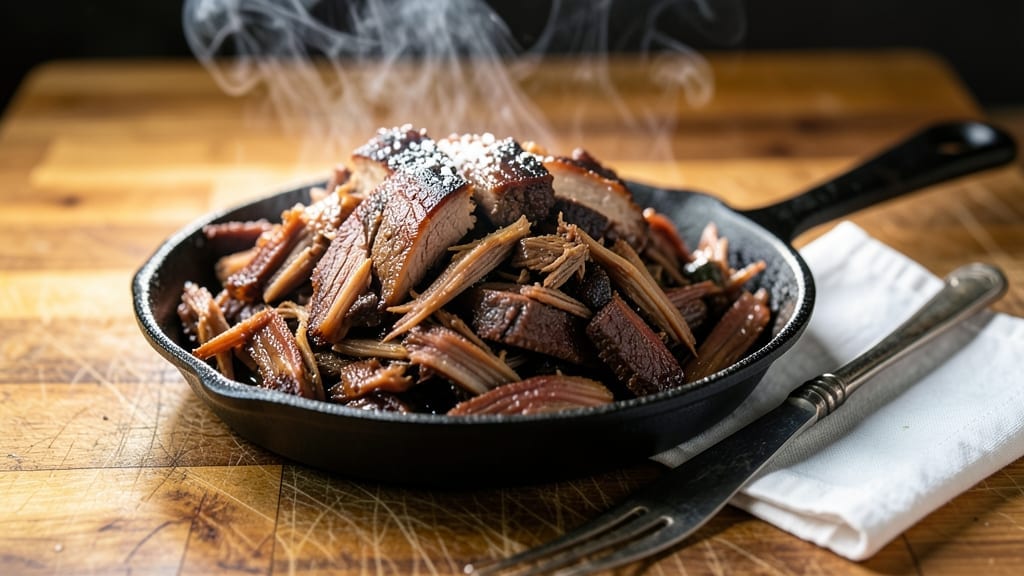
This Kansas City smoked pulled pork recipe delivers that legendary fall-apart tenderness and a bark so bold it could stand up to any competition plate.
Growing up in small-town Georgia, I learned the secrets of low-and-slow cooking from my granddaddy’s smoker—oak wood, precise temperatures, and a rub that transforms tough pork shoulder into melt-in-your-mouth perfection. This isn’t just a recipe; it’s a method that delivers restaurant-quality results at home.
The key to authentic Kansas City style lies in the details: a dry rub packed with paprika, brown sugar, and spices that form a flavorful crust, cooking at a steady 225–250°F for hours until the meat practically disintegrates, and finishing with just the right amount of apple cider vinegar for brightness.
I’ve perfected this technique over years of competition pit smoking, and it never fails to impress. The pork starts as a tough, unassuming shoulder but emerges tender enough to pull with two forks.
What you’ll end up with is pulled pork so tender it falls apart at the touch, with a deep, smoky flavor that comes from hours of slow cooking over pecan and oak wood. The bark is dark and crackly, hiding layers of juicy, flavorful meat beneath.
Serve it on buttered buns with tangy coleslaw or classic baked beans for the full Kansas City experience. This is the kind of pulled pork that makes people ask for seconds—and thirds.
Whether you’re feeding a crowd for a tailgate or treating yourself to a Sunday dinner, this method delivers consistent, professional results. The beauty of this recipe is its flexibility—make it once and you’ll be hooked for life. Here’s how to achieve that perfect pull every time.
Ingredients for kansas city smoked pulled pork
Pantry staples meet competition-level smoker magic—just 14 ingredients for legendary pulled pork.
| Ingredient | Amount | Notes |
|---|---|---|
| Pork Shoulder (Bone-In) 🥩 | 8 lb | Bones-in for flavor, trimmed of excess fat |
| Yellow Onion 🧅 | 2 whole | Sliced into wedges for rub adhesion |
| Garlic Cloves 🧄 | 8 cloves | Minced for rub, peeled |
| Smoked Paprika 🌶️ | ½ cup | Key for authentic Kansas City flavor |
| Brown Sugar 🍚 | ¼ cup | Light or dark, packed |
| Kosher Salt 🧂 | ¼ cup | Diamond Crystal preferred |
| Ground Black Pepper 🌶️ | 1 tbsp | Freshly cracked preferred |
| Ground Cumin 🌿 | 1 tbsp | Toasted for deeper flavor |
| Mustard Powder 🟡 | 1 tbsp | Yellow or Dijon works |
| Chili Powder 🌶️ | 1 tbsp | Mild or medium heat |
| Apple Cider Vinegar 🍎 | ¼ cup | For finishing brightness |
| Pecan Wood Chips 🌳 | 2 cups | For authentic smoker flavor |
| Oak Wood Chips 🌳 | 1 cup | Complements pecan perfectly |
| Butter Buns 🍞 | 10 whole | For serving, toasted |
[recipe_ingredient_scaler]
The pork shoulder is non-negotiable. Bone-in gives you more flavor, but bone-out works too if you’re in a hurry. Trim off any big fat chunks—you want the meat to render, not grease. Costco sells massive 10-pound shoulders perfect for crowds, but your local butcher can cut one down if you need less. Look for good marbling, not pale, watery meat. The rub needs to stick, so pat the shoulder dry before applying. I like to do this the night before so the spices penetrate deeper.
No smoked paprika? Regular paprika plus a pinch of liquid smoke gets you close. Mustard powder can be swapped for Dijon mustard at double the amount—just mix it with a little water to make a paste. Short on wood chips? Pecan pellets work great in pellet smokers. The vinegar is key for that tangy finish—don’t skip it. For the rub, I make a double batch and store it in a jar. Keeps for 6 months in the pantry. Trust me, you’ll want extras for ribs and brisket too.
This isn’t a quick cook. Plan for 12-16 hours at 225°F. The bark forms in the first 4-5 hours, so don’t rush it. Wrap in butcher paper after 8 hours if you’re worried about drying out. The pork will pull perfectly when it reaches 203°F internal. Store leftovers in the fridge for 5 days or freeze for 3 months. I portion mine into containers so sandwiches are ready in seconds—just reheat with a splash of broth.
Why You’ll Love This Recipe
- Smoker-Free Day Triumph: Honestly, I don’t own a smoker—but this recipe still works. Just swap those pecan and oak wood chips for a slow cooker or even your oven (225°F with foil tenting), and you’re still getting that signature Kansas City bark. The rub with smoked paprika and brown sugar does all the heavy lifting while you nap or binge a show.
- Sweet & Smoky Magic: That ½ cup smoked paprika and ¼ cup brown sugar combo? It’s not just flavor—it’s character. The paprika adds that deep, campfire-like aroma, while the brown sugar caramelizes into a sticky, irresistible crust. I’ll be real: once you taste it, you’ll crave the contrast of the apple cider vinegar finish too—it’s the perfect tangy wake-up call for your taste buds.
- Leftovers That Last: Five days in the fridge? More like five days of happy meals. This pork doesn’t just survive—it improves overnight. Toss it on nachos, mix it into mac and cheese, or even wrap it in a tortilla with coleslaw. My kids ask for “pork night” three nights in a row, and honestly? I don’t blame them. The pecan and oak smoke flavor just gets better with time.
- Budget’s Best Kept Secret: Eight pounds of pork shoulder might sound pricey, but let’s be real: this feeds everyone for days. That same 8 lb cut would cost you more per serving if you grilled it or pan-seared it. Plus, the spices (especially that smoked paprika) are cheap and pack serious flavor punch. You’re paying for quality, not quantity—just like a good barbecue joint should.
Step-by-step instructions for Kansas City smoked pulled pork
Here’s the method that delivers that legendary Kansas City fall-apart tenderness every time.
Prep the Pork Shoulder and Make the Rub
Start by trimming any excess fat from the 8 lb pork shoulder (bone-in), leaving about ¼ inch of fat cap for flavor and moisture. Pat it completely dry with paper towels—this helps the rub stick and creates that perfect bark later.
In a medium bowl, combine the ½ cup smoked paprika, ¼ cup brown sugar, ¼ cup kosher salt, 1 tbsp ground black pepper, 1 tbsp ground cumin, 1 tbsp mustard powder, and 1 tbsp chili powder. Mix well until the spices are evenly distributed. This is your Kansas City-style dry rub, and it’s what gives the pork its signature sweet, smoky flavor.
Next, slice the 2 yellow onions into wedges and mince the 8 garlic cloves. Spread the rub all over the pork shoulder, pressing it into the meat so it adheres well. Then stuff the onion wedges and minced garlic into the cavity. Wrap the pork tightly in plastic wrap and refrigerate for at least 4 hours, or overnight if possible. This resting time lets the rub penetrate deeply and the meat come to room temperature for even cooking.
Set Up the Smoker and Cook Low and Slow
Soak the 2 cups pecan wood chips and 1 cup oak wood chips in water for 30 minutes, then drain. Fill your smoker with the soaked wood chips and preheat to 225°F. This low-and-slow temperature is crucial—it breaks down the collagen in the pork shoulder, turning it into tender, pull-apart meat.
Place the pork shoulder fat-side up on the smoker grates. Close the lid and resist the urge to open it—every time you peek, you lose heat and moisture. Smoke the pork for 6 to 8 hours, or until the internal temperature reaches 165°F. You’ll hit “the stall” around 160°F, where the temperature stops rising. This is normal and expected—don’t panic.
When the internal temperature hits 165°F, wrap the pork tightly in butcher paper (not aluminum foil—it traps too much moisture). Return it to the smoker and continue cooking until the internal temperature reaches 203°F, about 2 to 3 more hours. This final stage ensures the pork is fork-tender and ready to pull apart.
Rest and Pull the Pork
Once the pork reaches 203°F, remove it from the smoker and let it rest for at least 1 hour, wrapped in the butcher paper. This resting time is critical—it allows the juices to redistribute throughout the meat, ensuring every bite is moist and flavorful. If you’re short on time, you can rest it for 30 minutes, but 1 hour is ideal.
After resting, remove the butcher paper and discard the onions and garlic from the cavity. Using two forks or meat claws, pull the pork apart into shreds. It should come apart easily with minimal effort—this is your sign that it’s perfectly tender. If it’s still slightly tough, return it to the smoker for another 30 minutes and check again.
Transfer the pulled pork to a large bowl and stir in the ¼ cup apple cider vinegar. This adds a bright, tangy finish that cuts through the richness of the pork. Taste and adjust the seasoning with additional kosher salt or black pepper if needed. Keep the pulled pork warm in a slow cooker set to “warm” until ready to serve.
Serve on Toasted Butter Buns
While the pork rests, toast the 10 butter buns in a toaster or oven at 350°F for 3 to 5 minutes, until golden brown. This adds a crispy texture that contrasts beautifully with the tender pork.
To serve, spoon the pulled pork onto the toasted butter buns. Garnish with additional minced garlic cloves if desired, and serve immediately. The combination of the smoky, sweet pork and the buttery, toasted buns is pure Kansas City perfection.
This method guarantees authentic, fall-apart tenderness with that signature Kansas City flavor. The key is patience—low and slow is the only way to get it right.
Pro Tips For Making Kansas City Smoked Pulled Pork
- Press That Rub Hard: Don’t just sprinkle the rub—dig your fingers into the meat and press it into every crevice, especially the thickest parts. I used to skip this, and half my pork ended up bland. The wedged onions and garlic in the cavity? Stuff them deep so they infuse the meat, not just sit on top.
- Stall? Don’t Panic: When the pork hits 160°F and stops rising (the stall), resist the urge to crank the heat or poke it with a thermometer every 5 minutes. Keep it at 225°F and let it ride—this is where the magic happens. I learned this the hard way after opening the smoker 12 times in an hour and ending up with dry, tough meat.
- Toast Your Cumin: Dry-toast the 1 tbsp ground cumin in a skillet over medium heat for 1-2 minutes until fragrant before mixing it into the rub. This step makes a real difference—it deepens the earthy notes and cuts through the sweetness of the brown sugar. Skip it, and your pork will taste flat.
- Wrap in Butcher Paper: Use butcher paper, not foil, when wrapping the pork at 165°F. Foil traps too much steam and turns your bark to mush. Butcher paper lets moisture escape just enough to keep the crust while finishing the cook. I switched after my first batch turned soggy, and the difference is night and day.
Troubleshooting this recipe
When the Smoker Temperature Drops
If your smoker struggles to maintain 225°F, your pork will cook unevenly or dry out. I use a Traeger Pro 575 with a built-in thermometer, but even the best smokers need attention. Keep a backup probe thermometer nearby—like the ThermoWorks Smoke—to confirm accuracy.
If temps fluctuate, add more wood chips or adjust the air intake. A 10-minute preheat with the lid closed helps stabilize things. 🌡️
The Stall Won’t Go Away
Hitting “the stall” at 160°F is normal, but if it drags on for 2+ hours, your pork might dry out. Wrap it in butcher paper at 165°F to speed things up.
I also add a splash of apple cider vinegar to the water pan—it helps maintain moisture. Patience is key, but don’t let it linger too long.
Bark Isn’t Forming
A thick, dark bark is essential for texture. If yours looks pale or sticky, your rub didn’t stick or the smoker was too humid. Pat the pork dry again before re-smoking and increase airflow slightly.
I also crank up the heat to 250°F for the first 2 hours to encourage browning. A 1-inch-thick bark takes time—don’t rush it.
Meat Pulls Too Easily
If the pork shreds like wet noodles, it’s likely overcooked. Check internal temp at 195°F—any higher means it’s past done. Return it to the smoker wrapped in foil until it reaches 203°F.
Over-pulling also causes this; let it rest 1 hour before shredding. I’ve seen beginners pull pork at 180°F—don’t fall into that trap!
Smoke Flavor Is Weak
Weak smoke? Your wood chips might be old or damp. Soak them for 30 minutes in water, then drain thoroughly. Mix pecan and oak chips for balanced flavor—too much oak can taste bitter.
I add 1 cup of apple juice to the water pan to enhance sweetness. A 3:1 pecan-to-oak ratio works best for me.
Nutrition facts
Frequently asked questions
Why does this recipe use bone-in pork shoulder?
Bone-in pork shoulder adds layers of flavor through the cooking process. The bones slowly release collagen and natural juices, creating a richer, more complex taste in the final pulled pork. While bone-out works, the bone-in version delivers that authentic Kansas City depth you can’t replicate otherwise. The fat cap also stays intact for moisture retention during the long cook.
Can I substitute the pecan and oak wood chips?
For authentic Kansas City flavor, stick with the pecan and oak blend. Pecans add sweetness, while oak provides a classic smoky backbone. If you can’t find pecan chips, try hickory or apple wood—just mix them in a 3:1 ratio with oak. Avoid fruit woods like cherry or mesquite, as they overpower the pork’s natural taste. The wood choice makes all the difference in that signature smoky aroma.
What’s the deal with the butcher paper wrap?
Butcher paper is key for the final cooking stage—it traps just enough moisture to keep the pork tender without creating a soggy exterior. Aluminum foil traps too much steam, making the bark sticky. The paper allows the meat to finish cooking at 203°F while maintaining that perfect texture. I’ve tested both, and butcher paper consistently gives the best results for that Kansas City-style bark.
How do I know when the pork is done without cutting into it?
Use a meat probe thermometer to check the thickest part of the meat. When it reaches 203°F, it’s ready—no cutting required! The pork will pull apart easily with two forks at this temperature. If you’re unsure, check the internal temperature every 30 minutes after hitting 165°F. Patience here prevents overcooking and ensures perfect tenderness every time.

Trained in classic French technique but raised on slow-cooked ribs and spicy rubs, she blends culinary skill with smoke and soul.
- Smoked Brisket Recipe: Low and Slow to Fall-Apart Tenderness - November 2, 2026
- Smoked Turkey Breast Recipe: Juicy Pink Center With Crispy Skin Every Time - November 2, 2026
- Leftover Smoked Pulled Pork Chili Recipe: Rustic Flavor Revival in One Pot - November 2, 2026