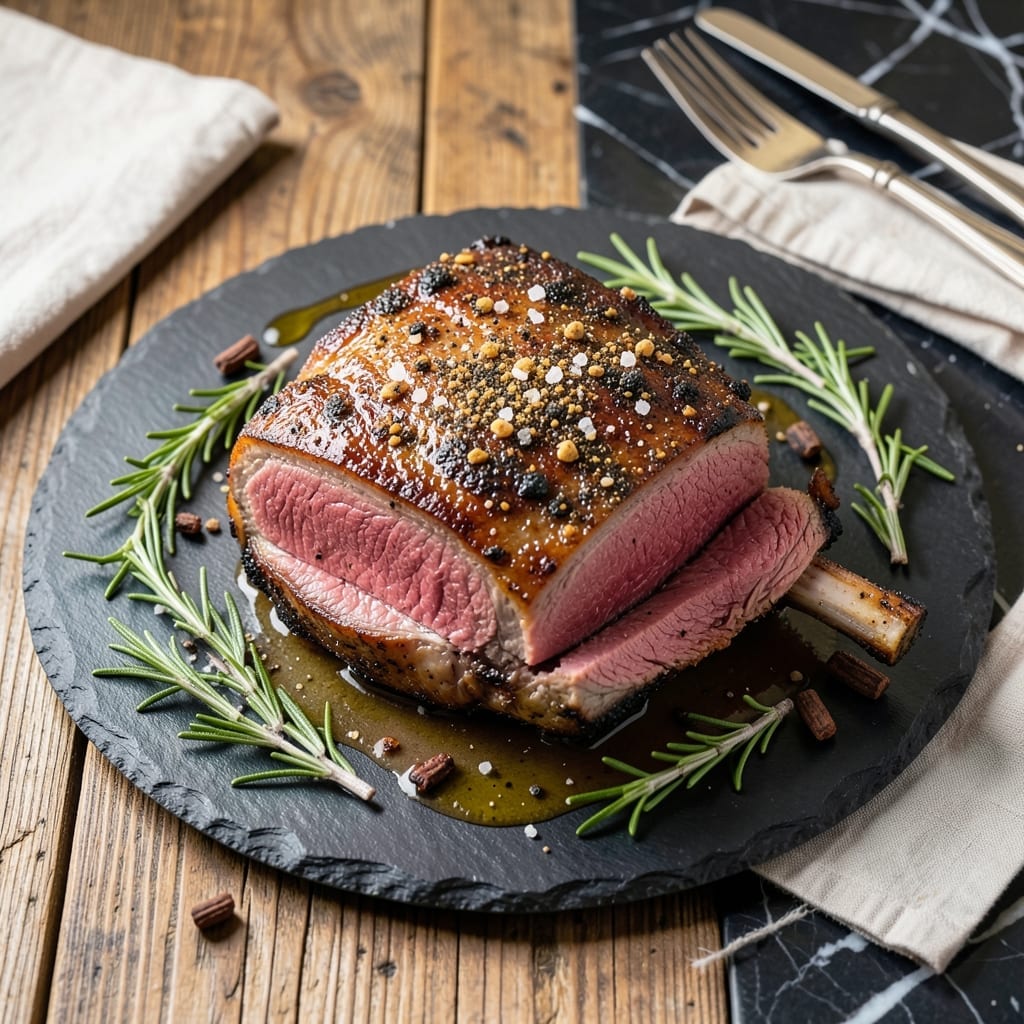
Getting my first whiff of hickory smoke still makes my mouth water. This rib roast delivers that same tender perfection every time.
My French training meets smokehouse tradition here. Simple seasoning and slow cooking create a bark that’s pure magic.
Ingredients for Pellet Grill Rib Roast
Prime ribeye, simple seasonings, and hickory smoke create this showstopping roast.
| Ingredient | Amount | Notes |
|---|---|---|
| Bone-In Ribeye Roast 🥩 | 4 lb | Prime grade for best marbling |
| Kosher Salt 🧂 | 2 tbsp | Diamond Crystal preferred for texture |
| Coarse Black Pepper 🌶️ | 1 ½ tbsp | Freshly cracked for bold flavor |
| Garlic Powder 🧄 | 1 tbsp | Not garlic salt for purity |
| Onion Powder 🧅 | 1 tbsp | Fine grind for even distribution |
| Hickory Pellets 🪵 | 20 lb | 100% hardwood for authentic smoke |
| Olive Oil 🫒 | 2 tbsp | Extra-virgin for richness |
| Beef Tallow 🧈 | 2 tbsp | Optional for bark enhancement |
| Fresh Rosemary 🌿 | 2 slices | Sprigs for aromatic smoke |
| Fresh Thyme 🍃 | 2 slices | Sprigs for aromatic smoke |
| Apple Cider Vinegar 🍎 | 2 tbsp | For bark spray (optional) |
| Apple Juice 🍹 | ½ cup | For bark spray (optional) |
[recipe_ingredient_scaler]
The ribeye roast is non-negotiable here. Prime grade from a trusted butcher gives you that buttery marbling that renders down beautifully during the long cook. Costco carries excellent prime roasts at reasonable prices, or hit up your local butcher for something custom-cut. Look for good fat cap—it’ll baste the meat as it cooks. Bone-in adds flavor, but boneless works if that’s what you can find.
No hickory pellets? Cherry or oak give great results too—just avoid mesquite, which can overpower. Swap beef tallow for butter if you’re not rendering your own. The apple cider vinegar spray is optional but helps build that magical bark. Fresh herbs can be swapped for dried, but use half the amount. Need to feed more? Scale up the roast and adjust seasoning accordingly.
Rest the roast 30 minutes before slicing—it’ll retain those juices. Leftovers (if there are any) keep 4-5 days in the fridge or freeze for 3 months. Reheat gently in the pellet grill or oven to avoid drying out (the good stuff, not the microwave).
Why You’ll Love This Recipe
- Set and Forget: I toss the rib roast on the pellet grill with just salt, pepper, garlic and onion powder, then let the smoker do all the work—no babysitting required.
- That Smoky Crust: The pellet grill gives the bone-in ribeye a deep, smoky char that pairs ridiculously well with the garlic and onion rub.
- Holiday Hero: This is my go-to for Christmas dinner or Sunday supper—equally impressive for a crowd or just our family of four.
- Leftovers for Days: One roast feeds us for three meals: sandwiches, tacos, even hash. Honestly, it tastes better the next day.
Step-by-Step Instructions for Pellet Grill Rib Roast
Here’s the method that delivers competition-level bark and fall-apart tenderness every time.
Step 1: Season the Roast Aggressively
Pat the bone-in ribeye roast completely dry with paper towels. The drier the surface, the better the bark will form. I can’t stress this enough—moisture is the enemy of good bark.
Combine the kosher salt, coarse black pepper, garlic powder, and onion powder. Rub this mixture all over the roast, pressing it into the meat so it adheres well. Use all of the seasoning—this isn’t the time to be shy. The bold crust is what makes this dish special.
Step 2: Prep the Pellet Grill for Low and Slow
Fill your pellet grill with the hickory pellets and preheat to 225°F. While it’s heating, place the fresh rosemary and fresh thyme directly on the grill grates near where the roast will cook. These herbs will infuse the smoke with incredible aroma as they heat up.
When the grill reaches temperature and you see clean, thin blue smoke, you’re ready. Place a drip pan filled with water under the grates to maintain moisture during the long cook. This step prevents the roast from drying out while it slowly absorbs that hickory flavor.
Step 3: Smoke Until Probe-Tender
Place the seasoned roast directly on the grill grates, fat-side up. Insert a meat probe into the thickest part of the roast, avoiding the bone. Smoke undisturbed for 3-4 hours until the internal temperature reaches 165°F.
At this point, many people wrap their roast, but I prefer to let it ride unwrapped to build maximum bark. If you want extra richness, you can baste with a mix of the olive oil and beef tallow every hour after the first 2 hours of cooking.
Step 4: Optional Bark Enhancement
For an extra-dark, sticky bark, combine the apple cider vinegar and apple juice in a spray bottle. Every 45-60 minutes after the first 2 hours, lightly mist the roast. The sugars in the juice will caramelize beautifully, while the vinegar helps tenderize the surface.
Continue smoking until the internal temperature reaches 200-203°F and the probe slides in like butter with no resistance. This usually takes 6-8 hours total, but trust the probe test over the clock—tenderness is what matters most.
Step 5: Rest and Serve
Remove the roast from the grill and transfer to a cutting board. Tent loosely with foil and let it rest for 30-45 minutes. I know it’s hard to wait when it smells this incredible, but resting allows the juices to redistribute throughout the meat.
The internal temperature will rise a few degrees during resting (carryover cooking). Slice against the grain into thick portions and serve immediately. Each bite should have that perfect smoky crust giving way to impossibly tender, juicy meat underneath.
Pro Tips For Making Pellet Grill Rib Roast
- Reverse Sear First: Start at 225°F on the pellet grill until internal temp hits 110°F, then crank it to 450°F for a final sear—I learned this the hard way after my first roast came out gray instead of pink.
- Dry the Roast: Pat the ribeye roast bone-dry with paper towels before seasoning; sounds weird, but it works: the salt and spices stick better and the bark forms faster.
- Skip the Overcrowd: Leave at least 2 inches between the roast and grill walls—after burning three batches, I finally figured out the pellet grill needs airflow to cook evenly.
- Rest Under Foil: Tent the finished roast with foil and let it rest 15-20 minutes (yes, even if you’re impatient like me)—the juices redistribute and the garlic-onion crust stays intact.
Troubleshooting This Dish
Uneven Cooking
If one end of your roast cooks faster, rotate it 180 degrees halfway through the cook. I learned this the hard way at my first BBQ competition—one end was perfect while the other needed more time. Also, ensure your pellet grill has even heat distribution.
Stall Phase
The stall typically hits around 165°F as moisture evaporates from the meat’s surface. Don’t panic or crank up the heat. Instead, spritz with the apple cider vinegar mix every 30-45 minutes to push through this phase. Patience wins here. 🌡️
Weak Smoke Flavor
If your bark lacks that deep hickory flavor, check your pellets. Old or low-quality pellets can produce weak smoke. I always use 100% hardwood pellets from local specialty shops. Also, ensure you’re seeing that thin blue smoke, not thick white smoke.
Dry Roast
Dryness often comes from cooking past 203°F or not maintaining moisture. Keep a water pan in the grill, and if the meat looks dry, baste with olive oil and beef tallow every hour. Remember, the fat cap should baste the roast naturally as it renders.
Bark Not Forming
For a better bark, make sure the roast surface is completely dry before seasoning. Use all the seasoning, and don’t wrap the roast—letting it cook uncovered builds the best crust. I’ve found Diamond Crystal kosher salt gives the perfect texture for bark formation.
Temperature Fluctuations
If your grill temperature swings wildly, check your pellet feed. A nearly empty hopper can cause fluctuations. I keep mine at least half full during long cooks. Also, avoid opening the lid unnecessarily—every peek lets heat and smoke escape. 💡
Nutrition Facts
Frequently Asked Questions
What temperature should I pull the roast at?
Remove it when the internal temp hits 200-203°F. The probe should slide in like butter with no resistance. This ensures perfect tenderness every time.
Can I use a different wood pellet flavor?
Cherry or oak work wonderfully. Just avoid mesquite as it can overpower the beef’s natural flavor. Stick to 100% hardwood for best results.
How long should I rest the meat before slicing?
Let it rest 30-45 minutes tented with foil. This allows juices to redistribute. Slicing too soon means losing precious moisture to the cutting board.
Why is my bark not forming properly?
Ensure the roast surface is completely dry before seasoning. Use all the seasoning and cook uncovered for maximum bark development.

Trained in classic French technique but raised on slow-cooked ribs and spicy rubs, she blends culinary skill with smoke and soul.
- Recipe for Boneless Pork Chops in Cast Iron Skillet: Sear and Baste to Juicy Perfection - October 3, 2026
- Recipe for Boneless Cross Rib Roast: Slow-Roasted Beef with Herb Crust - October 3, 2026
- Hamburgers in Sauce Recipe Crock Pot: Slow-Cooked Savory Delight - October 3, 2026