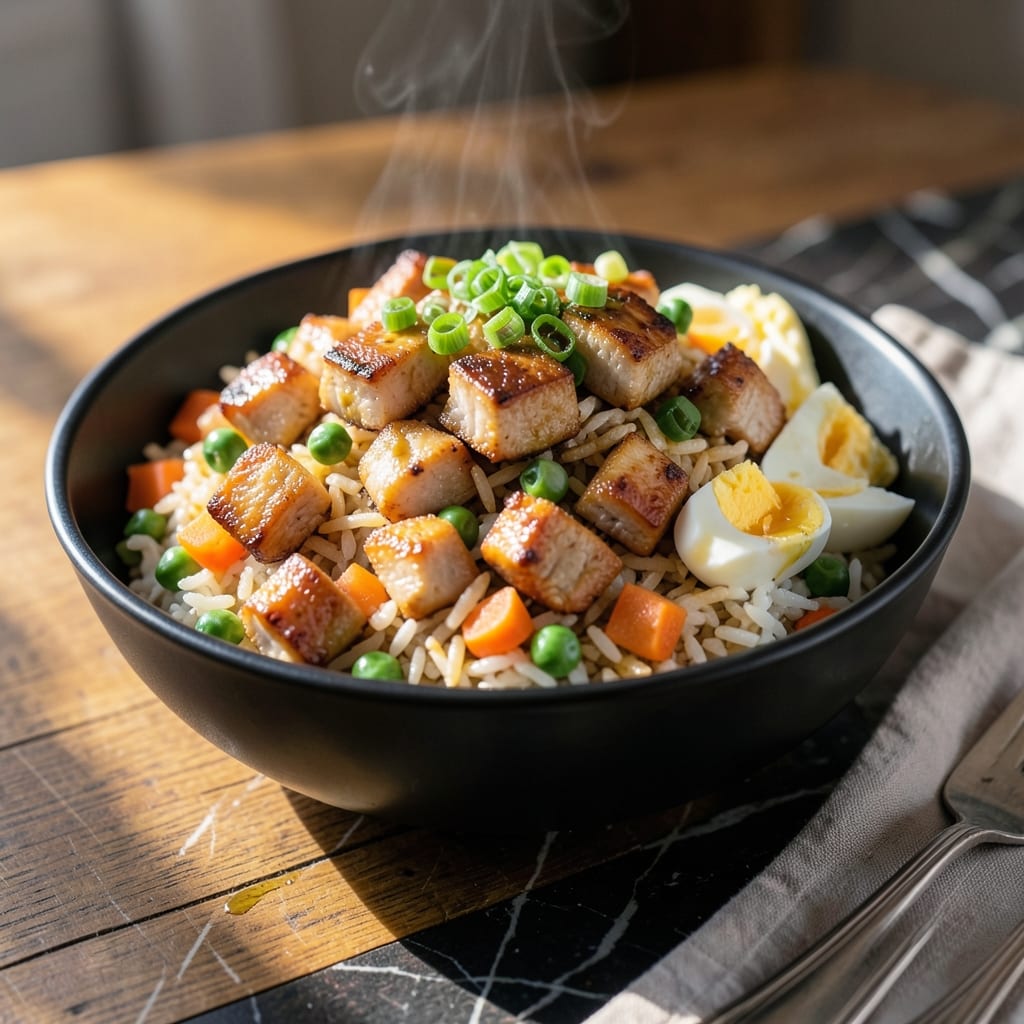
This pork-fried rice delivers restaurant-quality results with every bite. The dish combines tender pork pieces, fluffy rice, and crisp vegetables in a savory sauce that’s impossible to resist.
The secret lies in high-heat cooking and proper timing. Each ingredient cooks just long enough to develop bold flavors while maintaining its texture. The pork stays juicy, the vegetables retain their crunch.
What emerges from the wok is a perfectly balanced dish—savory, slightly sweet, and packed with satisfying textures. The rice grains stay separate, each one coated in flavorful sauce without turning mushy.
This creation transforms simple ingredients into something extraordinary. The process is straightforward, the results consistently delicious.
Ingredients for Pork-fried Rice
High-heat cooking transforms pork, rice, and vegetables into restaurant-quality wok-tossed perfection.
| Ingredient | Amount | Notes |
|---|---|---|
| Boneless Pork Shoulder 🥩 | 1 lb | Cut into small cubes, about 1/2-inch |
| Long-Grain White Rice 🍚 | 3 cups | Cooked and cooled completely, preferably day-old |
| Large Eggs 🥚 | 2 whole | Lightly beaten for scrambling |
| Carrots 🥕 | 2 whole | Peeled and diced into 1/4-inch cubes |
| Green Onions 🧅 | 4 whole | Thinly sliced, whites and greens separated |
| Frozen Peas 🌱 | 1 cup | Thawed under running water |
| Garlic Cloves 🧄 | 3 cloves | Minced finely for even distribution |
| Fresh Ginger 🌿 | 1 tbsp | Peeled and grated or minced |
| Soy Sauce 🫒 | 3 tbsp | Low-sodium recommended for balance |
| Oyster Sauce 🫒 | 2 tbsp | Essential for authentic umami depth |
| Sesame Oil 🫒 | 1 tbsp | Toasted variety for nutty aroma |
| Vegetable Oil 🫒 | 3 tbsp | Neutral flavor, high smoke point |
| Granulated Sugar 🍚 | 1 tsp | Balances savory and salty elements |
| Kosher Salt 🧂 | ½ tsp | Adjust to taste at the end |
| Ground White Pepper 🌶️ | ½ tsp | Traditional choice for subtle heat |
[recipe_ingredient_scaler]
The pork shoulder is ideal for its fat content and tenderness. Look for well-marbled cuts at your butcher or the meat section of Whole Foods. Day-old rice is non-negotiable—fresh rice turns mushy. Jasmine or long-grain white works best. For the oyster sauce, Lee Kum Kee is a reliable brand widely available at most supermarkets or Asian markets for superior quality.
Need a pork substitute? Chicken thighs (cut similarly) work well, or firm tofu for a vegetarian twist. No oyster sauce? Hoisin sauce at half the amount plus a splash of soy offers a close approximation. Frozen peas can be swapped for edamame or diced bell peppers for color variation. Always thaw frozen veggies first to prevent excess moisture in the wok.
Store raw pork in the fridge for up to 3 days or freeze for 3 months. Cooked fried rice keeps well in the fridge for 4-5 days and reheats beautifully in a skillet or microwave. For best results, cool completely before refrigerating to maintain texture integrity.
Why You’ll Love This Recipe
- One Pan Magic: I love that everything—pork, rice, eggs, and veggies—cooks together in a single wok or skillet.
- Umami Bomb: The pork shoulder soaks up the soy and garlic, while the crisp green onions add a fresh bite that’s ridiculously good.
- Feeds a Hungry Crowd: Between us, this is my go-to when friends drop by unexpectedly or when I need to stretch a meal for leftovers.
- Budget Hero: Boneless pork shoulder is cheap, and a little goes a long way with the rice and eggs to fill it out. Honestly, my wallet thanks me.
Step-by-Step Instructions for Pork Fried Rice
Master the wok technique for perfectly textured rice with balanced flavors and vibrant color.
Step 1: Velouté the Pork and Aromatics
Heat 1 tablespoon vegetable oil in a wok or large skillet over high heat until shimmering. Add the 1 lb boneless pork shoulder cubes and stir-fry for 4-5 minutes until the edges develop a light golden crust and the pork is just cooked through.
Push the pork to one side and add the 3 cloves minced garlic cloves and 1 tbsp fresh ginger. Stir-fry for 30 seconds until fragrant—this builds the aromatic foundation. Remove the pork mixture to a plate and set aside.
Step 2: Scramble the Eggs to Silky Perfection
Return the wok to high heat and add another 1 tablespoon vegetable oil. Pour in the 2 whole lightly beaten large eggs and let them set for 10 seconds before gently scraping with a spatula to create soft, billowy curds.
Cook until the eggs are just set but still slightly runny in spots—about 30-45 seconds. Immediately transfer the eggs to the plate with the pork to prevent overcooking. The residual heat will finish them perfectly.
Step 3: Wok-Toss the Vegetables and Rice
Add the final 1 tablespoon vegetable oil to the wok. Stir-fry the 2 whole diced carrots for 2 minutes until the edges begin to soften. Add the 1 cup thawed frozen peas and the white parts of the 4 whole thinly sliced green onions, tossing for another 1 minute.
Add the 3 cups cooked and cooled long-grain white rice, breaking up any clumps with your spatula. Press the rice against the hot wok surface for 30 seconds to develop a subtle sear. Incorporate the 0.5 tsp kosher salt and 0.5 tsp ground white pepper evenly throughout.
Step 4: Combine and Season with Signature Sauce
Return the pork and eggs to the wok. Drizzle the 3 tbsp soy sauce, 2 tbsp oyster sauce, and 1 tbsp sesame oil around the edges of the wok, allowing the heat to bloom the flavors before tossing everything together.
Add the 1 tsp granulated sugar and stir-fry for 2-3 minutes until every grain of rice is glossy and coated. The sauce should cling lightly to the ingredients without pooling. Taste and adjust seasoning if needed.
Step 5: Finish and Garnish for Vibrancy
Remove from heat and fold in the green parts of the 4 whole green onions. The residual heat will soften them slightly while maintaining their bright color and crisp texture.
Let rest for 1 minute to allow the flavors to meld completely. Serve immediately while hot, ensuring each portion has an even distribution of pork, eggs, and vegetables. The rice should be tender with a slight chew, and each bite should offer a harmonious balance of savory, sweet, and umami notes.
Pro Tips For Making Pork-Fried Rice
- Use Cold Rice: Always use day-old, cold rice—fresh rice is too moist and will turn mushy when stir-fried. I learned this the hard way after my first few attempts ended up as a soggy mess.
- Velvet the Pork: Marinate the pork shoulder with a teaspoon of baking soda and a tablespoon of water for 15 minutes before cooking. Sounds weird, but it keeps the pork tender and juicy in the final dish.
- High Heat Only: Crank the heat to max and work in small batches. After burning three batches, I finally figured out that crowded pans and low heat steam the rice instead of frying it.
- Scramble Eggs Separately: Cook the eggs first, remove them from the pan, then add them back at the end. This prevents them from turning rubbery and guarantees they stay fluffy and distinct in the rice.
Storing and Reheating This Recipe
Refrigerator Storage
Let your fried rice cool completely before transferring to airtight containers. Store in the fridge at 40°F or below for up to 4-5 days. The flavors continue to develop as the ingredients meld together. ❄️
Freezer Storage
For longer storage, freeze in quart-sized freezer bags with excess air removed. Lay flat to save space and freeze for up to 3 months. Portion into individual servings for easy thawing later.
Stovetop Reheating
Heat a skillet over medium-high heat with 1 tbsp vegetable oil. Add the rice and stir-fry for 3-4 minutes, breaking up any clumps. Sprinkle 1-2 tbsp water and cover to steam for 1 minute. 🔥
Microwave Reheating
Place a single portion in a microwave-safe dish with a damp paper towel on top. Heat on 70% power for 1-2 minutes, stir, then continue in 30-second bursts until reaching 165°F.
Texture Revival Tip
If your rice seems dry after storage, add a splash of soy sauce or chicken broth while reheating. This restores moisture and enhances flavor. I always keep a small bottle of Lee Kum Kee soy sauce handy for this.
Nutrition Facts
Frequently Asked Questions
Can I use leftover rice for this dish?
Yes, day-old cooked rice works best. It’s drier and firms up in the fridge, preventing mushiness when stir-fried. Fresh rice contains too much moisture and can turn to paste in the wok.
What’s the best cut of pork to use?
Boneless pork shoulder is ideal for its marbling and tenderness. For a leaner option, pork loin works too, but cook it quickly over high heat to prevent dryness. Always cut into 1/2-inch cubes for even cooking.
Can I make this without a wok?
A large, heavy skillet works as a substitute. Use medium-high heat and cook in batches to avoid overcrowding. The key is maintaining that hot surface temperature for proper searing.
How do I prevent soggy fried rice?
Cook rice at least a day ahead and chill completely. Use high heat and avoid overloading the pan. Add sauces at the end of cooking, not the beginning, to maintain texture.

Trained in classic French technique but raised on slow-cooked ribs and spicy rubs, she blends culinary skill with smoke and soul.
- Recipe for Boneless Pork Chops in Cast Iron Skillet: Sear and Baste to Juicy Perfection - October 3, 2026
- Recipe for Boneless Cross Rib Roast: Slow-Roasted Beef with Herb Crust - October 3, 2026
- Hamburgers in Sauce Recipe Crock Pot: Slow-Cooked Savory Delight - October 3, 2026