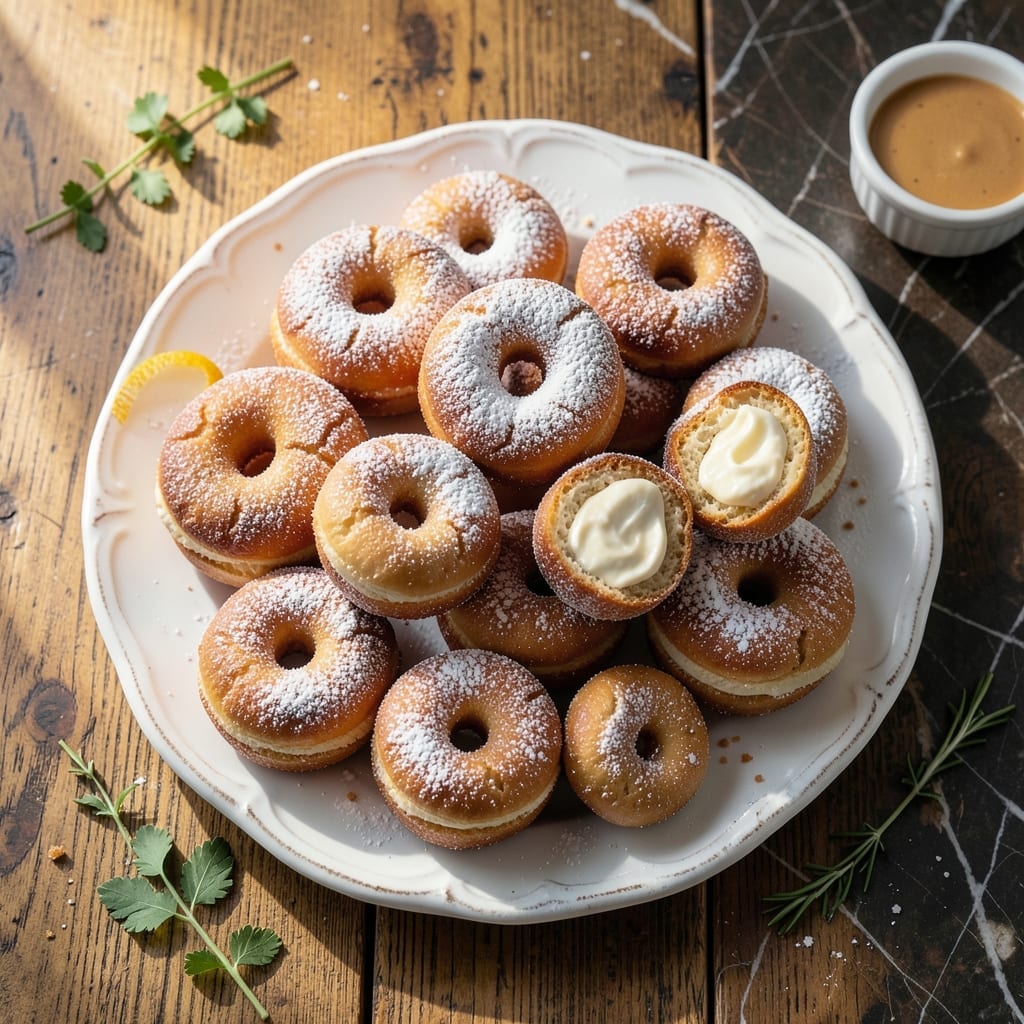
Mastering homemade cream-filled doughnuts is a rewarding challenge that delivers bakery-quality results. I developed this recipe after years of testing to achieve the perfect balance of pillowy soft dough and rich vanilla pastry cream.
The dough requires precise proofing to create that airy texture, while the pastry cream needs careful tempering to avoid curdling. Every step builds toward that first bite where crisp exterior gives way to creamy filling.
This method ensures doughnuts that are light yet substantial, with a filling so velvety it bursts through the center. David swears these are better than any doughnut shop version he’s tried.
With attention to temperature and timing, you’ll create doughnuts that rival professional bakeries. The process demands patience but rewards with unforgettable results.
Ingredients for Recipe for Cream Filled Doughnuts
Bakery-quality results start with these precise ingredients for airy dough and velvety filling.
| Ingredient | Amount | Notes |
|---|---|---|
| All-Purpose Flour 🌾 | 4 cups | Plus extra for dusting work surface |
| Granulated Sugar 🍚 | ½ cup | Divided for dough and filling |
| Active Dry Yeast 🍞 | 2 ¼ tsp | One packet, instant or active dry |
| Whole Milk 🥛 | 1 cup | Warmed to 110°F for yeast activation |
| Unsalted Butter 🧈 | ½ cup | Softened to room temperature |
| Large Eggs 🥚 | 2 whole | Room temperature for even mixing |
| Vanilla Extract 🌿 | 2 tsp | Pure extract for best flavor |
| Salt 🧂 | 1 tsp | Fine sea salt or table salt |
| Vegetable Shortening 🫒 | 2 cups | For deep frying doughnuts |
| Vanilla Bean 🌿 | 1 whole | Split and scraped for pastry cream |
| Heavy Cream 🥛 | 2 cups | Cold, divided for pastry cream |
| Cornstarch 🌾 | ¼ cup | For thickening pastry cream |
| Powdered Sugar ✨ | 1 cup | For dusting finished doughnuts |
[recipe_ingredient_scaler]
The flour is the foundation—King Arthur or Gold Medal all-purpose deliver consistent results. Yeast freshness is critical; check the expiration date and store it in the freezer. Whole milk provides the fat needed for tender dough, but ensure it’s at the correct temperature (110°F) to activate the yeast properly. For the butter, Plugrá or Kerrygold unsalted are premium choices that enhance flavor without overpowering.
No vanilla bean? Use 1 tbsp pure vanilla extract as a substitute. Heavy cream can be replaced with whole milk for the pastry cream, though the texture will be less rich. If avoiding dairy, use full-fat coconut milk (canned) for the cream, but expect a slight coconut flavor. Vegetable shortening for frying can be swapped with canola or peanut oil—just maintain 350°F consistently.
Store yeast in an airtight container in the freezer for up to 6 months. The pastry cream keeps refrigerated for 3 days—press plastic wrap directly on the surface to prevent a skin. Doughnuts are best eaten the day they’re made but can be stored at room temperature for 2 days.
Why You’ll Love This Recipe
- One Bowl Wonder: I love that everything mixes in a single bowl—flour, sugar, yeast, warm milk, melted butter—no fancy equipment needed.
- Crowd Pleaser: From kids’ birthdays to Sunday brunch, these doughnuts always disappear first. I’ll be real: I double the batch just to be safe.
- Budget Friendly: A few pantry staples and one batch makes a dozen. Between us, it costs less than a single donut from that trendy shop.
Step-by-Step Instructions for Cream Filled Doughnuts
Master the technique for achieving light, airy doughnuts paired with rich vanilla pastry cream.
Step 1: Activate Yeast and Prepare Dough
Warm the whole milk to 110°F—this temperature activates the active dry yeast without killing it. In a stand mixer bowl, whisk the yeast into the milk with 0.5 cup granulated sugar and let it sit for 5-7 minutes until foamy. This visual confirmation tells you the yeast is alive and ready.
Add the 2 whole large eggs, 0.5 cup unsalted butter, vanilla extract, and salt to the yeast mixture. Mix on low until combined, then gradually incorporate 4 cups all-purpose flour. The dough should pull away from the bowl and feel slightly tacky but elastic.
Step 2: First Rise and Shape the Doughnuts
Transfer the dough to a lightly floured surface and knead briefly by hand for 1-2 minutes until smooth. Place it in a greased bowl, cover with a damp towel, and let rise in a warm place for 1-1.5 hours until doubled in volume. This first rise develops the gluten structure for pillowy texture.
Roll out the dough to ½-inch thickness and cut into 3-inch rounds using a doughnut cutter or biscuit cutter. Place the rounds on a floured tray, cover, and let rise again for 30-45 minutes until puffy. The doughnuts should spring back slowly when pressed lightly with a finger.
Step 3: Fry to Golden Perfection
Heat the 2 cups vegetable shortening in a deep pot to 360-370°F. Use a thermometer for accuracy—oil temperature is critical. Fry the doughnuts in batches for 1-2 minutes per side until deep golden brown. Do not overcrowd the pot; this lowers the oil temperature and results in greasy doughnuts.
Drain the fried doughnuts on a wire rack set over a baking sheet. This allows air circulation to keep them crisp while cooling. Avoid using paper towels, as they can trap steam and create a soggy bottom. Let them cool completely before filling.
Step 4: Prepare the Vanilla Pastry Cream
In a saucepan, heat 1.5 cups heavy cream with the scraped seeds from the vanilla bean until steaming. In a separate bowl, whisk the remaining 0.5 cup heavy cream with the 0.5 cup granulated sugar, 0.25 cup cornstarch, and a pinch of salt until smooth.
Slowly pour the hot cream into the egg mixture while whisking constantly to temper the eggs. Return the mixture to the saucepan and cook over medium heat for 3-5 minutes, stirring continuously, until the pastry cream thickens to a pudding-like consistency and coats the back of a spoon. Remove from heat and stir in the vanilla extract.
Transfer the pastry cream to a bowl, cover with plastic wrap pressed directly onto the surface to prevent a skin from forming, and chill for at least 2 hours.
Step 5: Fill and Finish the Doughnuts
Transfer the chilled pastry cream to a piping bag fitted with a small round tip. Insert the tip into the side of each cooled doughnut and pipe in 1-2 tablespoons of cream until the doughnut feels slightly heavy. Be careful not to overfill, as this can cause the doughnuts to split.
Dust the filled doughnuts generously with powdered sugar just before serving. This final touch adds a sweet finish and enhances the presentation. Serve immediately for the best texture, as the pastry cream is at its peak freshness.
Pro Tips For Making Recipe For Cream Filled Doughnuts
- Warm the Milk: Heat the whole milk to 110°F—too hot kills the yeast, too cold won’t activate it. I learned this the hard way after wasting a batch with lukewarm milk that refused to rise.
- Chill the Dough: Pop the dough in the fridge for 30 minutes before rolling and cutting. It relaxes the gluten, making the doughnuts lighter and easier to shape.
- Fry at 350°F: Use a thermometer and keep the oil steady at 350°F. Any hotter and they’ll brown too fast outside while staying raw inside; cooler and they’ll soak up grease like a sponge.
- Poke Twice: When filling, poke the hole in the doughnut twice with the piping tip—once to pierce, then again at an angle to create space for the cream. Sounds weird, but it works.
Regional Styles of recipe for cream filled doughnuts
New England Style
In Boston, these are often called Boston cream doughnuts, featuring a lighter custard filling. I use 1 tsp vanilla bean paste for an extra boost of flavor. The dough is slightly sweeter, with an extra 2 tbsp sugar in the mix.
Southern Tradition
Atlanta bakeries often add a touch of bourbon to the pastry cream—about 1 tbsp—for a warm, boozy depth. David insists this reminds him of his grandma’s kitchen. The dough may include cornmeal for a subtle crunch.
French Influence
In New Orleans, you’ll find a crème pâtissière filling, richer with 3 egg yolks added to the cream. The doughnuts are often smaller, about 2-inch rounds, and rolled in cinnamon sugar post-filling. 💫
Midwest Classic
The Midwest stays true to the original, but with a twist: chocolate pastry cream made by adding ¼ cup cocoa powder to the mix. I tested this at Central Market and it was a hit with the kids.
Texas Bold
Austin bakeries amp up the size—think 4-inch doughnuts—and often drizzle with caramel or chocolate glaze after filling. The pastry cream might include a pinch of cayenne for a subtle kick. 🔥
Pacific Northwest
Seattle’s version leans toward a lighter filling with whipped cream folded into the pastry cream. The dough often includes whole wheat flour for a nuttier flavor. I like using 1 cup in place of all-purpose for this variation.
Nutrition Facts
Frequently Asked Questions
Can I make the pastry cream ahead of time?
Yes! Pastry cream stays fresh in the fridge for up to 3 days. Press plastic wrap directly on the surface to prevent a skin from forming. Stir well before using.
Why did my doughnuts turn out dense?
Dense doughnuts usually mean the dough didn’t rise enough. Check your yeast freshness and ensure the first rise takes 1-1.5 hours in a warm spot. Overworking the dough can also cause this.
What’s the best way to fill them without splitting?
Use a small round piping tip and insert it just ½ inch into the side. Pipe 1-2 tablespoons slowly until the doughnut feels slightly heavy. Avoid overfilling.
Can I bake instead of fry?
Baking works but changes the texture. Use 375°F for 10-12 minutes, then brush with melted butter for crispness. They won’t be as rich as fried, though.

Trained in classic French technique but raised on slow-cooked ribs and spicy rubs, she blends culinary skill with smoke and soul.
- Recipe for Boneless Pork Chops in Cast Iron Skillet: Sear and Baste to Juicy Perfection - October 3, 2026
- Recipe for Boneless Cross Rib Roast: Slow-Roasted Beef with Herb Crust - October 3, 2026
- Hamburgers in Sauce Recipe Crock Pot: Slow-Cooked Savory Delight - October 3, 2026