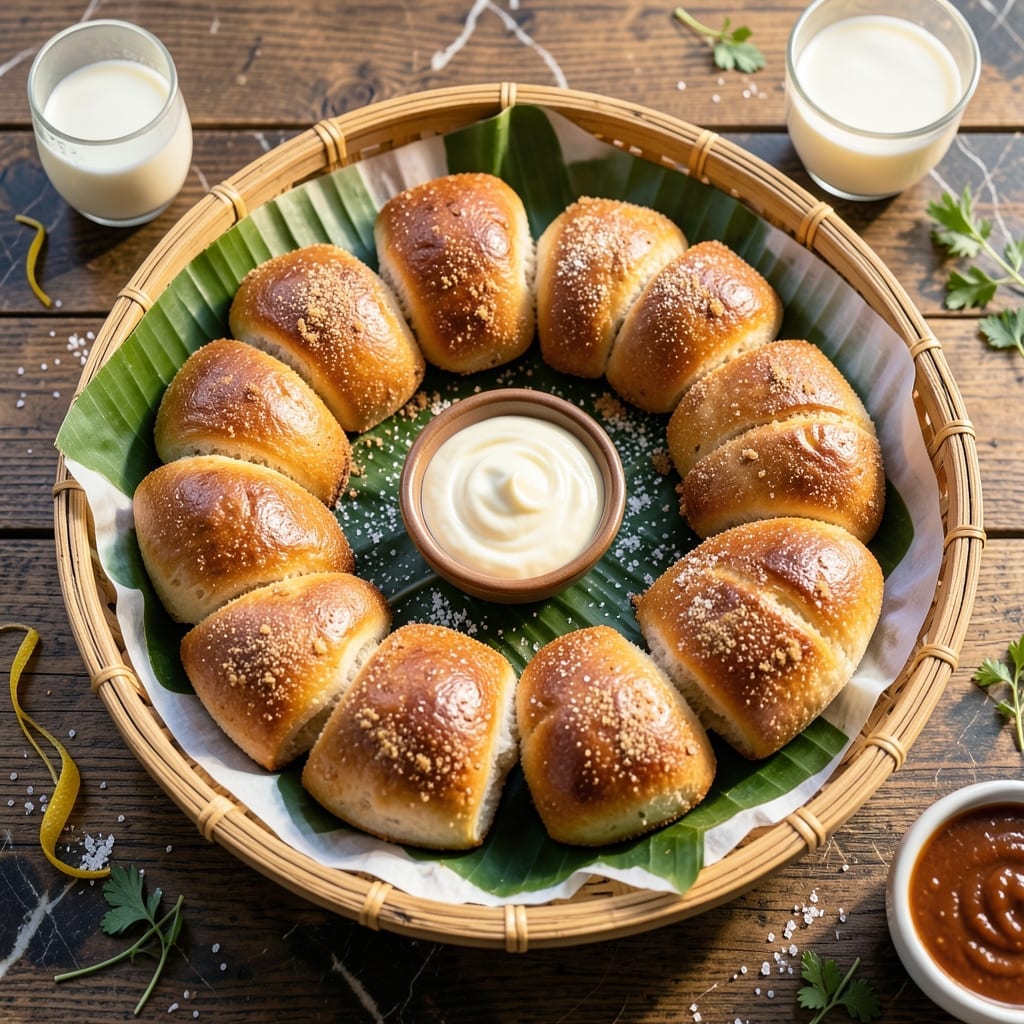
Pandesal holds a special place in Filipino breakfasts, offering soft, slightly sweet rolls perfect for any filling. This recipe brings authentic taste to your kitchen with a simple, proven method.
You’ll create pillowy bread with a golden crust, ready for butter, cheese, or your favorite savory additions. The process is straightforward yet delivers professional results every time.
Ingredients for Recipe for Pandesal Filipino
A dozen soft, sweet rolls with authentic Filipino flavor. Simple ingredients, stellar results.
| Ingredient | Amount | Notes |
|---|---|---|
| Bread Flour 🌾 | 4 cups | All-purpose works in a pinch |
| Granulated Sugar 🍚 | ¼ cup | Fine white sugar preferred |
| Active Dry Yeast 🍞 | 2 ¼ tsp | One packet plus extra |
| Warm Water 💧 | 1 cup | 110-115°F for activation |
| Whole Milk 🥛 | ½ cup | Warmed to room temperature |
| Unsalted Butter 🧈 | ¼ cup | Softened to room temperature |
| Large Egg 🥚 | 1 whole | For richness and color |
| Salt 🧂 | 1 tsp | Fine sea salt preferred |
| Breadcrumbs 🍞 | ½ cup | For coating the rolls |
| All-Purpose Flour 🌾 | ½ cup | For dusting work surface |
| Melted Butter 🧈 | 2 tbsp | For brushing finished rolls |
| Vegetable Oil 🫒 | 1 tbsp | For greasing bowl |
[recipe_ingredient_scaler]
The flour is non-negotiable here—bread flour gives that signature chew. I grab King Arthur from Whole Foods (the 5lb bag lasts forever). Yeast matters too—check the expiration date on that packet, stale yeast won’t rise. The milk adds richness, but if you’re out, warm water with a spoon of powdered milk works in a pinch (not as good, but functional).
No bread flour? All-purpose plus 1 tbsp vital wheat gluten per cup gets you close. Egg-free? Skip it—texture changes but still tasty. Butter substitutes: vegetable oil or coconut oil (use same amount). For the breadcrumbs, panko adds extra crunch, but regular works. The sugar can be swapped for honey or brown sugar—just use the same volume.
Dough rises best in a warm spot (75-80°F). Cover tightly—plastic wrap works. Baked rolls keep 2-3 days at room temp (best fresh though). Freeze extras for 1 month—reheat in oven at 350°F for 5-10 minutes to restore that pillowy texture.
Why You’ll Love This Recipe
- One-Bowl Wonder: I mix everything straight in one bowl—no fancy equipment, just bread flour, yeast, and warm milk coming together effortlessly.
- Sweet Morning Bite: The granulated sugar gives it that subtle sweetness that pairs perfectly with coffee or butter.
- Breakfast or Merienda: Honestly, it’s my go-to for breakfast and afternoon snacks—fills the house with that warm, yeasty smell every time.
- Budget-Friendly Batch: A few cents’ worth of ingredients yields dozens of soft, pillowy rolls—my wallet stays happy, and so does my family.
Step-by-Step Instructions for Pandesal Filipino
Here’s my proven method for creating these beloved Filipino bread rolls with perfect texture.
Step 1: Activate the Yeast and Prepare the Dough
In a small bowl, combine the 2.25 tsp Active Dry Yeast with 1 cup Warm Water and let it sit for 5-7 minutes until it becomes frothy. This confirms your yeast is active and ready to work its magic.
Meanwhile, in a large mixing bowl, whisk together the 4 cups Bread Flour, 0.25 cup Granulated Sugar, and 1 tsp Salt. I always make a well in the center before adding the wet ingredients—this helps distribute them more evenly.
Pour the yeast mixture, 0.5 cup Whole Milk, 0.25 cup Unsalted Butter, and 1 whole Large Egg into the well. Mix until a shaggy dough forms, then switch to a dough hook attachment if using a stand mixer.
Step 2: Knead Until Smooth and Elastic
Turn the dough out onto a surface lightly dusted with 0.5 cup All-Purpose Flour. Knead for 8-10 minutes by hand until the dough becomes smooth, elastic, and slightly tacky. If using a stand mixer, knead on medium speed for 5-6 minutes.
The dough should pass the windowpane test—stretch a small piece thinly, and it should be translucent without tearing. If it’s too sticky, add All-Purpose Flour 1 tablespoon at a time. If it’s too dry, add Warm Water 1 teaspoon at a time.
Step 3: First Rise Until Doubled in Size
Lightly grease a large bowl with 1 tbsp Vegetable Oil. Place the dough in the bowl, turning to coat all sides. Cover with a damp kitchen towel and let it rise in a warm, draft-free place for 1 to 1.5 hours, or until doubled in size.
I like to turn on my oven light to create a warm environment for rising. The dough is ready when it springs back slowly when pressed gently with a finger. Don’t rush this step—proper rising is key to achieving those signature soft, fluffy rolls.
Step 4: Shape, Coat, and Second Rise
Punch down the risen dough to release the air. Turn it out onto your lightly floured surface and divide it into 12 equal portions. Roll each portion into a log about 4-5 inches long and 1 inch in diameter.
Roll each log in 0.5 cup Breadcrumbs until fully coated. This gives the pandesal its characteristic slightly crisp exterior. Arrange the rolls seam-side down on a baking sheet lined with parchment paper, leaving about 1 inch of space between each roll.
Cover with the damp towel again and let them rise for another 30-45 minutes until puffy. They won’t double in size this time, but they should look noticeably larger.
Step 5: Bake to Golden Perfection
Preheat your oven to 375°F. Once preheated, bake the rolls for 15-20 minutes until they turn a beautiful golden brown on top. Rotate the baking sheet halfway through for even browning if your oven has hot spots.
As soon as they come out of the oven, brush the tops generously with 2 tbsp Melted Butter. This adds a glossy finish and extra richness. Transfer the rolls to a wire rack to cool slightly before serving. They’re best enjoyed warm, either plain or with your favorite sweet or savory filling.
Pro Tips For Making Recipe For Pandesal Filipino
- Check Yeast First: I learned this the hard way—always proof your active dry yeast in warm water with a pinch of sugar for 5-10 minutes until frothy. If it doesn’t bubble, your pandesal won’t rise, no matter how long you wait.
- Use Bread Flour: Skip the all-purpose flour; bread flour’s higher protein content gives pandesal that soft yet slightly chewy texture we all love. My grandmother swore by this, and she was right.
- Don’t Overknead: After burning three batches, I finally figured out that kneading just until the dough is smooth and elastic—about 8-10 minutes—is enough. Overworking it makes pandesal dense and tough.
- Brush with Milk: Sounds weird, but brushing the pandesal with whole milk before baking gives it that golden-brown crust and a subtle richness. I was skeptical until I tried it—now it’s non-negotiable.
Troubleshooting Perfect Results
Dough Not Rising
Check your yeast first—it should be frothy after 5-7 minutes in 110-115°F water. If it’s not bubbling, your water may be too hot or the yeast may be expired. I always test my yeast before adding it to the flour.
Dense Texture
Under-kneading is a common culprit. The dough must pass the windowpane test after 8-10 minutes of kneading. Also, ensure your first rise is in a warm spot (75-80°F) for the full 1-1.5 hours. Rushing this step results in heavy rolls. 💡
Breadcrumbs Not Sticking
If the logs are too dry, the breadcrumbs won’t adhere properly. Lightly mist the shaped dough with water before rolling in 0.5 cup Breadcrumbs. I use a spray bottle for even coverage. The dough should feel slightly tacky, not dry.
Uneven Browning
Rotate your baking sheet halfway through the 15-20 minute bake time. If your oven has hot spots, this prevents some rolls from browning too quickly. Also, ensure your oven is fully preheated to 375°F before baking.
Rolls Spreading Too Much
This usually means the dough was too wet. Add All-Purpose Flour 1 tablespoon at a time during kneading until the dough is smooth but not sticky. Also, maintain exactly 1 inch of space between rolls on the baking sheet.
Proper shaping helps too—roll the logs tightly and taper the ends slightly. 🔥
Nutrition Facts
Frequently Asked Questions
Can I use all-purpose flour instead of bread flour?
Yes, but add 1 tbsp vital wheat gluten per cup to mimic bread flour’s higher protein. The texture will be slightly less chewy but still delicious.
Why didn’t my dough rise properly?
Check your yeast freshness and water temperature—it needs to be 110-115°F. Also, ensure your rising spot is warm (75-80°F) and draft-free. Old yeast is the most common culprit.
How do I store leftover pandesal?
Keep in an airtight container at room temperature for 2-3 days. For longer storage, freeze up to 1 month and reheat in a 350°F oven for 5-10 minutes.
Can I make these without an egg?
Yes, but the texture will be slightly less rich. The rolls will still be soft and flavorful. Consider adding an extra 1 tbsp sugar for color.

Trained in classic French technique but raised on slow-cooked ribs and spicy rubs, she blends culinary skill with smoke and soul.
- Recipe for Boneless Pork Chops in Cast Iron Skillet: Sear and Baste to Juicy Perfection - October 3, 2026
- Recipe for Boneless Cross Rib Roast: Slow-Roasted Beef with Herb Crust - October 3, 2026
- Hamburgers in Sauce Recipe Crock Pot: Slow-Cooked Savory Delight - October 3, 2026