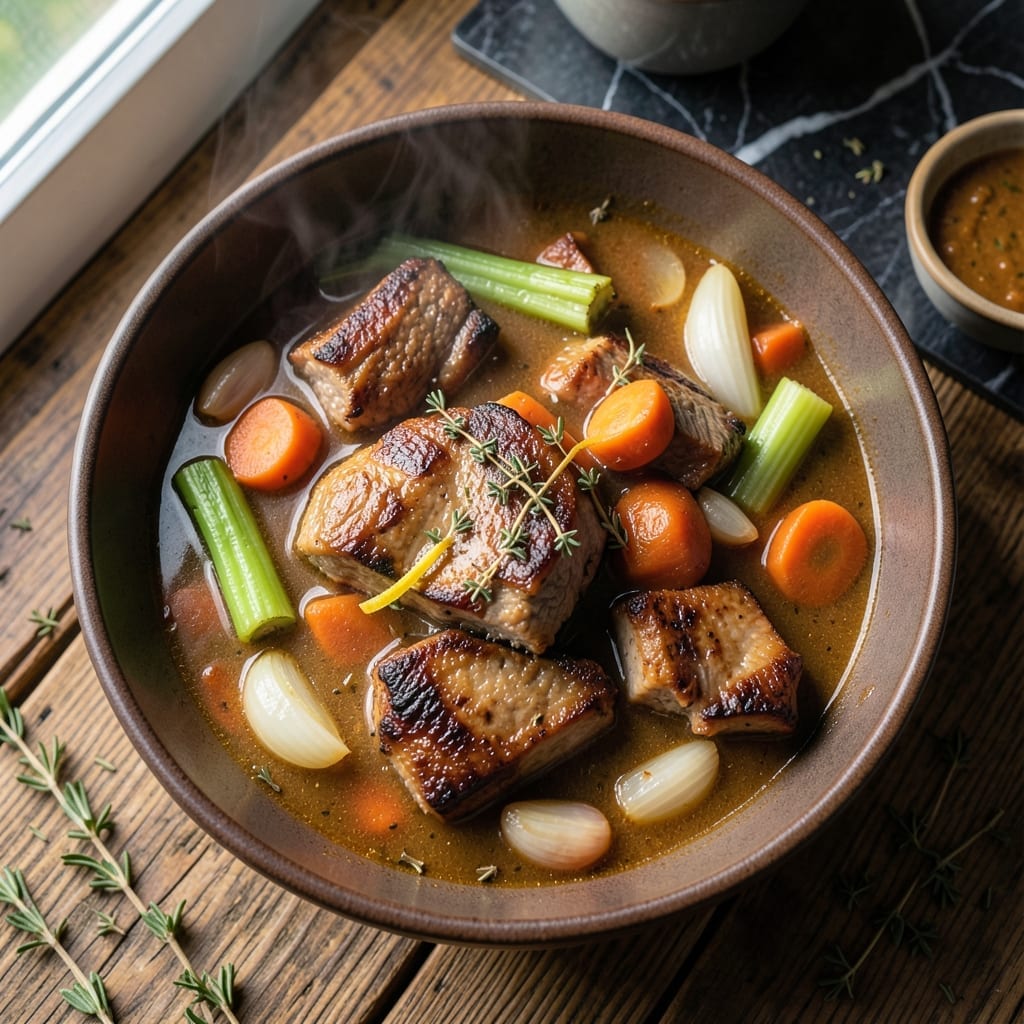
There’s something deeply satisfying about a stew that simmers all day, filling your home with rich aromas and tender pork that falls apart at the touch.
This method transforms simple ingredients into a hearty meal with deep, complex flavors that taste like they took hours of attention, not just time.
Ingredients for Slow Cooker Pork Stew
Rich, slow-simmered flavors start with these carefully chosen ingredients for a truly hearty dish.
| Ingredient | Amount | Notes |
|---|---|---|
| Pork Shoulder 🍖 | 2 lb | Boneless, trimmed of excess fat |
| Yellow Onions 🧅 | 2 whole | Medium-sized, diced |
| Carrots 🥕 | 3 whole | Peeled and sliced into chunks |
| Celery Stalks 🌿 | 3 whole | Trimmed and chopped |
| Garlic Cloves 🧄 | 4 cloves | Minced for depth of flavor |
| Dried Thyme 🍃 | 1 tsp | Crushed between fingers |
| Dried Rosemary 🌿 | 1 tsp | Crushed for aroma release |
| Bay Leaves 🍃 | 2 whole | Removed before serving |
| Low-Sodium Chicken Broth 🥣 | 3 cups | Divided for layering flavors |
| Tomato Paste 🍅 | 2 tbsp | For umami richness |
| Red Wine 🍷 | ½ cup | Dry variety preferred |
| Olive Oil 🫒 | 2 tbsp | Extra-virgin for searing |
| Kosher Salt 🧂 | 1 ½ tsp | Diamond Crystal preferred |
| Black Pepper 🌶️ | 1 tsp | Freshly ground for best results |
[recipe_ingredient_scaler]
The pork shoulder is non-negotiable for that fall-apart texture—bone-in adds depth but boneless is easier to trim. Costco or Whole Foods have reliable options; look for good marbling. Onions, carrots, and celery form the aromatic base, so use fresh, firm produce. The dried herbs should be less than a year old (smell them—if they’re faint, replace).
Short on time? Pre-chopped mirepoix from the grocery store works fine (though fresh is better). No red wine? Beef broth with a splash of balsamic vinegar mimics the acidity. If avoiding alcohol entirely, extra broth plus a teaspoon of sugar balances the richness. The tomato paste can be swapped for tomato sauce reduced by half.
This stew reheats beautifully—flavors deepen overnight. Store in an airtight container for up to 5 days in the fridge or freeze for 3 months. The pork can be prepped the night before; just keep it chilled until cooking. Always discard bay leaves before serving.
Why You’ll Love This Recipe
- Set and Forget: I dump everything in the slow cooker before work and come home to a house that smells like heaven.
- Feeds a Crowd: Between us, I’ve stretched this stew to feed six hungry adults with zero complaints.
- Leftovers for Days: Honestly, it tastes even better the next day—if it lasts that long.
Step-by-Step Instructions for Slow Cooker Pork Stew
Master the technique for building deep, complex flavors with minimal hands-on time.
Step 1: Sear the Pork Shoulder for Depth
Heat the 2 tbsp Olive Oil in a large skillet over medium-high heat until shimmering. Pat the 2 lb Pork Shoulder dry with paper towels, then season generously with the 1.5 tsp Kosher Salt and 1 tsp Black Pepper. Sear the pork on all sides for 8-10 minutes total, turning only when it releases easily from the pan.
You’re looking for a deep golden-brown crust on each surface. This Maillard reaction creates the foundation of flavor for your stew. Don’t rush this step—proper browning ensures the final dish has that rich, meaty complexity that defines a great stew.
Step 2: Sauté the Aromatic Base
Remove the pork and set aside. In the same skillet, add the diced 2 whole Yellow Onions, chunked 3 whole Carrots, and chopped 3 whole Celery Stalks. Cook over medium heat for 6-8 minutes, stirring occasionally, until the onions begin to soften and develop light caramelization.
Add the minced 4 cloves Garlic Cloves, 2 tbsp Tomato Paste, 1 tsp Dried Thyme, and 1 tsp Dried Rosemary. Cook for 1-2 minutes until the tomato paste darkens slightly and the herbs become fragrant. This builds the aromatic backbone that will infuse the entire dish.
Step 3: Deglaze and Transfer to Slow Cooker
Pour in the 0.5 cup Red Wine and scrape up all the browned bits from the bottom of the skillet with a wooden spoon. Let it simmer for 2-3 minutes until the liquid reduces by about half. These fond bits contain concentrated flavor that would otherwise be lost.
Transfer the pork and all the vegetable mixture to your slow cooker. Add the 2 whole Bay Leaves and 2 cups of the Low-Sodium Chicken Broth (reserve the remaining 1 cup for later). The liquid should come about halfway up the pork—this ensures proper braising without diluting the flavors.
Step 4: Slow Cook to Perfection
Cover and cook on low for 7-8 hours or on high for 4-5 hours. The pork is done when it shreds easily with a fork and the vegetables are fork-tender. About 30 minutes before serving, add the remaining 1 cup Low-Sodium Chicken Broth to adjust the consistency.
Here’s the thing—resist the urge to lift the lid during cooking. Each time you do, you lose 20-30 minutes of cooking time as the slow cooker must reheat. The pork should be falling apart and the sauce should have thickened slightly from the natural gelatin released by the meat.
Step 5: Finish and Serve
Remove and discard the 2 whole Bay Leaves. Skim any excess fat from the surface if desired, though I find the flavor it contributes is worth keeping some. Taste and adjust seasoning with additional Kosher Salt or Black Pepper if needed.
The stew should have a rich, velvety texture with pork that melts in your mouth. Serve hot in shallow bowls to showcase the hearty chunks of meat and vegetables. The flavors will continue to meld and improve over the next day, making leftovers even more delicious.
Pro Tips For Making Slow Cooker Pork Stew
- Brown the Pork First: Sear the pork shoulder in batches in a hot pan before adding to the slow cooker—it adds depth of flavor that skipping this step just can’t match. I learned this the hard way after making bland stew for years.
- Cut Uniformly: Chop the carrots, celery, and onions into even, bite-sized pieces so they cook at the same rate. Sounds obvious, but my first few stews had mushy carrots and crunchy celery.
- Skip the Pre-Soaked Beans: If adding beans, use canned and rinse them well—dried beans can turn to mush in a slow cooker and leave you with an odd texture. I was skeptical until I tried it.
- Wait to Thicken: Stir in a cornstarch slurry or mash a few potatoes into the stew only in the last 30 minutes. Adding thickeners too early makes the pork tough and the sauce gluey.
Essential Equipment for Perfect Results
Slow Cooker Choice
For this dish, I swear by my 6-quart Cuisinart slow cooker—it’s the perfect size for 2 lb pork shoulder and has a programmable timer. The ceramic insert distributes heat evenly and retains warmth for hours after cooking. Look for one with a tight-sealing lid to trap moisture.
Essential Skillet
A heavy-bottomed 12-inch stainless steel skillet is non-negotiable for searing. My go-to is All-Clad—it heats evenly and develops that perfect fond. Never use nonstick for this step; you need those browned bits for flavor. 🔥
Avoid thin pans that warp at medium-high heat. Cast iron works too, but requires more attention to prevent hot spots.
Quality Knives
Invest in a sharp 8-inch chef’s knife for breaking down the pork and chopping vegetables. I use a Wüsthof—it glides through pork shoulder like butter. A good knife makes prep faster and safer.
Measuring Tools
Precision matters with spices and liquids. I keep a set of OXO measuring spoons and a 1-cup glass measuring cup handy. For the 0.5 cup red wine, any heatproof measuring cup works—just avoid plastic.
Serving Essentials
Shallow bowls show off the hearty chunks beautifully. I love my stoneware bowls from a local pottery—wide rims make them perfect for stews. Add a ladle for easy serving straight from the slow cooker.
Nutrition Facts
Frequently Asked Questions
Can I skip searing the pork?
You can, but it’s not recommended. Searing creates a golden-brown crust that builds deep flavor through the Maillard reaction. Without it, your stew may lack that rich, meaty complexity.
What if I don’t have red wine?
Substitute with beef broth plus 1 tsp balsamic vinegar for similar acidity. For alcohol-free, use extra chicken broth with 1 tsp sugar. The key is balancing richness and acidity.
Can I cook this on high heat?
Yes, but expect slightly less tender meat. On high, cook for 4-5 hours instead of 7-8 hours on low. Low heat yields the most fall-apart texture.
How do I store leftovers?
Store in an airtight container in the fridge for up to 5 days or freeze for 3 months. Flavors actually improve overnight as they meld together.

Trained in classic French technique but raised on slow-cooked ribs and spicy rubs, she blends culinary skill with smoke and soul.
- Recipe for Fried Pork Chops With Flour: Crispy Crust and Juicy Centers - October 3, 2026
- Octopus Recipe Pan Fried: Crispy Edges With Tender Bites - October 3, 2026
- Recipe For Fried Pork Chops In An Iron Skillet: Crispy Crust With Juicy Centers - October 3, 2026