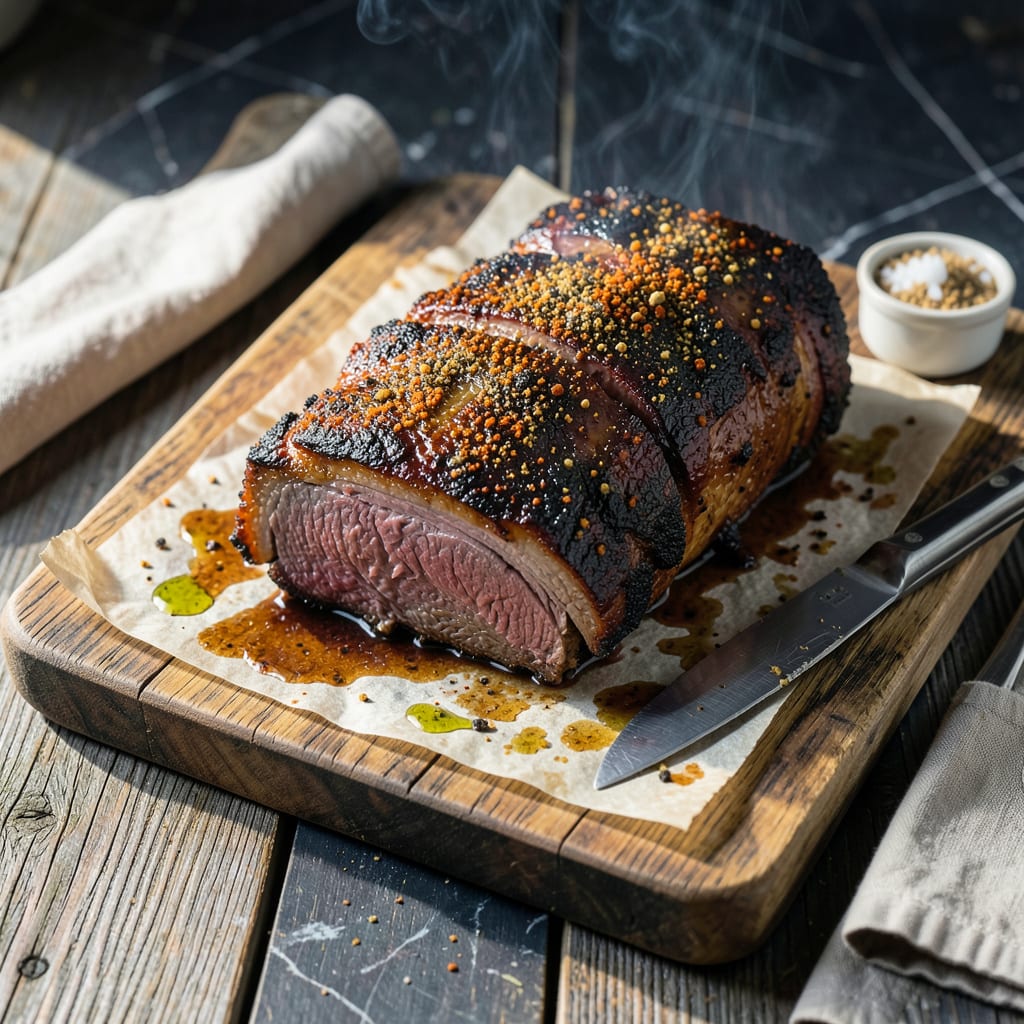
Getting my first whiff of hickory smoke takes me right back to those family cookouts. This brisket delivers that same deep, smoky flavor you’d expect from a Texas pitmaster, right in your own backyard.
Low and slow is the name of the game here. With the right wood and a little patience, you’ll achieve that perfect bark and tender meat that falls apart with just a nudge.
Ingredients for Smoked Bbq Beef Brisket
This is what Texas dreams are made of. Simple rub, quality beef, and time.
| Ingredient | Amount | Notes |
|---|---|---|
| Beef Brisket 🥩 | 4 lb | Whole packer cut, trimmed |
| Kosher Salt 🧂 | ¼ cup | Coarse grain for bark |
| Coarse Black Pepper 🌶️ | ¼ cup | Freshly ground for best flavor |
| Garlic Powder 🧄 | 2 tbsp | Not garlic salt |
| Onion Powder 🧅 | 2 tbsp | Balances the rub |
| Paprika 🌶️ | 2 tbsp | Sweet or smoked variety |
| Mustard Powder 🟡 | 1 tbsp | Adds depth to rub |
| Brown Sugar 🟤 | ¼ cup | Light or dark works |
| Hickory Wood Chunks 🪵 | 4 pieces | For authentic smoke flavor |
| Apple Cider Vinegar 🍏 | ½ cup | For spritzing during cook |
| Beef Broth 🥘 | 2 cups | Low-sodium preferred |
| Butter 🧈 | ½ cup | For wrapping stage |
| Yellow Mustard 🟡 | ¼ cup | Binder for the rub |
[recipe_ingredient_scaler]
The brisket is everything here. Look for a packer cut (point and flat together) with good marbling at Costco or a local butcher. Avoid pre-trimmed flats—they dry out. Weight matters: plan on 1 to 1.5 pounds per person for leftovers (and you’ll want leftovers). The rub spices? Penzeys or bulk bins at natural food stores for freshness.
No hickory? Oak or pecan wood give great results too. Swap brown sugar for white in a pinch, but the molasses notes in brown add complexity. Out of apple cider vinegar? White vinegar plus a teaspoon of sugar mimics the tang. Mustard powder missing? Dijon mustard reduced by half works as a binder. The butter wrap is non-negotiable though—it’s what gives that final moisture boost.
Brisket holds beautifully. Rest it wrapped in towels in a cooler for up to 4 hours—it’ll stay hot. Slice only when ready to serve. Leftover brisket keeps 5 days in the fridge or freezes for 3 months (vacuum-sealed is best).
Why You’ll Love This Recipe
- Set and Forget: The rub of salt, pepper, garlic, and onion powder takes two minutes to pat on, then the smoker does all the work.
- Pure Beef Magic: That crusty bark from the coarse pepper and the deep, smoky flavor of the brisket? I make extra just to snack on while it rests.
- Feeds the Whole Crew: I’ve served this at summer cookouts and Sunday suppers—always disappears, and the leftovers make killer sandwiches the next day.
- Budget-Friendly Centerpiece: A full brisket looks impressive but costs less per serving than steak, and honestly, it tastes twice as good.
Step-by-Step Instructions for Smoked BBQ Beef Brisket
Here’s my proven method for achieving competition-quality results right in your own backyard.
Step 1: Prepare and Season the Brisket
Start by trimming the 4 lb Beef Brisket fat cap to about ¼ inch thickness. I use a sharp boning knife for precision, ensuring you retain enough fat to baste the meat during the long smoke while removing any large, hard fat deposits.
Create the rub by combining the 0.25 cup Kosher Salt, 0.25 cup Coarse Black Pepper, 2 tbsp Garlic Powder, 2 tbsp Onion Powder, 2 tbsp Paprika, 1 tbsp Mustard Powder, and 0.25 cup Brown Sugar. Spread the 0.25 cup Yellow Mustard over the brisket as a binder, then apply the rub generously, pressing it into the meat. Let it sit at room temperature for 1 hour before smoking.
Step 2: Set Up Your Smoker and Begin Cooking
Preheat your smoker to 225-250°F using the 4 pieces Hickory Wood Chunks for authentic smoke flavor. When the smoker reaches temperature and you see thin blue smoke, place the brisket fat-side up on the grates. Position a water pan in the smoker to maintain moisture.
Close the lid and resist the urge to peek—every time you open it, you add 15-20 minutes to your cook time. Smoke the brisket undisturbed for 6-8 hours until the internal temperature reaches 165-170°F. This is when you’ll hit “the stall,” where the temperature plateaus.
Step 3: Wrap and Continue Cooking
At the stall, remove the brisket from the smoker and wrap it tightly in pink butcher paper. Add the 0.5 cup Butter, a splash of the 2 cups Beef Broth, and a little of the 0.5 cup Apple Cider Vinegar to the wrap for moisture and flavor. This is called the “Texas crutch,” and it helps power through the stall while preserving the bark.
Return the wrapped brisket to the smoker and continue cooking until the internal temperature reaches 200-205°F and a probe slides in like butter. This stage usually takes another 4-6 hours, but trust the probe test over the thermometer.
Step 4: Rest and Slice for Serving
Remove the brisket from the smoker and let it rest in the butcher paper for at least 1 hour (I prefer 2 hours wrapped in towels in a cooler). This resting period allows the juices to redistribute throughout the meat, ensuring every slice is moist and flavorful.
Unwrap the brisket and locate the grain direction—you’ll see lines running through the meat. Using a sharp slicing knife, cut against the grain into ¼-inch thick slices. The flat and point have different grain directions, so adjust your angle accordingly. Serve immediately while still warm.
Pro Tips For Making Smoked Bbq Beef Brisket
- Low and Slow Wins: Keep your smoker between 225-250°F—any higher and the brisket tightens up before the fat renders. I learned this the hard way after pulling a tough, dry brisket at 275°F.
- Trim the Fat Cap: Leave about 1/4 inch of fat on the brisket, but trim any thicker sections so the rub penetrates evenly. Sounds weird, but it works: the bark forms better without a greasy barrier.
- Skip the Rush: Resist the urge to crank the heat when it stalls—this phase can last hours, and patience is the thing that matters most. After burning through a tank of propane trying to speed it up, I finally figured out it’s just part of the process.
- Rest Overnight: Wrap the brisket in foil and let it rest in a cooler or warm oven for at least 2 hours—4 is better. My grandmother swore by this, and she was right: the juices redistribute, and slicing is a dream.
Essential Equipment for Great smoked bbq beef brisket
Smoker Essentials
For backyard pitmaster results, I swear by my Weber Smokey Mountain—it maintains steady 225-250°F temps with minimal fuss. A quality dual-probe thermometer like ThermoWorks Smoke is non-negotiable; one probe for meat, one for smoker temp. 🌡️
Fuel and Smoke
Use lump charcoal (I prefer Jealous Devil) for clean, consistent heat. Add 4 hickory wood chunks for that classic Texas smoke flavor. Avoid green wood—it creates bitter smoke. A chimney starter gets your coals ready without lighter fluid.
Tools of the Trade
A sharp 12-inch boning knife (I use Dexter-Russell) makes trimming that fat cap precise. For wrapping, keep pink butcher paper on hand—it breathes better than foil. Don’t forget heat-resistant gloves for handling hot grates and wrapped brisket.
Moisture Management
A water pan in your smoker adds humidity to prevent drying. I also keep a spray bottle with apple cider vinegar for occasional spritzing. A drip pan under the brisket catches rendered fat, making cleanup easier.
Resting Setup
After the long smoke, you’ll need a large cooler and towels for resting. This setup keeps your brisket hot for 2-4 hours while juices redistribute. A long slicing knife (I love my Victorinox) ensures clean cuts against the grain. 💪
Nutrition Facts

Trained in classic French technique but raised on slow-cooked ribs and spicy rubs, she blends culinary skill with smoke and soul.
- Recipe for Boneless Pork Chops in Cast Iron Skillet: Sear and Baste to Juicy Perfection - October 3, 2026
- Recipe for Boneless Cross Rib Roast: Slow-Roasted Beef with Herb Crust - October 3, 2026
- Hamburgers in Sauce Recipe Crock Pot: Slow-Cooked Savory Delight - October 3, 2026