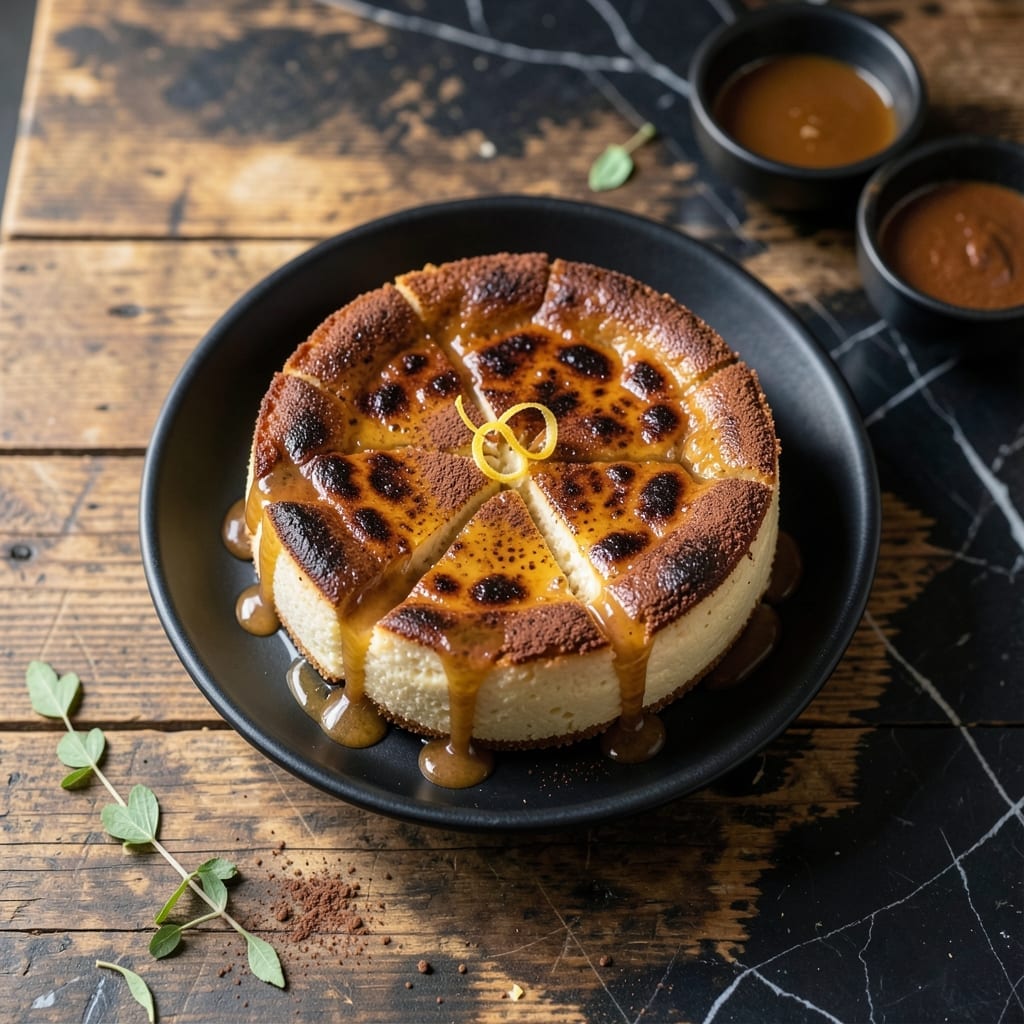
This cheesecake redefines dessert with its creamy texture and bold coffee swirl. The condensed milk base creates a rich, velvety foundation.
Perfectly balanced espresso cuts through the sweetness, delivering a sophisticated flavor that lingers with every bite.
Ingredients for Vietnamese Coffee Basque Cheesecake Recipe with Condensed Milk
Rich cream cheese and sweetened condensed milk form the velvety base for this dessert masterpiece.
| Ingredient | Amount | Notes |
|---|---|---|
| Cream Cheese 🧀 | 2 lb | Full-fat, room temperature |
| Sweetened Condensed Milk 🥛 | 1 can | 14 oz can preferred |
| Large Eggs 🥚 | 6 whole | Room temperature |
| All-Purpose Flour 🌾 | ¼ cup | Sifted for smoothness |
| Granulated Sugar 🍚 | ½ cup | Fine grain preferred |
| Unsalted Butter 🧈 | ½ cup | Melted and cooled |
| Vanilla Extract 🌿 | 2 tsp | Pure extract recommended |
| Espresso Powder ☕ | 2 tbsp | Instant or finely ground |
| Heavy Cream 🥛 | ½ cup | Cold, for swirl mixture |
| Fine Sea Salt 🧂 | ½ tsp | Balances sweetness |
| Lemon Juice 🍋 | 1 tbsp | Freshly squeezed |
[recipe_ingredient_scaler]
The cream cheese is the foundation—Philadelphia or Organic Valley deliver consistent quality and fat content. Room temperature is non-negotiable for a smooth batter (cold cream cheese = lumps). For condensed milk, Eagle Brand is the standard, but any full-fat version works. The espresso powder should be intensely aromatic; Medaglia d’Oro or King Arthur brands are reliable for that deep coffee punch.
Need a condensed milk substitute? Dulce de leche at 1:1 ratio works in a pinch. No espresso powder? 2 tbsp strong brewed coffee reduced to 1 tbsp will do, though the flavor won’t be as concentrated. The flour can be swapped for cornstarch at half the amount, but the texture will be slightly denser. Always use full-fat dairy here—low-fat versions compromise the signature creamy texture.
This cheesecake actually improves overnight as flavors meld. Store covered at room temperature for 2 days or refrigerated for 5 days. For longer storage, freeze whole (well-wrapped) for up to 3 months. Thaw overnight in the fridge before serving.
Why You’ll Love This Recipe
- One-Bowl Wonder: I just dump cream cheese, condensed milk, and eggs in one bowl—no mixer, no fuss. Honestly, cleanup is almost nonexistent.
- Rich Coffee Swirl: That deep Vietnamese coffee flavor cuts through the sweetness of the condensed milk like a dream. The contrast is ridiculous.
- Make Ahead Magic: Bake it Saturday, serve it Tuesday—it tastes even better after a day in the fridge. Between us, leftovers disappear fast.
- Budget-Friendly Luxe: Cream cheese and condensed milk stretch further than you’d think. I’ll be real: it feels fancy for the cost.
Step-by-Step Instructions for Vietnamese Coffee Basque Cheesecake
This method ensures a velvety texture with a striking espresso swirl throughout the cake.
Step 1: Prepare the Cream Cheese Base
In a stand mixer fitted with the paddle attachment, beat the 2 lb Cream Cheese on medium speed for 2-3 minutes until completely smooth and free of lumps. Scrape down the sides of the bowl as needed to ensure even mixing.
Add the 0.5 cup Granulated Sugar and continue beating for another 2 minutes until the mixture is light and fluffy. The sugar should be fully incorporated and the mixture should look slightly pale in color. This step is crucial for achieving that signature creamy texture.
Step 2: Incorporate Wet Ingredients and Flavorings
With the mixer on low speed, add the 6 whole Large Eggs one at a time, allowing each to fully incorporate before adding the next. This slow addition prevents the mixture from curdling and ensures a smooth batter.
Next, add the 1 can Sweetened Condensed Milk, 0.5 cup Unsalted Butter, 2 tsp Vanilla Extract, 1 tbsp Lemon Juice, and 0.5 tsp Fine Sea Salt. Mix for another 1-2 minutes until all ingredients are fully combined. The batter should be silky and homogeneous at this stage.
Step 3: Add Dry Ingredients and Prepare the Swirl
Sift in the 0.25 cup All-Purpose Flour and mix on low speed just until it disappears into the batter. Be careful not to overmix, as this can introduce too much air and affect the cake’s texture.
In a separate bowl, prepare the coffee swirl by combining the 0.5 cup Heavy Cream and 2 tbsp Espresso Powder. Mix until the espresso powder is fully dissolved and the mixture is smooth. This will create the rich coffee flavor that contrasts beautifully with the creamy base.
Step 4: Layer and Bake
Pour the cream cheese batter into a 9-inch springform pan lined with parchment paper. Smooth the top with a spatula. Then, carefully pour the coffee mixture over the batter. Use a butter knife or skewer to gently swirl the coffee mixture into the batter, creating a marbled effect.
Bake in a preheated 325°F oven for 50-60 minutes. The cheesecake should be set around the edges but still have a slight wobble in the center when gently shaken. This indicates it’s perfectly cooked and will continue to set as it cools.
Step 5: Cool and Chill
Turn off the oven and crack the door open slightly. Allow the cheesecake to cool in the oven for 1 hour. This gradual cooling prevents the top from cracking due to sudden temperature changes.
After cooling in the oven, transfer the cheesecake to a wire rack and let it cool completely at room temperature, about 2 hours. Once cooled, refrigerate for at least 4 hours or overnight to allow the flavors to meld and the texture to set fully. Serve chilled for the best creamy consistency.
Pro Tips For Making Vietnamese Coffee Basque Cheesecake Recipe With Condensed Milk
- Room Temp Cream Cheese: Let your cream cheese sit out for at least 1 hour before mixing—I learned this the hard way after ending up with lumpy batter that never smoothed out.
- Whisk Eggs Gently: Beat the eggs just until combined, about 15-20 seconds. Overmixing adds air that can cause cracks in your cheesecake.
- Preheat the Pan: Start with a hot water bath (180°C/350°F oven) to set the edges quickly before lowering the temperature to 160°C/325°F for even baking.
- Strain the Batter: After mixing, run the batter through a fine-mesh sieve to remove any lumps—sounds tedious, but it guarantees that silky texture everyone loves.
Common Mistakes When Making vietnamese coffee basque cheesecake recipe with condensed milk
Overmixing the Batter
Once you add the 0.25 cup All-Purpose Flour, mix just until it disappears. Overmixing introduces too much air, causing the cake to puff excessively during baking, then collapse and crack as it cools. I learned this the hard way with my first three attempts. 💡
Cold Cream Cheese
Using 2 lb Cream Cheese straight from the fridge creates lumps that never fully smooth out. Always let it sit at room temperature for at least 2 hours before starting. For faster results, cut it into 1-inch cubes and spread on a plate.
Skipping the Water Bath
Basque cheesecake is baked without a water bath, but don’t compensate by overbaking. The 325°F oven should produce a wobbly center after 50-60 minutes. If the top browns too quickly, tent with foil to prevent burning while the center finishes.
Improper Swirling
When adding the coffee mixture, use a gentle hand with your butter knife. Over-swirling blends the flavors too much, losing that beautiful marbled effect. I aim for 3-4 wide swirls around the pan, then a few figure-eights through the center.
Rushing the Cooling
The 1-hour oven cool with the door cracked is non-negotiable. Skipping this step or moving to the fridge too soon causes the drastic temperature change that leads to that dreaded cracked top. Patience here ensures a smooth, professional finish.
Underchilling Before Serving
This dessert needs at least 4 hours in the fridge to set properly. Serving too soon results in a runny texture that won’t hold its shape when sliced. Overnight chilling is ideal for the cleanest slices and most developed flavors.
Nutrition Facts
Frequently Asked Questions
Can I use regular coffee instead of espresso powder?
Yes, but you’ll need to reduce 1/4 cup strong brewed coffee down to 2 tablespoons for equivalent intensity. The flavor won’t be as concentrated as espresso powder.
Why does my cheesecake crack on top?
Rapid temperature changes are usually to blame. Always cool gradually in the oven with the door cracked for 1 hour. Overmixing or overbaking can also cause cracks.
Can I make this gluten-free?
Replace the 0.25 cup All-Purpose Flour with 2 tablespoons cornstarch. The texture will be slightly denser but still delicious.
How far in advance can I make this?
It actually improves overnight! Store covered at room temperature for 2 days or refrigerated for 5 days. Freeze for up to 3 months for longer storage.

Trained in classic French technique but raised on slow-cooked ribs and spicy rubs, she blends culinary skill with smoke and soul.
- Recipe for Boneless Pork Chops in Cast Iron Skillet: Sear and Baste to Juicy Perfection - October 3, 2026
- Recipe for Boneless Cross Rib Roast: Slow-Roasted Beef with Herb Crust - October 3, 2026
- Hamburgers in Sauce Recipe Crock Pot: Slow-Cooked Savory Delight - October 3, 2026