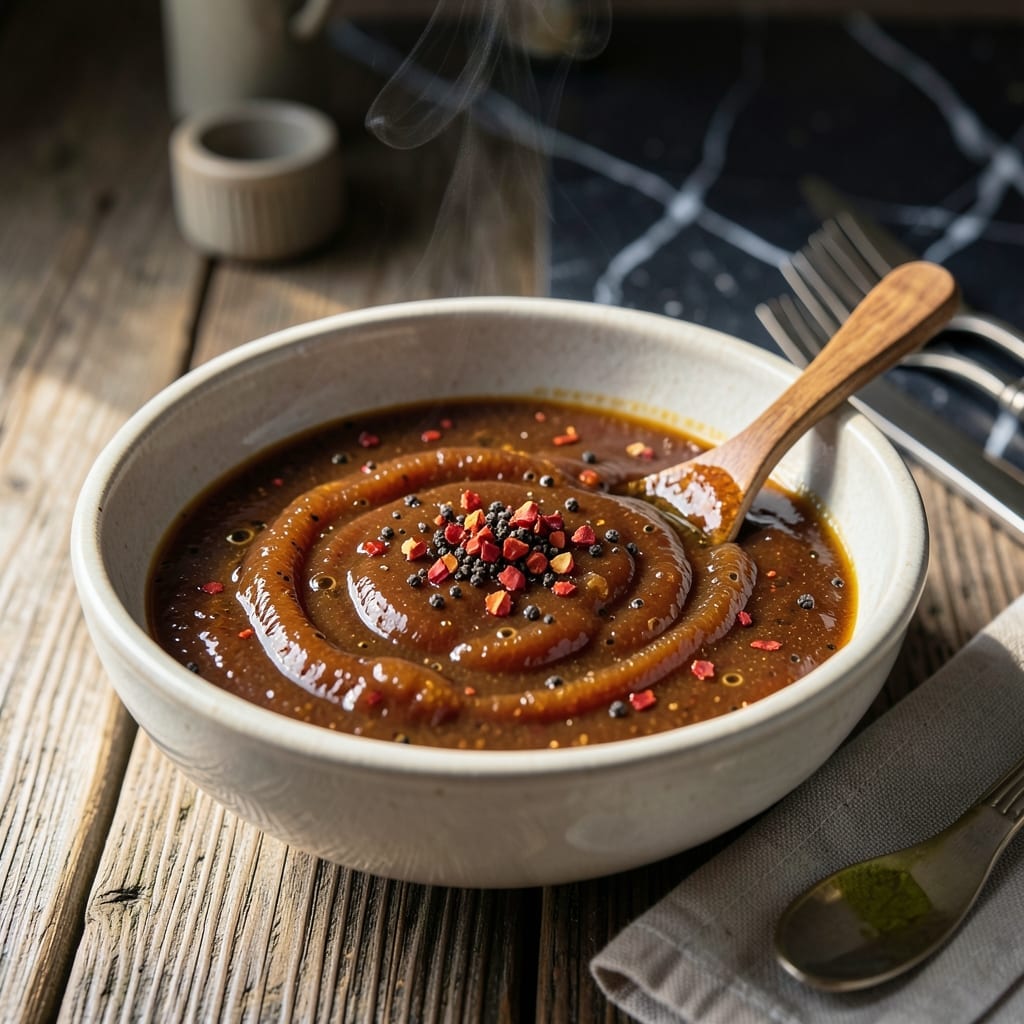
This Carolina-style sauce delivers the bright, tangy punch that defines Eastern barbecue tradition. My first taste came at a roadside pit stop, where the vinegar cut through rich smoked pork perfectly.
With just a few simple ingredients and 10 minutes of simmering, you’ll have a versatile sauce that works on pulled pork, ribs, or as a mop during cooking.
Ingredients for Vinegar Based Barbecue Sauce
Nine simple ingredients for that signature Carolina tang you can’t get enough of.
| Ingredient | Amount | Notes |
|---|---|---|
| Apple Cider Vinegar 🍏 | 2 cups | The base for tangy flavor |
| White Vinegar 🍶 | ½ cup | For extra sharpness |
| Brown Sugar 🍚 | ½ cup | Light or dark works |
| Ketchup 🍅 | ½ cup | For body and sweetness |
| Crushed Red Pepper Flakes 🌶️ | 1 tsp | Adjust for heat preference |
| Black Pepper 🌶️ | 1 tsp | Freshly ground preferred |
| Kosher Salt 🧂 | 1 tsp | Diamond Crystal preferred |
| Yellow Mustard 🟡 | 1 tbsp | For depth of flavor |
| Worcestershire Sauce 🫒 | 1 tbsp | Use vegan variety |
[recipe_ingredient_scaler]
The vinegar is non-negotiable here. Bragg is my go-to for apple cider vinegar—raw and unfiltered gives the best flavor. White vinegar should be basic distilled (no fancy stuff needed). For the brown sugar, Domino or C&H are solid choices. Most grocery stores carry these, but if you’re near a Whole Foods, their organic vinegars are great (though pricier).
No apple cider vinegar? White vinegar with a splash of apple juice gets close. Short on ketchup? Tomato paste thinned with water and a touch of sugar works in a pinch. The Worcestershire must be vegan—Annie’s or Edward & Sons make good ones. Want more heat? Add cayenne instead of red pepper flakes for a different kind of burn.
This keeps forever—honestly, the flavor deepens over time. Store in a sealed jar at room temp for 6 months, or fridge for 1 year. I make a double batch so I’m never without it for summer grilling.
Why You’ll Love This Recipe
- 5-Minute Mix: I dump everything in a pot and let it simmer—no chopping, no fuss.
- Tangy Kick: That apple cider vinegar and red pepper flakes combo? Ridiculously good on pulled pork or ribs.
- Grill Night Hero: Honestly, it’s my go-to for burgers, chicken, or even as a dipping sauce for fries.
- Pantry Staples: I already had all the ingredients, so it cost me next to nothing and keeps for weeks.
Step-by-Step Instructions for Vinegar Based Barbecue Sauce
Here’s how I make this tangy Carolina classic with perfect balance every time.
Step 1: Combine the Vinegar Base and Sweetener
In a medium saucepan, pour in the 2 cups Apple Cider Vinegar and 0.5 cup White Vinegar. I always use a non-reactive pot to prevent any metallic taste from developing. Add the 0.5 cup Brown Sugar and stir until it begins to dissolve.
Place the saucepan over medium heat and let it warm gradually. You’ll see the sugar fully dissolve after 3-4 minutes of gentle stirring. Don’t rush this—high heat can cause the sugars to caramelize too quickly, which we don’t want for this sauce.
Step 2: Incorporate the Thickening and Flavor Agents
Once the sugar is dissolved, stir in the 0.5 cup Ketchup, 1 tbsp Yellow Mustard, and 1 tbsp Worcestershire Sauce. The ketchup adds body and a touch of sweetness, while the mustard and Worcestershire deepen the flavor profile with their unique tang and umami notes.
At this point, the mixture will look thin, but don’t worry—it thickens as it simmers. I switch to a whisk here to ensure everything blends smoothly and no lumps remain from the mustard or ketchup.
Step 3: Season and Simmer to Perfection
Add the 1 tsp Kosher Salt, 1 tsp Black Pepper, and 1 tsp Crushed Red Pepper Flakes. Stir well to distribute the spices evenly. I always taste at this stage—if you prefer a milder sauce, you can reduce the crushed red pepper slightly, but I love the subtle kick it adds.
Reduce the heat to low and let the sauce simmer uncovered for 15-20 minutes. You’ll notice it thicken slightly and the flavors meld together beautifully. Stir occasionally to prevent sticking, especially toward the end when the sauce has reduced a bit.
Step 4: Adjust and Cool for Optimal Flavor
After simmering, remove the saucepan from heat and let it cool to room temperature. The sauce will thicken a bit more as it cools. I always give it a final stir once cooled to redistribute any spices that may have settled.
Taste and adjust seasoning if needed. If it’s too sharp, a pinch more brown sugar can balance it. If it’s too sweet, a splash of additional apple cider vinegar will brighten it up. This sauce keeps well in the refrigerator for up to 2 weeks, and the flavors deepen over time.
Pro Tips For Making Vinegar Based Barbecue Sauce
- Simmer Low and Slow: Keep the heat at a gentle simmer—too high and the vinegars will evaporate too quickly, leaving a harsh, overly tangy sauce. I learned this the hard way after burning a batch that tasted like pure acid.
- Balance the Vinegars: Use a 2:1 ratio of apple cider vinegar to white vinegar for depth without overpowering sharpness. My grandmother swore by this, and she was right: white vinegar alone makes it taste flat.
- Dissolve the Sugar: Whisk the brown sugar into the warm vinegar mixture first to prevent grainy texture. Sounds weird, but it works—stirring it into cold liquid just leaves clumps.
- Rest Before Serving: Let the sauce sit for at least 30 minutes after cooking so the flavors meld. I skip this when I’m lazy, but the sauce is noticeably smoother when I don’t.
Creative Variations of This vinegar based barbecue sauce
Western Carolina Style
This variation leans harder into the vinegar with a 3:1 ratio of apple cider to white vinegar. I add 1 tbsp crushed red pepper and 1 tsp cayenne for extra heat. The result is thinner and sharper—perfect for pulled pork sandwiches. It reminds me of the sauces I grew up with.
Sweet and Tangy
For those who prefer balance, increase the brown sugar to ¾ cup and add ¼ cup honey. The extra sweetness rounds out the acidity beautifully. I discovered this version at a local BBQ competition—it won second place.
Smoky Depth
Add 1 tsp smoked paprika and ½ tsp liquid smoke to the original recipe. This gives a subtle campfire flavor without overpowering the vinegar base. I use Wright’s liquid smoke—it’s the most consistent brand I’ve found. 🔥
Herb-Infused
Stir in 1 tbsp fresh rosemary and 1 tbsp fresh thyme during simmering. I forage these wild herbs from my coastal rides. Strain before serving for a clean texture. The herbal notes complement chicken exceptionally well.
Spicy Mustard Twist
Replace yellow mustard with Dijon and add 1 tsp horseradish. This gives a more complex, spicier profile. I first tried this at a friend’s cookout—it became an instant favorite.
Fruit-Enhanced
Blend in ½ cup peach preserves with the ketchup. The fruit adds a subtle sweetness and beautiful color. This variation works wonderfully with grilled chicken. 💛
Nutrition Facts
Frequently Asked Questions
What can I use if I don’t have apple cider vinegar?
White vinegar with a splash of apple juice makes a fine substitute. The apple juice adds a touch of fruitiness that mimics cider vinegar. Avoid rice or balsamic vinegar as they alter the flavor profile too much.
How long does homemade sauce keep?
Store in a sealed jar at room temperature for up to 6 months. For best freshness, refrigerate after opening and use within 2 weeks. The flavors actually improve with time as they meld together.
Why is my sauce too thin?
Simmer it longer to reduce the liquid. If in a hurry, mix 1 tsp cornstarch with 1 tbsp water and stir in while heating. Never boil vigorously as it can make the sauce bitter.
Can I make it less tangy?
Add 1-2 tbsp honey or maple syrup to balance the acidity. Brown sugar also helps mellow the vinegar taste while keeping the traditional flavor.

Trained in classic French technique but raised on slow-cooked ribs and spicy rubs, she blends culinary skill with smoke and soul.
- Recipe for Boneless Pork Chops in Cast Iron Skillet: Sear and Baste to Juicy Perfection - October 3, 2026
- Recipe for Boneless Cross Rib Roast: Slow-Roasted Beef with Herb Crust - October 3, 2026
- Hamburgers in Sauce Recipe Crock Pot: Slow-Cooked Savory Delight - October 3, 2026