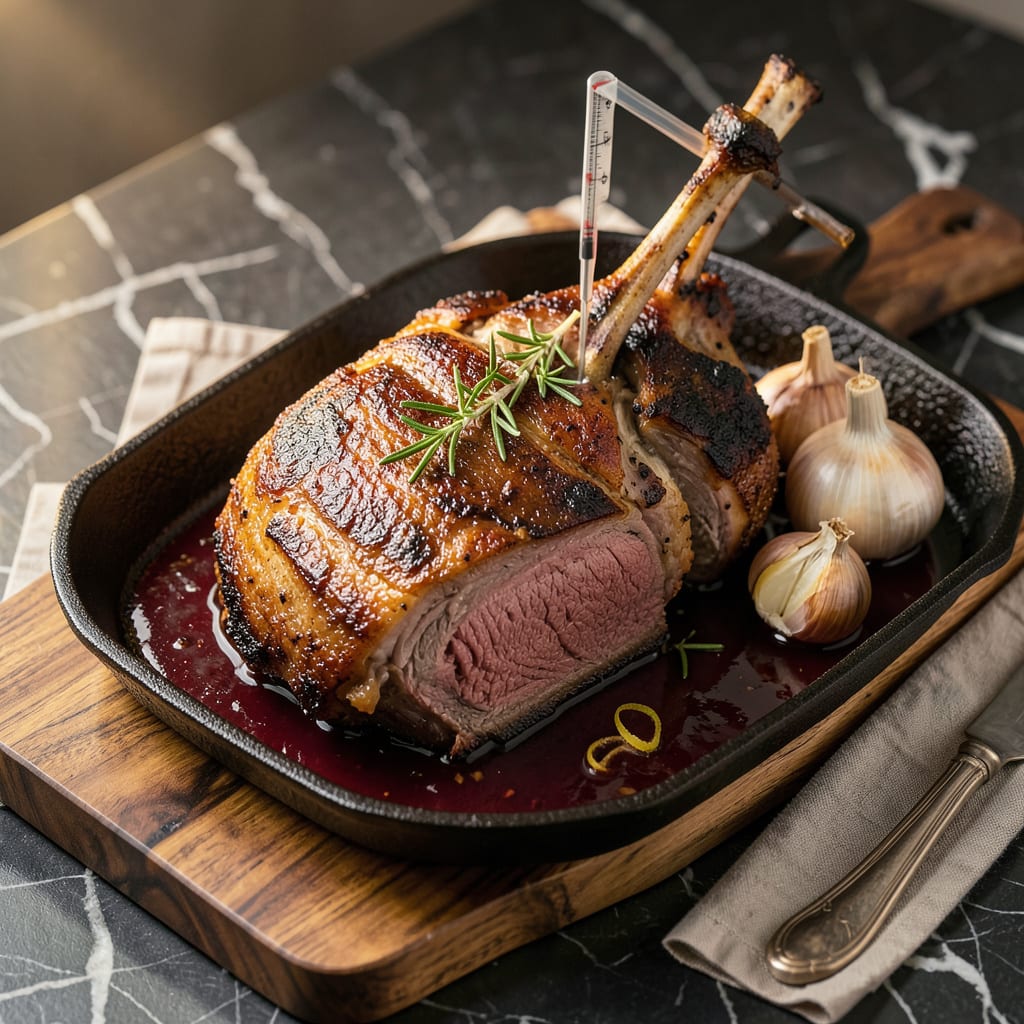
Insert the meat thermometer into the thickest part of the prime rib, avoiding bone and fat. Aim for the center of the roast, about 2-3 inches deep for the most accurate temperature reading.
Getting this right means the difference between a juicy, perfectly cooked roast and one that’s overdone on the outside while still raw inside. 🔥 I’ve learned through years of smoking and roasting that the thickest center gives you the truest reading because that’s where heat penetrates last. The 2-3 inch depth matters because surface temperatures can be misleading—especially with a thick crust or bark. Think of it like testing a cake: you wouldn’t check the edge, you’d go for the middle where it cooks slowest.
💡 In This Article
- Why Thermometer Placement Affects Prime Rib Doneness
- Step-by-Step Guide to Testing Prime Rib Temperature
Why Thermometer Placement Affects Prime Rib Doneness
Prime rib’s uneven composition creates temperature zones that cook at different rates. The center muscle (longissimus dorsi) has less fat marbling than the outer layers, making it the slowest to reach temperature. Bone acts as an insulator—areas near the rib bones can be 10-15°F cooler than surrounding meat.
Meanwhile, the fat cap on top conducts heat differently than lean tissue, creating microclimates within the roast. 🔥
Heat travels from the exterior inward during cooking, forming a gradient where the outermost 1/2 inch might be 20°F hotter than the core. This is why surface readings give false highs. The 2-3 inch depth recommendation accounts for this gradient—it’s deep enough to avoid the overheated perimeter but still representative of the overall doneness.
Think of it like testing a baked potato: you wouldn’t check the skin, you’d probe the center where heat arrives last.
Fat pockets and connective tissue also distort readings. A thermometer touching a fat deposit might show 140°F while the actual muscle is still at 125°F. The dense bone near the rib end creates another cold spot—this area often needs 20% more cooking time than the center.
I’ve seen roasts where the bone-end was still bloody while the middle hit perfect medium-rare. ✨
Muscle density varies too. The eye of the rib (central muscle) is more compact than the outer muscles, requiring precise placement. A 1/4 inch shift can mean the difference between reading the dense center versus the looser-grained outer muscles.
This is why experienced pitmasters use the “three-point check”: center, bone-end, and fat-cap side for comprehensive accuracy.
Temperature recovery during resting adds another layer. The center continues rising 5-10°F after removal from heat, while edges may plateau or even drop slightly. Proper placement lets you account for this carryover cooking.
I once pulled a roast at 118°F internal that reached perfect 125°F medium-rare after resting—all because the probe was in the true center. 💫
Consider these key factors when positioning your probe:
- Bone proximity: Stay 1 inch away from ribs to avoid false lows
- Fat deposits: Angle probe to miss visible fat seams
- Muscle grain: Insert parallel to fibers for easier penetration
- Depth consistency: Mark probe with tape at 2.5 inches for repeatable results

Trained in classic French technique but raised on slow-cooked ribs and spicy rubs, she blends culinary skill with smoke and soul.
- Recipe for Boneless Pork Chops in Cast Iron Skillet: Sear and Baste to Juicy Perfection - October 3, 2026
- Recipe for Boneless Cross Rib Roast: Slow-Roasted Beef with Herb Crust - October 3, 2026
- Hamburgers in Sauce Recipe Crock Pot: Slow-Cooked Savory Delight - October 3, 2026