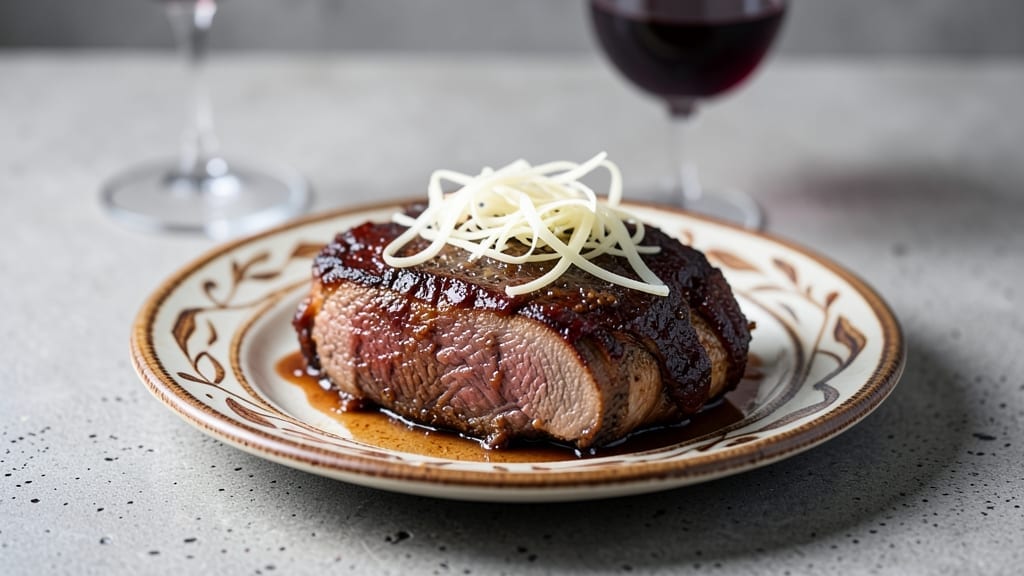
This beer-braised beef brisket recipe transforms tough cuts into melt-in-your-mouth perfection with just one pot and a few hours of hands-off cooking. The secret lies in slow simmering the brisket in rich beer—whether stout or ale—until it becomes fork-tender and infused with deep, malty flavors.
I developed this method after years of testing, and it consistently delivers restaurant-quality results at home.
The process begins with searing the brisket to lock in juices, then building layers of flavor with onions, garlic, and herbs before adding the beer. As it braises, the liquid reduces to a glossy, caramelized sauce that coats every bite.
This technique turns a simple cut of meat into a showstopper that pairs beautifully with mashed potatoes or crusty bread.
By the time you slice into it, you’ll find brisket that falls apart with minimal effort, drenched in a sauce that’s both savory and slightly sweet from the beer’s caramelization.
The aroma alone will have everyone gathering at the table. With precise timing and a few key steps, you’ll master this dish every time.
Perfect for game day, holiday feasts, or a cozy Sunday dinner, this recipe proves that slow cooking doesn’t require fancy equipment—just patience and the right technique. Let’s get started on creating brisket that’s so tender, it practically melts in your mouth.
Ingredients for beer braised beef brisket
Short list. Big flavor. One pot. Perfectly tender brisket in hours.
| Ingredient | Amount | Notes |
|---|---|---|
| Beef Brisket 🥩 | 3 ½ lb | Fat cap trimmed, 1-inch thick |
| Yellow Onions 🧅 | 2 whole | Thinly sliced, 1/4-inch pieces |
| Garlic Cloves 🧄 | 6 cloves | Minced, peeled |
| Carrots 🥕 | 2 cups | Diced, medium size |
| Dark Beer 🍺 | 2 cups | Stout or ale, room temp |
| Beef Broth 💧 | 2 cups | Low-sodium preferred |
| Tomato Paste 🍅 | ¼ cup | Unsweetened, smooth texture |
| Brown Sugar 🍚 | ¼ cup | Light or dark, packed |
| Dried Thyme 🌿 | 1 tbsp | Fresh thyme at 1/3 amount |
| Dried Rosemary 🌿 | 1 tbsp | Chopped, fresh preferred |
| Olive Oil 🫒 | ½ cup | Extra-virgin for richness |
| Salt 🧂 | 1 tsp | Kosher or sea salt |
| Black Pepper 🌶️ | 1 tsp | Freshly ground preferred |
[recipe_ingredient_scaler]
The brisket is everything here. Chuck or packer cut works best—look for fat marbling (that white streaking) for extra tenderness. Most grocery stores sell it pre-wrapped, but Costco or butcher shops give you the best quality. I always buy it the day I cook—it keeps well in the fridge for 3-4 days if wrapped tightly. Don’t skip trimming the fat cap though—it burns during searing. For the best results, let it sit at room temperature for 30 minutes before cooking to ensure even cooking.
Dark beer is non-negotiable for that deep, malty flavor. Stout or porter work best, but amber ale gets you close. No beer? Beef broth plus 1 tbsp molasses mimics the caramelization. Dried thyme and rosemary are fine, but fresh herbs at half the amount add brightness. Tomato paste can be that squeeze tube from Trader Joe’s—no waste, lasts forever. The brown sugar? Light or dark doesn’t matter—just pack it down in the measuring cup for accuracy.
This reheats beautifully—honestly tastes even better the next day. Store in the fridge for 5-6 days or freeze for 3 months. I portion mine into containers so lunches are sorted for the week. The sauce thickens as it cools, so add a splash of broth if it gets too stiff. For game day, cook it a day ahead—flavor deepens overnight. And don’t skip the rest day! The meat needs that time to relax and become fork-tender.
Why You’ll Love This Recipe
- One-Pot Magic: That Dutch oven does all the work—sear, braise, even thicken the sauce—while you relax. No last-minute scrubbing of pots or frantic chopping; just toss in the onions, dump the beer, and let it simmer.
- Beer-Infused Richness: The dark beer caramelizes into a syrupy glaze, while the brown sugar and tomato paste add depth. That first bite? Crispy edge, creamy center—like a hug in every forkful.
- Feeds a Crowd (Without the Stress): You’re serving 6? 8? This 3.5 lb brisket stretches effortlessly, and the leftovers? Even better the next day. I pack mine for lunches—it’s the kind of meal that makes people ask for your secret.
- Budget-Friendly Luxury: Brisket’s affordable, and using dark beer instead of expensive wine keeps costs low. Plus, the herbs and broth stretch the flavors further—you’re getting restaurant-quality without the price tag.
Step-by-step instructions for beer braised beef brisket
Here’s the straightforward method for melt-in-your-mouth brisket that falls apart with a fork.
Sear the Brisket for Deep Flavor
Heat a large Dutch oven over medium-high heat. Add the ½ cup olive oil and let it get shimmering hot—about 2 minutes. Pat the 3½ lb beef brisket completely dry with paper towels, then season both sides generously with 1 tsp salt and 1 tsp black pepper.
Place the brisket in the hot oil and sear for 4-5 minutes per side until it develops a deep golden-brown crust. Don’t move it around—let it develop that flavorful crust. Once browned, remove the brisket and set it aside on a plate. You’ll notice the oil will be dark and rich from the rendered fat—that’s exactly what we want for the braise.
Build the Braising Liquids
In the same Dutch oven, add the 2 thinly sliced yellow onions and 2 cups sliced carrots and cook for 3-4 minutes until they begin to soften and turn translucent. Stir in the 6 minced garlic cloves and cook for another 30 seconds until fragrant—you should smell that aromatic punch.
Pour in the 2 cups dark beer and scrape up all those browned bits from the bottom of the pan. Add the 2 cups beef broth, ¼ cup tomato paste, ¼ cup brown sugar, 1 tbsp dried thyme, and 1 tbsp dried rosemary. Stir everything together until the tomato paste dissolves completely and the sugar integrates smoothly.
Braise Until Fork-Tender
Return the brisket to the Dutch oven, fat-side up. Bring the liquid to a gentle simmer over medium heat—you should see small bubbles breaking the surface but not a rolling boil. Once simmering, reduce heat to low, cover tightly with a lid, and transfer to a preheated 325°F oven.
Braise for 3-4 hours until the brisket is fork-tender. You’ll know it’s ready when a fork slides in easily and the meat pulls apart with minimal resistance. The liquid should have reduced significantly but still coat the brisket nicely. If it looks too thin, uncover and simmer for another 10-15 minutes to thicken slightly.
Rest and Serve
Remove the brisket from the pot and transfer it to a cutting board. Tent loosely with foil and let it rest for at least 20 minutes. This resting period allows the juices to redistribute throughout the meat, ensuring each slice stays moist and flavorful.
While the brisket rests, skim any excess fat from the braising liquid and adjust the seasoning if needed. The brisket should have a beautiful mahogany color and that irresistible aroma that fills your kitchen. Slice against the grain into ¼-inch thick pieces and serve with the reduced braising liquid spooned over the top.
Pro Tips For Making Beer Braised Beef Brisket
- Don’t Rush the Sear: That golden crust isn’t just for looks—it traps flavor. I used to flip the brisket too soon, and the sear turned into a sad, pale brown. Let it sit undisturbed for those full 4-5 minutes per side, even if it feels like forever. The oil will darken and smell incredible—that’s when you know you’ve got it right.
- Slice Onions Like a Pro: Thin, even slices (¼-inch) cook faster and soak up the braising liquid better than thick chunks. I learned this the hard way after serving mushy onions that turned to mush. Use a sharp knife or mandoline, and don’t skip the quick sauté—those translucent edges add depth to the whole dish.
- Scrape the Pan Like Your Dinner Depends on It: Those browned bits on the bottom? That’s where the magic lives. After searing the brisket, don’t just dump the beer in—use a wooden spoon to scrape up every crispy fragment. I once skipped this, and the sauce tasted flat. A few extra seconds here make a real difference.
- Test Doneness with a Fork, Not Time: The recipe says 3-4 hours, but ovens lie. The brisket is done when a fork glides in like butter—no fighting, no resistance. If you’re unsure, cut into a small section; if it shreds easily, it’s ready. Overcooking turns tender meat into shoe leather, and nobody wants that.
Pro cooking tips for perfect results
Precision Temperature Control
I can’t stress enough how crucial it is to maintain that 325°F oven temperature throughout the braising process. Even a 10°F fluctuation can affect tenderness and cooking time. I use a mechanical oven thermometer (like the Thermoworks model) to verify accuracy—your oven’s dial might not be precise.
If your oven runs hot, reduce it to 310°F to avoid drying out the brisket. 🌡️
Searing Like a Pro
That initial sear is where the magic happens—don’t rush it! Let the ½ cup olive oil become shimmering hot before adding the brisket, and resist the urge to move it. A good sear creates the Maillard reaction that gives your brisket its deep, complex flavor.
I’ve learned the hard way that skipping this step results in bland, rubbery meat. Let it sear until it’s a rich, golden brown on all sides.
Beer Selection Matters
The beer you choose transforms the dish entirely. Dark stouts like Guinness or amber ales like Allagash add malty sweetness, while porters bring deeper caramel notes. For maximum flavor, use 2 cups of room-temperature beer—cold beer won’t caramelize properly.
If you’re out of beer, substitute 2 cups beef broth + 1 tbsp molasses for a similar depth. I always keep a stout on hand for this recipe—it’s non-negotiable for that classic brisket taste.
Fat Management
After searing, you’ll have rendered fat in your Dutch oven—don’t discard it! That fat is flavor gold. Before adding the beer, skim off ½ inch of excess fat to prevent the sauce from becoming greasy, but leave the rest.
The fat adds richness and helps the sauce cling to the meat. If your brisket has a thick fat cap, trim it to ¼ inch before cooking to avoid burning during the sear.
Resting is Non-Negotiable
I’ve made the mistake of slicing brisket too soon, and it’s a disaster—juices spill out, and the meat falls apart unevenly. After braising, let it rest for at least 20 minutes, covered loosely with foil.
This allows the fibers to relax and the juices to redistribute. For the best results, rest it for 30-45 minutes if you’re serving a crowd. Trust me, the wait is worth it for that melt-in-your-mouth texture.
Nutrition facts
Frequently asked questions
Why does this recipe use beer instead of just broth?
The beer adds depth and complexity that broth alone can’t match! The malty sweetness from dark stouts or amber ales caramelizes during braising, creating a rich, glossy sauce. Plus, the alcohol cooks off, leaving behind concentrated flavors that tenderize the meat beautifully. If you’re out of beer, use 2 cups beef broth + 1 tbsp molasses for a similar effect.
How do I know when the brisket is fully cooked?
Check for fork-tenderness by inserting a fork into the thickest part—it should slide in with minimal resistance. The internal temperature should reach around 195°F (though it may drop slightly when rested). The liquid should have reduced but still coat the meat nicely. If it’s too thin, simmer uncovered for 10-15 minutes to thicken.
Can I make this recipe ahead of time?
This dish tastes even better the next day. Cook the brisket ahead, then refrigerate it with the sauce. Reheat gently in the oven at 300°F for 30-45 minutes, adding a splash of broth if needed. The flavors deepen overnight, making it perfect for game day or meal prep. Store for 5-6 days in the fridge or 3 months frozen.
What should I do if my brisket has a thick fat cap?
Trim the fat cap to about ¼ inch before cooking to prevent it from burning during the sear. If you skip trimming, skim off ½ inch of excess fat after searing but before adding the beer. The fat adds richness, but too much can make the sauce greasy. Don’t discard it—use it for cooking potatoes or other sides!
Why is resting the brisket so important?
Skipping the 20-minute rest causes juices to spill out when sliced, leaving dry meat. Resting lets the fibers relax and redistribute those juices, ensuring every bite is moist and flavorful. For large cuts, rest up to 45 minutes—it’s worth the wait for that melt-in-your-mouth texture!

Trained in classic French technique but raised on slow-cooked ribs and spicy rubs, she blends culinary skill with smoke and soul.
- Beer Braised Beef Brisket Recipe: Deep-Flavored Tenderness in One Pot - October 16, 2026
- Aldi Corned Beef Brisket Recipe: Slow-Cooked Tender Brisket With Bold Aldi Spice - October 16, 2026
- Jewish Brisket Crock Pot Recipe: Slow-Simmered Tenderness With Spiced Rub - October 16, 2026