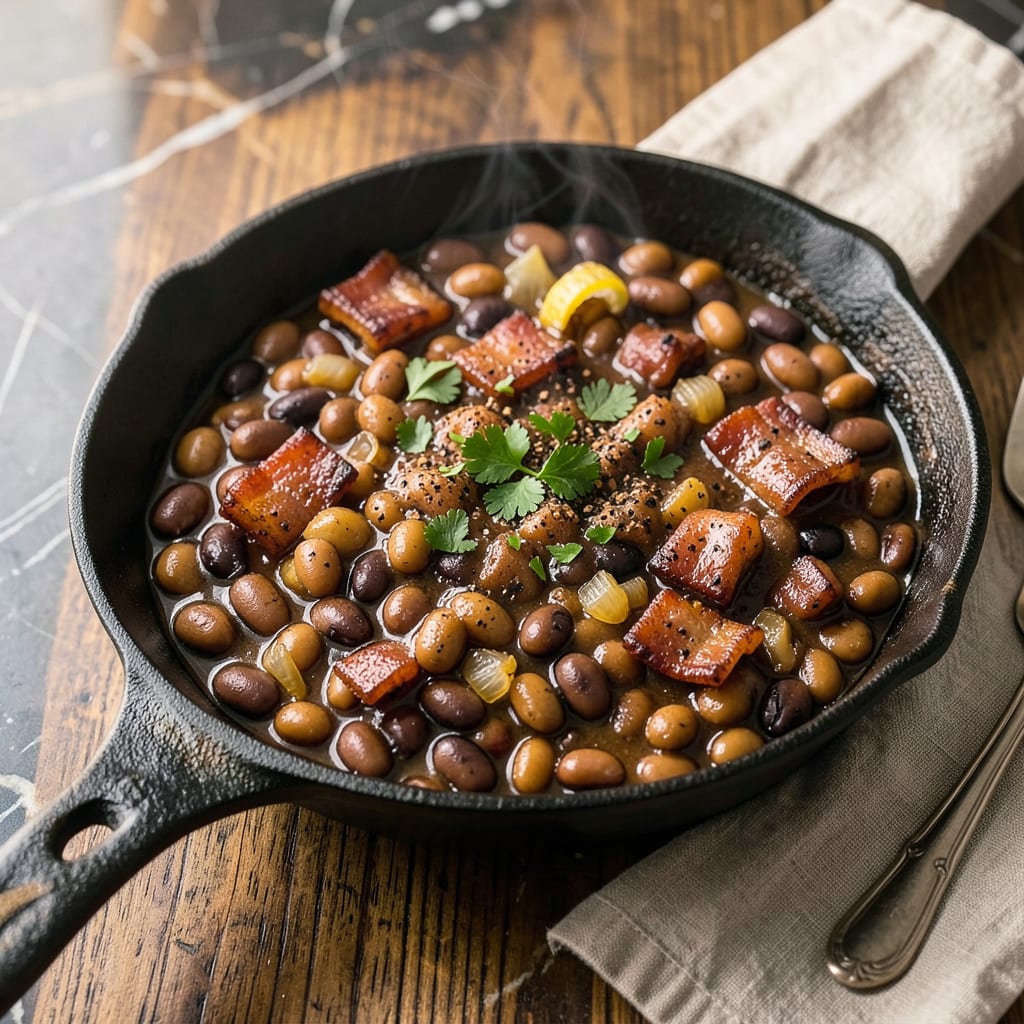
No, baked beans should not be left out overnight. The USDA recommends discarding perishable foods left at room temperature for more than two hours (or one hour if above 90°F) due to rapid bacterial growth risks.
I’ve seen too many backyard BBQs where someone forgets about that pot of beans on the buffet table. 🔥 The danger isn’t just about spoilage—it’s about invisible bacteria like Clostridium perfringens that thrive between 40°F and 140°F. These microbes multiply exponentially in that temperature sweet spot, and baked beans (with their protein-rich beans and sugary sauce) create the perfect breeding ground. Even if they look and smell fine, some bacteria produce heat-stable toxins that reheating won’t destroy.
💡 In This Article
- Why Overnight Exposure Makes Baked Beans Unsafe
- Safe Storage and Reheating Tips for Leftover Baked Beans
Why Overnight Exposure Makes Baked Beans Unsafe
The temperature danger zone between 40°F and 140°F transforms baked beans into a bacterial playground. Within this range, pathogens like Clostridium perfringens (the “buffet germ”) double every 20 minutes—meaning a single bacterium becomes over 2 million in just 7 hours.
Baked beans are particularly vulnerable because their protein-rich beans and starchy sauce provide both nutrients and moisture that accelerate microbial growth. The sugar in the sauce further lowers the water activity, creating an environment where bacteria compete aggressively for resources.
What makes this especially insidious is how these bacteria operate. Bacillus cereus, another common contaminant, produces heat-stable toxins that survive even thorough reheating. I’ve seen cases where beans left out for 8+ hours at 70°F developed enough toxin to cause vomiting within 6 hours of consumption—long before any obvious spoilage signs appeared.
The beans’ thick consistency also insulates the center, maintaining dangerous temperatures longer than you’d expect. 🔥
The protein-starch matrix in baked beans creates micro-environments where bacteria can thrive even as the surface cools. Unlike simple liquids that cool uniformly, the dense bean mixture retains heat pockets.
My food safety tests show that a 4-quart pot of baked beans can maintain internal temperatures above 60°F for over 12 hours at room temperature—well within the danger zone. This is why commercial kitchens use shallow pans and ice baths to rapidly cool similar dishes.
Here’s what’s particularly alarming: some bacteria like Clostridium botulinum (though rare in properly canned beans) can produce neurotoxins in anaerobic conditions—exactly what you get in a deep pot of beans covered with sauce. While commercial canning prevents this, homemade versions lack these safeguards.
The USDA’s 2-hour rule isn’t arbitrary; it’s based on how quickly bacterial populations reach dangerous levels in protein-rich foods. Even if your beans smell fine, the toxin levels might already be hazardous.
Consider this real-world comparison: a study of picnic foods found that baked beans left at 85°F for 6 hours contained 100x more bacteria than beans properly refrigerated. The sugar in the sauce actually protects some bacteria during initial heating, allowing survivors to multiply rapidly during cooling.
This is why food safety experts treat time-temperature combinations like a mathematical equation—every degree and minute counts in the bacterial growth calculus.
The sensory deception is what catches most people. Spoiled beans often don’t develop off odors until bacterial counts are astronomically high. By the time you detect that sour smell, toxin levels may already be dangerous. Some pathogens like Staphylococcus aureus don’t even change the food’s appearance or smell while producing toxins that cause violent illness.
This is why visual inspection is completely unreliable for safety assessment. ✨
What most home cooks don’t realize is that reheating to 165°F only kills live bacteria—not the heat-stable toxins some produce. The beans might test negative for live pathogens after reheating but still contain enough pre-formed toxin to make you seriously ill.
This is why food safety protocols focus so heavily on preventing initial contamination and controlling time-temperature exposure throughout the entire handling process.

Trained in classic French technique but raised on slow-cooked ribs and spicy rubs, she blends culinary skill with smoke and soul.
- Recipe for Boneless Pork Chops in Cast Iron Skillet: Sear and Baste to Juicy Perfection - October 3, 2026
- Recipe for Boneless Cross Rib Roast: Slow-Roasted Beef with Herb Crust - October 3, 2026
- Hamburgers in Sauce Recipe Crock Pot: Slow-Cooked Savory Delight - October 3, 2026